DNA Replication Enzymes: Roles and Worked Examples
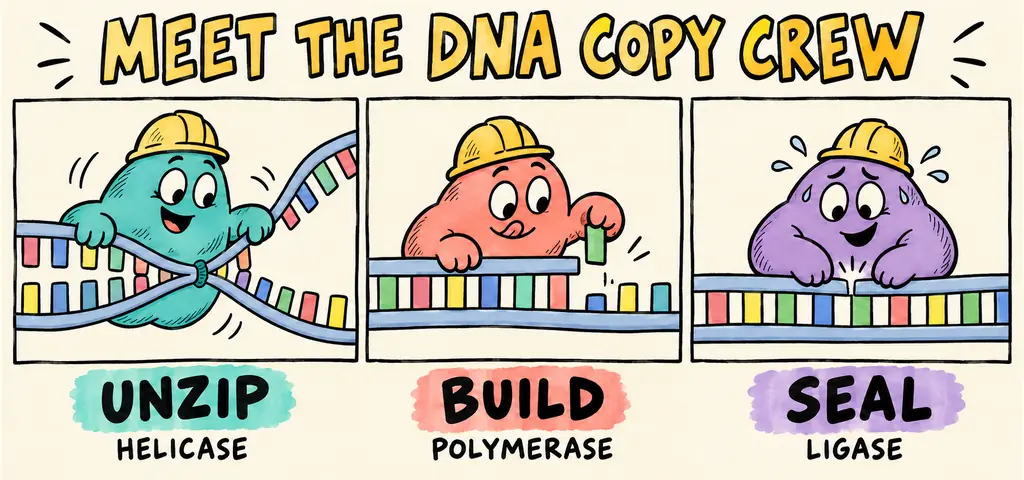
DNA replication enzymes divide the copying job. Helicase opens the duplex, topoisomerase relieves twisting strain, primase supplies RNA primers, DNA polymerase extends new DNA, and ligase seals remaining backbone nicks. Single-strand binding proteins stabilize exposed templates. Follow the order of these jobs to predict what an enzyme block would leave unfinished.
A typical diploid human cell preparing to divide copies roughly six billion base pairs of nuclear DNA. Each daughter cell needs a complete set. An error at every thousandth base would leave extensive damage, while the illustrative final error rate used here is about one per billion after correction. That accuracy depends on complementary templates, several copying enzymes, and repair. Follow what each enzyme does at the replication fork, then predict what would remain unfinished if it were blocked.
Watch the process
DNA Replication (Updated)
The two DNA strands are antiparallel and complementary. Each can therefore guide construction of its partner. Replication separates them and uses each strand as a template.
Replication Copies Each Strand Once, Not the Molecule Twice
Semiconservative replication means that each daughter double helix contains one strand inherited intact from the parent molecule and one strand newly synthesized against it. Two rival models were live in the 1950s. The conservative model predicted that the original helix stays whole and an entirely new helix appears beside it. The dispersive model predicted that both daughter molecules are patchworks of old and new segments along their length.
The Meselson-Stahl Experiment (Science Practice 4)
Bacteria were grown for many generations in medium whose only nitrogen source was the heavy isotope \(^{15}\text{N}\), so every base in every strand was heavy. The cells were then moved to medium containing only ordinary \(^{14}\text{N}\) and allowed to divide. DNA was extracted after one round of replication and again after two, and each sample was spun in a density gradient, where DNA settles at the depth matching its density.
Round one. All the DNA formed a single band at an intermediate density, halfway between heavy and light. Ask what each model predicted. Conservative replication predicts two bands after one round, one fully heavy and one fully light, because the parent helix is preserved whole. A single intermediate band therefore eliminates the conservative model outright. It does not yet decide between the other two, because semiconservative and dispersive replication both predict one hybrid band at this point.
Round two. The sample separated into two bands of roughly equal quantity, one intermediate and one light. Semiconservative replication predicts exactly that: each hybrid molecule separates, the old heavy strand templates a light partner and stays hybrid, while the new light strand templates another light partner and gives a fully light molecule. Dispersive replication predicts one band again, positioned a quarter of the way from light to heavy, because every molecule would still be a uniform mixture. The number of bands after the second round separates these model predictions.
Interpreting the result
Round one rules out the conservative model; round two rules out the dispersive model and leaves semiconservative replication as the only surviving explanation. The first round alone cannot distinguish semiconservative from dispersive replication. The second-round pattern distinguishes the three standard predictions, and the time series provides the stronger test.
Where Copying Starts, and How Many Places at Once
Replication does not begin at the end of a chromosome and run to the other end. It begins at an origin of replication, a specific sequence where the strands are pried apart to form a replication bubble. Each bubble has two replication forks, one at each end, and they travel outward in opposite directions, so a single origin copies DNA in both directions at once.
The standard bacterial model uses a circular chromosome with one origin; bacterial chromosome number and structure can vary. A human chromosome is linear, far longer, and carries thousands of origins that fire during S phase. The reason is arithmetic, and it is worth doing.
Why Eukaryotes Need Many Origins
A bacterial polymerase adds roughly 1000 nucleotides per second. A eukaryotic polymerase is slower, roughly 50 nucleotides per second. In a simplified model, assume constant fork speed, a centrally placed single origin, or 2000 evenly spaced origins that all fire together. Estimate the time to copy a 250-million-base-pair chromosome in each case.
Step 1: account for the two forks. One origin produces two forks moving in opposite directions, so the DNA copied per second at one origin is \(2 \times 50 = 100\) base pairs.
Step 2: divide. From one origin the chromosome would take \[\frac{250{,}000{,}000\ \text{bp}}{100\ \text{bp/s}} = 2{,}500{,}000\ \text{s}.\]
Step 3: convert to something you can judge. There are 86,400 seconds in a day, so \(2{,}500{,}000 \div 86{,}400 \approx 29\) days. A cell that took a month to copy one chromosome would take far longer than the cell cycles being modeled.
Step 4: add origins. With 2000 origins firing, the same chromosome is divided into 2000 stretches, so the time falls to \(2{,}500{,}000 \div 2000 = 1250\) seconds, about 21 minutes. That is compatible with an S phase of a few hours.
Answer
One origin would need roughly 29 days; 2000 origins need roughly 21 minutes. Multiple origins permit rapid copying of a large chromosome. Actual origins fire at different times, and dormant origins can also provide backup when forks stall.
Walk the Fork: Every Enzyme and What Fails Without It
Take the enzymes in the order a single stretch of DNA encounters them. For each one, hold two things: the job, and the specific failure that follows if the enzyme is missing or inhibited. Use the unfinished product to identify which enzyme’s function is missing.
Helicase unwinds the double helix at the fork by breaking the hydrogen bonds between paired bases. It does not cut the backbone; it separates the rungs. Block helicase and the fork never opens, so new template is not exposed at that fork and replication cannot progress normally; this does not mean all nucleic-acid synthesis throughout the cell instantly stops.
Topoisomerase relieves the twisting strain that builds up ahead of the advancing fork by making a controlled cut in the backbone, letting the DNA unwind, and resealing it. Unwinding a closed helix at one point overwinds it further along, the way pulling apart the strands of a rope makes the rest of the rope coil tighter. Block topoisomerase and the fork stalls under torsional stress, or the strained DNA breaks. Several antibiotics and chemotherapy drugs work exactly here.
Single-strand binding proteins coat the separated strands and keep them from snapping back together or pairing with themselves. Without this stabilization, exposed strands can reanneal or form secondary structures that interfere with copying.
Primase synthesizes a short RNA primer, roughly ten nucleotides long, directly on the template. It exists because DNA polymerase cannot start a strand from nothing; it can only extend a strand that already has a free \(3’\) hydroxyl. Primase, an RNA polymerase by chemistry, has no such restriction. Blocking primase prevents new RNA primers from forming. If the block is present before replication starts, DNA polymerase lacks the primed starting points needed to begin copying. At an active fork, already primed DNA can still be extended, but new lagging-strand fragments cannot start normally.
DNA polymerase adds nucleotides to the free \(3’\) hydroxyl of the growing strand, always extending \(5’\) to \(3’\), and many replicative polymerases proofread as they work by excising and replacing a mismatched base they have just added. Block it and the primers sit on the template with nothing built from them. A defect limited to proofreading can increase copying errors while leaving nucleotide addition possible. The size of the increase depends on the enzyme and experimental conditions; an increased error rate differs from complete failure of synthesis.
RNA primers are removed and replaced with DNA. In the standard bacterial example, DNA polymerase I contributes to both activities; eukaryotes use a combination of primer-removal enzymes and polymerases. That step is easy to overlook, and it matters: the finished molecule contains no RNA at all.
Ligase catalyzes the final phosphodiester bond that seals the nick between the newly filled gap and the fragment ahead of it. Block ligase and the strand is present, complete in sequence, and still broken into pieces, because the last covalent bond in each junction was never formed. A strand with unsealed nicks has been synthesized, but its backbone is still discontinuous.
Why Synthesis Is Only \(5’\) to \(3’\)
An incoming nucleotide arrives as a nucleoside triphosphate. The energy to form the phosphodiester bond comes from the incoming nucleotide’s own triphosphate, and the growing strand’s \(3’\) hydroxyl attacks the incoming nucleotide’s phosphate, releasing pyrophosphate. So the growing chain supplies the hydroxyl and the newcomer supplies the energy. Build in the other direction and the growing chain would have to carry the triphosphate at its end, meaning a single proofreading removal would strip the chain of its ability to keep going. The ordinary replicative polymerases use \(5’\)-to-\(3’\) synthesis; that is the rule needed for these fork diagrams.
Now combine that restriction with antiparallel strands. At a replication fork the two template strands run in opposite directions, so a polymerase moving \(5’\) to \(3’\) on the new strand travels toward the fork on one template and away from it on the other. The new strand synthesized continuously toward the advancing fork is the leading strand. At that fork, its template runs 3’ to 5’ in the direction the polymerase reads, while the new DNA grows 5’ to 3’. The other must wait for helicase to expose more template, then back up and synthesize a short piece heading away from the fork. Those pieces are Okazaki fragments, and the strand assembled from them is the lagging strand. Each fragment begins with its own RNA primer, which is later replaced with DNA, and ligase joins the fragments into one continuous strand. There is nothing special about the lagging-strand template chemically. The discontinuity exists only because a one-directional enzyme is copying a two-directional structure.
Building Both New Strands From One Short Duplex
A replication fork opens in the following region. The upper strand is written \(5’\) to \(3’\) and the lower strand is its antiparallel partner.
5’-A T G C C G T A A G C T-3’
3’-T A C G G C A T T C G A-5’
The fork is moving to the right. Write the new strand made on each template and say which is leading and which is lagging.
Step 1: pick a template and read its direction. Take the lower strand, \(3’\text{-TACGGCATTCGA-}5’\). A polymerase moving along it toward the right is traveling from the template’s \(3’\) end toward its \(5’\) end. The new strand it builds is antiparallel to the template, so the new strand grows \(5’\) to \(3’\) toward the right, the same direction the fork is opening. This template gives the leading strand, built in one continuous piece that simply follows the fork.
Step 2: write the product. Pair each template base: T gives A, A gives T, C gives G, G gives C, G gives C, C gives G, A gives T, T gives A, T gives A, C gives G, G gives C, A gives T. The leading strand reads \(5’\text{-ATGCCGTAAGCT-}3’\), which is identical to the upper parental strand, as it must be.
Step 3: now the other template. Take the upper strand, \(5’\text{-ATGCCGTAAGCT-}3’\). Its new partner must also be built \(5’\) to \(3’\), which on this template means moving right to left, away from the advancing fork. The polymerase can only work backward here, so it waits for helicase to expose a new stretch, is supplied with a new primer by primase, and synthesizes back toward the previous fragment. This is the lagging strand, and the pieces are Okazaki fragments.
Step 4: check the outcome. Both new strands end up antiparallel to their templates and both were built \(5’\) to \(3’\). Nothing about the lagging template is chemically unusual. The only difference is which way it points relative to the fork.
Answer
The lower strand templates the leading strand, \(5’\text{-ATGCCGTAAGCT-}3’\), built continuously; the upper strand templates the lagging strand. Across the displayed interval its sequence is \(3’\text{-TACGGCATTCGA-}5’\), or \(5’\text{-AGCTTACGGCAT-}3’\) when rewritten conventionally. It is synthesized in fragments and joined by ligase.
Three Layers of Accuracy
DNA polymerase inserts a wrong base about once every \(10^5\) nucleotides on the basis of base pairing alone. Proofreading by the polymerase itself catches most of those immediately, dropping the error rate to about one in \(10^7\). A separate mismatch repair system then scans the newly made strand for distortions in the helix, excises the offending stretch, and resynthesizes it, giving a final rate near one in \(10^9\). Treat these error rates as approximate illustrative values, not universal constants. For an arithmetic example, copying \(3\times10^9\) nucleotides at a residual error rate of \(10^{-9}\) per nucleotide gives an expected three errors. This is not an exact prediction of mutations in a diploid human cell division: the total DNA copied, repair processes, and definition of an error all matter.
A separate system, nucleotide excision repair, handles damage rather than copying errors. Ultraviolet light fuses adjacent thymines into a dimer that kinks the helix; a nuclease removes the damaged stretch, polymerase fills the gap, and ligase seals it. People with a defect in this pathway are extremely sensitive to sunlight, which is the standard stem for this idea.
The Problem at the Ends of a Linear Chromosome
Every Okazaki fragment needs a primer, and every primer is eventually removed and replaced with DNA extended from the fragment behind it. At the very end of a linear chromosome there is no fragment behind the last primer, so when that RNA is removed the gap cannot be filled. Each round of replication therefore leaves a linear chromosome slightly shorter. Circular bacterial chromosomes never face this, because there is no end.
Eukaryotes handle it by ending each chromosome with a telomere, a region of repeated DNA and associated proteins that protects the chromosome end. Telomere shortening can eventually compromise that protection and trigger cell-cycle arrest. In most somatic cells telomeres shorten with each division and the cell eventually stops dividing. Many germ-line, stem, and cancer cells maintain telomeres through an enzyme called telomerase, which extends the telomere using an RNA template it carries with it, restoring what replication removes. Telomere maintenance helps explain differences in replicative capacity between germ-line lineages and many somatic cell cultures.
DNA Copying and RNA Production
Replication produces DNA, whereas transcription produces RNA. Replication copies both strands of the entire genome once, uses DNA polymerase, requires a primer, produces two complete double helices, and occurs during S phase in an ordinary eukaryotic cycle. Transcription reads one DNA template strand in a transcription unit, which can contain one gene or multiple bacterial operon genes, uses RNA polymerase, needs no primer, produces a short single-stranded RNA, and can happen hundreds of times a day for a busy gene. When a stem describes a product, ask whether it is genome-sized and double-stranded or gene-sized and single-stranded. Use the product description together with the enzyme and timing evidence.
Leading and lagging strand synthesis obey the same polymerase rule. A single polymerase rule, extend a free \(3’\) hydroxyl, meets two templates pointing opposite ways, and continuous synthesis on one and fragmentary synthesis on the other is the unavoidable result. Follow the labeled ends when a diagram is reversed.
Replication is one rule applied to an antiparallel structure: add only to a free \(3’\) hydroxyl.
Because the two templates point opposite ways, that one rule produces one continuous strand and one built in fragments at the same fork.
Do not memorize leading and lagging as separate mechanisms. They are the same enzyme obeying the same rule on two templates that happen to face opposite directions.
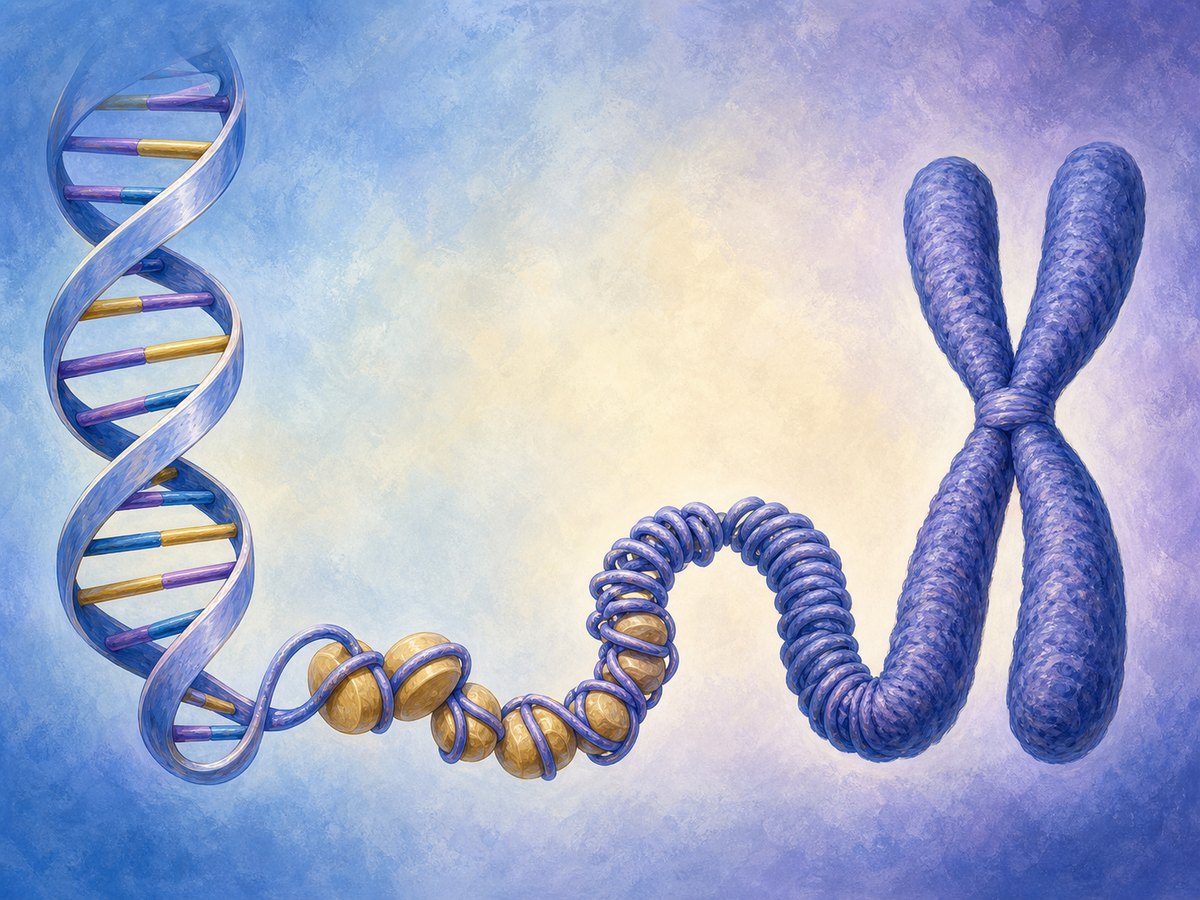
Replication and its evidence
Practice question 1
After one round of replication in \(^{14}\text{N}\) medium, DNA from cells previously grown in \(^{15}\text{N}\) forms a single band of intermediate density. This result by itself
-
establishes semiconservative replication and rules out both of the competing models
-
eliminates the conservative model but does not distinguish semiconservative from dispersive replication
-
eliminates the dispersive model but leaves the conservative model still possible
-
is equally well explained by all three models and so distinguishes none of them
Practice question 2
The lagging strand is synthesized discontinuously because
-
its template is richer in G-C pairs and therefore separates from its partner more slowly
-
ligase acts only on short fragments, so it forces the polymerase to stop at regular intervals
-
DNA polymerase extends only a free 3’ hydroxyl, so on the template pointing away from the fork it must restart
-
primase can lay down a primer on only one of the two template strands at a fork
Practice question 3
Which enzyme supplies the starting point that DNA polymerase requires?
-
helicase
-
primase
-
ligase
-
topoisomerase
Practice answer key
1. B; 2. C; 3. B.
Practice answer explanations
-
Replication and its evidence, Question 1. Choice B is correct. A single hybrid band after one round is incompatible with conservative replication, which predicts a heavy band and a light band, but both semiconservative and dispersive replication predict one intermediate band at this stage. Choice A claims more than one round of data can deliver. Choice C reverses which model the result eliminates. Choice D ignores that the conservative prediction has already failed.
-
Replication and its evidence, Question 2. Choice C is correct. DNA polymerase adds nucleotides only to a free 3’ hydroxyl, so on the template oriented away from the fork the enzyme must repeatedly return to newly exposed template and synthesize a short piece. Choice A invents a base-composition cause that does not apply to a whole strand. Choice B reverses cause and effect, since ligase acts after the fragments exist rather than creating them. Choice D is false, because primase primes both strands.
-
Replication and its evidence, Question 3. Choice B is correct. Primase lays down the short RNA primer that supplies the free 3’ hydroxyl DNA polymerase requires. Choice A names the enzyme that separates strands but leaves no 3’ end behind. Choice C names the enzyme that seals nicks after synthesis. Choice D names the enzyme that relieves supercoiling ahead of the fork.
Continue your review at the AP Biology study hub.
Further reading
Review the experimental models in OpenStax Biology 2e: Basics of DNA Replication and the copying machinery in DNA Replication in Prokaryotes. The bacterial model helps separate enzyme jobs; eukaryotic details differ.

Related to This Article
More math articles
- Identifying correlations
- The Best Grade 5 ELA Practice Tests for Maine Students
- Political tolerance
- Buffers and Titrations: Endpoint vs. Equivalence
- How to Simplify Algebraic Expressions: The Rules You Need
- Vermont Algebra 1 Free Worksheets: Free Printable Algebra 1 PDF Worksheets with Worked Solutions
- New York Grade 6 Math Worksheets: 72 PDF Links
- Area of a Parallelogram
- The Best Grade 3 ELA Practice Tests for Nevada Students
- Keep short-run adjustment separate from long-run adjustment









What people say about "DNA Replication Enzymes: Roles and Worked Examples"?
No one replied yet.