Artificial Selection: Examples, Breeding and Trade-Offs
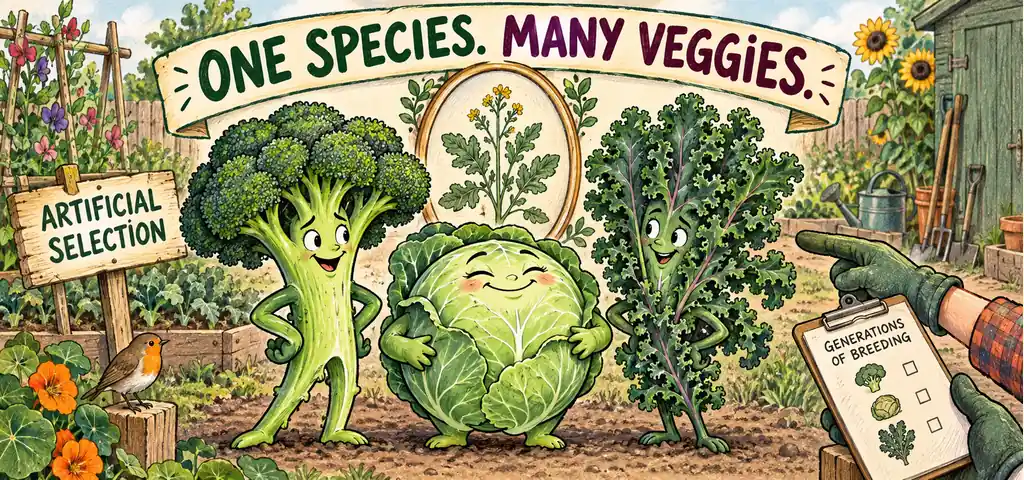
Artificial selection means people choose which organisms reproduce based on heritable traits. Across generations, those choices can change a population. Selection sorts available variation; mutation can create new alleles, and crossing can bring variants into a breeding population.
A Chihuahua and a Great Dane belong to the same species and can, in principle, exchange genes, although their size difference can make mating difficult. Their shared ancestry traces to wolves tens of thousands of years ago. Breeders produced these forms by repeatedly choosing which dogs reproduced. The selected differences accumulated across generations without direct editing of their genomes.
Watch the process
Evolution Continues
Now look at a vegetable aisle. Broccoli, cabbage, kale, cauliflower, Brussels sprouts, and kohlrabi are not six species but six populations of one species, Brassica oleracea, descended from a single wild mustard. Growers who kept the plants with the tightest flower clusters got broccoli; those who kept the fattest terminal buds got cabbage; those who kept the largest lateral buds got Brussels sprouts.
Breeding records let you follow selection over generations. Darwin used domestic organisms to develop this argument: controlling reproduction can change a population when the differences among potential parents are inherited.
One Definition, One Difference
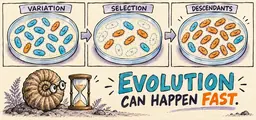
Artificial selection, also called selective breeding, is the process in which humans choose which individuals reproduce, so that the heritable variants those individuals carry become more common in later generations. Read that sentence next to the definition of natural selection and check what changed. Both require a population that already varies. Both require that the variation be heritable. Both work by making reproduction unequal across genotypes. When inherited variants become more or less common across generations, the population evolves.
The central distinction is who or what favors reproductive success. In natural selection the criterion emerges from the environment and no one sets it, so the trait that spreads is whatever happens to correlate with leaving more surviving offspring in that place. In artificial selection a person sets the criterion in advance, and the trait that spreads is whatever the person picked, even when it lowers the organism’s survival prospects in the wild. A modern broiler chicken grows breast muscle so fast that its legs struggle to carry it. Selection did not fail; it succeeded at what it was pointed at, and nothing in the mechanism cares whether the target is good for the animal.
Why the Change Can Be So Fast
Breeders get large results quickly because they push three features that can also vary in nature. They raise the intensity of selection, letting the top one percent of a herd sire an entire generation while no one else breeds. They hold the criterion constant for decades, where a fluctuating environment favors large seeds one decade and small seeds the next. And they remove competing pressures with food, shelter, and veterinary care, so a variant that would be lethal in a field survives in a barn.
The limit on all three is variation. A breeding program moves a trait only as long as the population still holds alleles that push it further, and as favored alleles approach fixation the response slows and eventually stops. This is called reaching a selection plateau, meaning a point at which further selection produces no further measurable response. Depleted heritable variation is one possible cause; opposing selection, genetic trade-offs, and environmental limits can also contribute. When depleted heritable variation is limiting, a possible response is to introduce new variation, by crossing in an unselected line, by outcrossing to a wild relative, or by waiting for mutation, and every one of those options is the artificial version of something natural populations also do.
Reading a Long-Term Selection Experiment
In this hypothetical teaching data set, an agricultural station selects maize for oil content in the kernel. Each generation, only the plants with the highest oil percentage are allowed to pollinate the next crop. The station reports mean kernel oil content and the variation among plants at four checkpoints.
| Generation | 0 | 20 | 50 | 90 |
|---|---|---|---|---|
| Mean oil content (percent) | 4.7 | 7.8 | 12.6 | 19.4 |
| Standard deviation (percent) | 1.10 | 0.94 | 0.71 | 0.38 |
Three questions. What mode of selection is this? What is happening to the population’s variation, and what does that predict? And does the result show that selection created high-oil alleles?
Question 1. The mean moved in one direction, from 4.7 percent to 19.4 percent, and only the high tail was retained each generation. That is directional selection, imposed by a breeder rather than by an environment. Compute the total change to keep the scale in view: \[19.4-4.7 = 14.7\ \text{percentage points, or about } \frac{19.4}{4.7} = 4.1 \ \text{times the starting value.}\]
Question 2. The standard deviation fell steadily, from 1.10 to 0.38, a reduction of \[\frac{1.10-0.38}{1.10} = \frac{0.72}{1.10} = 0.65,\] about 65 percent. This is a decline in observed phenotypic spread, not a direct measurement of genetic diversity or allele fixation. If the heritable component is also declining, the response could approach a plateau. Common-environment offspring measurements and genotyping would test that explanation. The mean is still rising, so these checkpoints do not themselves demonstrate a plateau.
Question 3. No. Selection sorted variation the original population already contained, plus whatever new mutations appeared and were retained. The starting standard deviation of 1.10 percent is the evidence that variation was present at generation 0; phenotypic spread alone does not establish heritability, so a parent, offspring comparison under controlled conditions would strengthen the genetic interpretation.
Interpreting the result
Directional artificial selection quadrupled mean oil content while cutting the standard deviation by about two-thirds. A plateau is a conditional prediction if heritable variation becomes limiting, and the rise reflects sorting of preexisting variants, not creation of new ones.
What Breeding Costs a Population
Choosing a small set of parents samples only part of a population’s alleles. Follow that reduced pool through later generations to predict loss of diversity and increased relatedness.
One possible consequence is lost genetic diversity. A herd descended from a handful of prize sires is, in population-genetic terms, a founder population, and it carries a narrow slice of the species’ variation. That narrowness is why commercial crop monocultures, fields planted with one crop species, can be vulnerable to specialized pathogens. Monoculture does not necessarily mean genetic uniformity. If the crop is also genetically uniform at resistance-related loci, many plants may share susceptibility, increasing the risk of widespread losses.
Another is inbreeding depression, meaning the decline in health and fertility that follows when close relatives breed and rare recessive alleles are brought together in homozygotes. Inbreeding does not change allele frequencies by itself; it changes genotype frequencies, raising the proportion of homozygotes and lowering the proportion of heterozygotes. That is enough to expose recessive alleles that were previously hidden, which is why purebred lines accumulate characteristic disorders and why breeders track pedigree relatedness deliberately.
A third effect is subtler. Selecting hard on one trait drags others along, because genes sit near one another on chromosomes and one gene often affects several characters: selecting dogs for a flattened face brought breathing problems with it. A genome is not a list of independent switches, so selection on one trait can have correlated effects on others.
Diagnosing a Stalled Breeding Program
A breeder has selected a wheat line for drought tolerance for thirty generations. Yield under drought rose steadily for the first eighteen generations, then stopped improving, and over the last five generations seed germination rates have fallen. Genotyping shows increased relatedness and reduced diversity; controlled crosses find little remaining heritable variation for drought yield, while outcrossed offspring germinate better than within-line offspring in the same environment. Explain both observations and propose a follow-up breeding strategy.
Take the plateau first. Sustained directional selection removes the alleles that push the trait down, generation after generation, so the favored alleles rise toward fixation. Once nearly every plant carries them, there is no longer variation for the trait, and selecting the best plants selects among plants that are effectively identical at those loci. The response stops. Little heritable variation remains for continued selection on drought yield.
Now the germination problem. The breeder has been crossing an increasingly narrow set of parents, so relatedness among them has risen. Rising relatedness raises homozygosity, and homozygosity exposes deleterious recessive alleles that were masked in heterozygotes. Falling germination is a classic possible symptom of inbreeding depression. The controlled outcrossing result, together with genetic evidence, supports that explanation more strongly than the timing alone.
The fix addresses the shared cause, which is depleted variation. Test crosses to a compatible, unrelated drought-tolerant line, using within-line crosses as controls. Such crosses can introduce alleles and increase heterozygosity, but offspring should be evaluated for germination, drought performance, and unwanted trade-offs. Successful reproduction after the cross introduces gene flow.
Answer
In this scenario, the controlled measurements support depleted heritable variation and inbreeding depression. Outcrossing can introduce variation and increase heterozygosity; test the offspring for drought performance, germination, and unwanted trade-offs.
Breeding and Direct Genetic Changes
Artificial selection changes which organisms reproduce; genetic engineering changes genetic material directly. Artificial selection works with available heritable variants, including variants introduced by mutation or crossing, and spreads them by controlling reproduction, and takes generations. Genetic engineering inserts or edits a sequence directly in one organism and can move a gene between species that could never interbreed. A stem describing a bacterial gene placed into a maize genome is not describing artificial selection, and a stem describing forty years of choosing the best cows is not describing genetic engineering.
Artificial selection uses ordinary mechanisms of inheritance. Alleles are inherited the same way, meiosis works the same way, and frequencies change the same way. The chooser is human; the process is ordinary evolution. When an answer choice claims that artificial selection creates new alleles, or acts on acquired traits, or changes individuals during their lifetimes, it has confused the chooser with the mechanism.
Artificial and natural selection both act on heritable variation, but artificial selection involves human breeding choices. Environmental pressures can still act on domesticated populations.
Allele frequencies shift toward whatever the breeder rewards, usually faster when selection is intense and the breeder maintains the same criterion over generations.
Watch for the claim that breeding invents traits. It only sorts variation that is available when selection acts. Mutation or gene flow can supply additional variants during a breeding program.
Artificial selection
Practice question 1
Kale and cabbage were both derived from one wild mustard species by centuries of selective breeding. This history is best used as evidence that
-
humans can create new alleles by choosing which plants to grow
-
selection acting on preexisting heritable variation can produce large morphological change in relatively few generations
-
domesticated plants are no longer subject to natural selection
-
acquired characteristics become heritable when they are useful to people
Practice question 2
After forty generations of selection for larger seed size, a plant line stops responding even though the breeder continues to select the largest plants. Controlled offspring measurements find no detectable heritable variation for seed size under the breeding conditions. The best explanation is that
-
the seed-size alleles have mutated back to their original forms
-
the population no longer contains heritable variation for seed size, so selection has nothing left to sort
-
directional selection has been replaced by stabilizing selection, which now holds the trait at its current mean
-
the environment has begun favoring smaller seeds
Practice question 3
A dairy herd descended from a small number of prize bulls shows rising rates of a recessive metabolic disorder. The best explanation is that
-
intense selection for milk yield caused the disorder allele to arise
-
close relatedness among parents raised homozygosity, exposing recessive alleles that heterozygotes had masked
-
artificial selection increases the mutation rate in selected lines
-
gene flow from other herds introduced the disorder allele
Practice answer key
1. B; 2. B; 3. B.
Practice answer explanations
-
Artificial selection, Question 1. Choice B is correct. One wild species yielded kale and cabbage because breeders repeatedly chose which plants reproduced, sorting heritable variation the population already carried into strikingly different forms. Choice A credits selection with creating alleles, which only mutation does. Choice C is false, since crops still face pathogens, drought, and competitors. Choice D revives the inheritance of acquired characteristics, which selective breeding does not use.
-
Artificial selection, Question 2. Choice B is correct. Controlled offspring measurements find no detectable heritable variation for seed size under these conditions, supporting a limit on the response to selection. A invents coordinated mutation. C mistakes a plateau for a change in the selection criterion; the breeder still selects the largest plants. D introduces an environmental change not reported. Without the controlled measurements, a plateau alone would have several possible causes.
-
Artificial selection, Question 3. Choice B is correct. Descent from few sires makes parents relatives, and mating relatives raises homozygosity, which brings rare recessive alleles together and exposes them as disease; that is inbreeding depression. Choice A has selection creating the allele it later exposes. Choice C asserts a link between selection intensity and mutation rate that does not exist. Choice D points outward, but a disorder concentrated in a closed, narrowly descended herd points to relatedness inside it rather than to immigration.
Continue your review at the AP Biology study hub.
For background on directional selection, existing variation, and genetic trade-offs, see OpenStax Biology 2e: Adaptive Evolution.

Related to This Article
More math articles
- High School Placement Test (HSPT): Complete Guide
- Grade 4 Discussion and Simple Research Skills: Stronger Speaking, Listening, Notes, and Sources
- Marginal product pulls average product
- Expansion of suffrage
- The Best Grade 3 Math Book for Michigan Students
- Integrals: Complete Explanation of the Applications and Use
- Overview of the ACT Mathematics Test
- A Comprehensive Collection of FREE SAT Math Practice Tests
- Enhanced ACT Math Four Answer Choices: Change Your Practice Habits (2027 Prep)
- How to Graphs of Rational Functions?


What people say about "Artificial Selection: Examples, Breeding and Trade-Offs"?
No one replied yet.