How Viruses Replicate: Life Cycles and Practice Questions
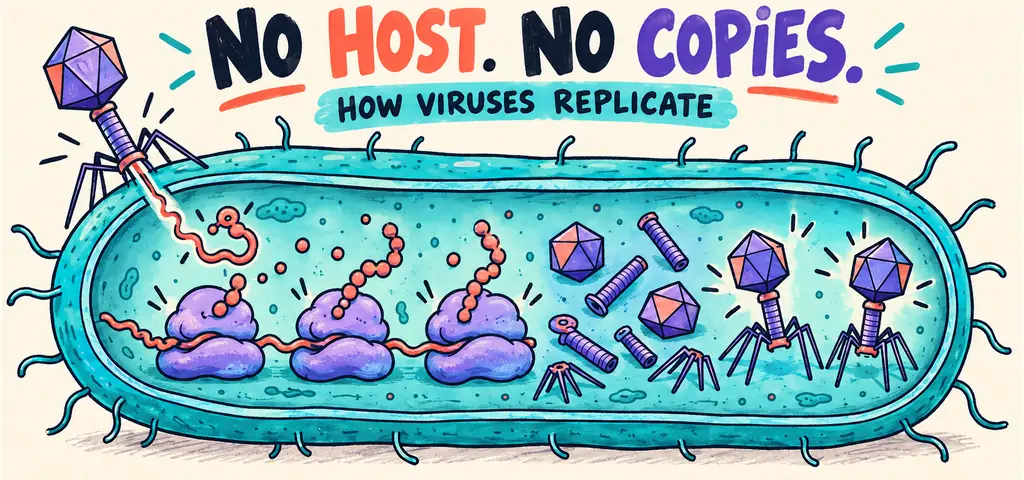
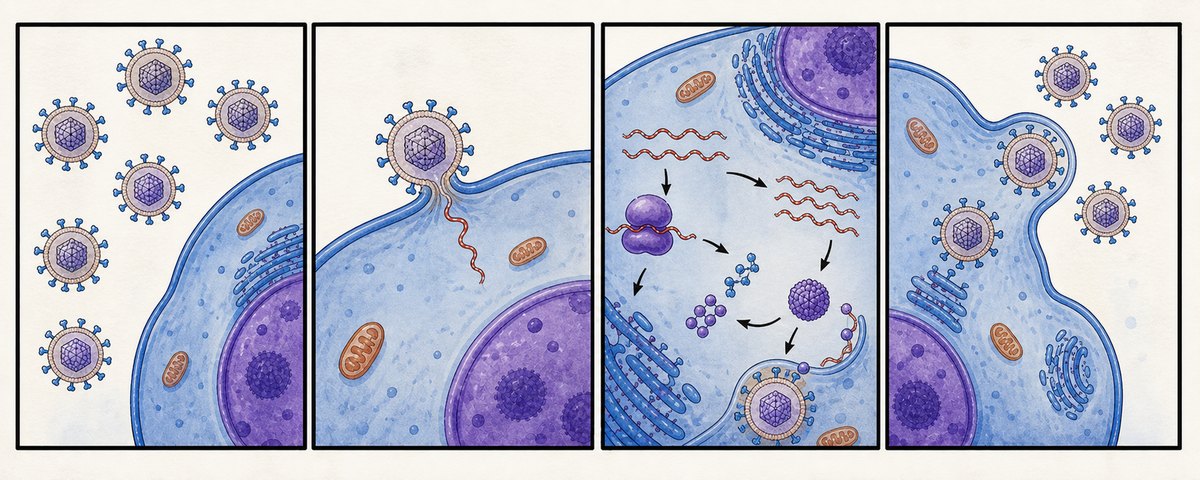
Viruses replicate inside compatible host cells by attaching, entering, making viral genomes and proteins, assembling particles, and releasing them. Host ribosomes make the proteins, but the enzymes used to copy a genome depend on the virus. Compare this productive pathway with phage lysogeny, in which the viral genome is copied with the host without producing new particles.
A virus particle cannot reproduce in cell-free nutrient broth. It lacks the independent machinery needed to make new particles, and its infectivity may decline while it remains outside a host. A compatible cell supplies resources and ribosomes, while some viruses also supply or encode enzymes. The timing and yield of an infection depend on the virus and the host.
Watch the process
Viruses (Updated)
Whatever its genome type, a virus must produce messages that host ribosomes can translate. Identifying the genome as DNA or RNA helps you work out which copying steps are needed before translation.
A virus is a genome of DNA or RNA enclosed in a protein capsid, sometimes wrapped in a membrane envelope taken from a previous host, and sometimes carrying a few packaged enzymes. It has no ribosomes, no metabolism, and no way to reproduce itself. Major viral genome types include: double-stranded DNA, single-stranded DNA, double-stranded RNA, single-stranded RNA. That variety is itself a point worth holding, because the first step in predicting how a virus replicates is asking what its genome is made of and what has to happen before a ribosome can read it.
What a virus does have is a set of surface proteins that fit particular host-cell receptors. Attachment contributes to host range, the set of species and cell types a virus can infect. HIV entry, for example, requires appropriate receptor and coreceptor interactions. Successful infection also depends on entry routes, intracellular compatibility, and host defenses. A cell can bind a virus without supporting its replication. If a question attributes tissue specificity to a receptor, look for an attachment or receptor experiment that supports that mechanism.
Two Programs After Entry
In a typical bacteriophage lytic cycle, a virus delivers its genome, host resources, host ribosomes, and host or virus-encoded enzymes are used to make viral nucleic acid and capsid proteins, new particles assemble, and the cell lyses to release them. The infection is fast and the host cell dies.
In the standard temperate-phage lysogenic cycle, the viral genome instead integrates into the host chromosome as a prophage, a viral sequence sitting inside the host’s own DNA, and is replicated passively each time the host divides. No new particles are made in the lysogenic state. Descendants usually inherit the prophage, and stress can later induce entry into the lytic cycle. A lysogenic infection is therefore inherited by a bacterial lineage with no visible sign of infection, which is why a culture can appear healthy and then lyse suddenly after a dose of ultraviolet light.
Retroviruses run the flow of information backward at one step. Their genome is RNA, and they carry reverse transcriptase, which synthesizes DNA from that RNA template. The resulting DNA is integrated into the host genome by a viral integrase, and from then on the host transcription machinery produces viral RNAs and host ribosomes translate the viral mRNAs. The integrated viral DNA is called a provirus. HIV works this way. Information still flows from nucleic acid to nucleic acid to protein; reverse transcription adds an RNA-to-DNA step, and the integrated copy is a permanent addition to that cell’s genome, which is a large part of why the infection is so difficult to clear.
Two consequences follow from the enzymes involved. The HIV reverse transcriptase lacks the proofreading activity of typical high-fidelity DNA polymerases, so copying errors can generate viral variants. If a variant resists a drug, selection can favor it during treatment. Mutation supplies variation; selection changes which variants become common. These are different processes, and a mutation does not arise because the virus needs it.
Where Does the Drug Act?
Consider cells with no pre-existing HIV infection, treated before exposure. Each compound completely blocks the named step; assume no resistant virus or alternative entry route. Predict which viral intermediates can be detected during this infection, after extracellular input particles are removed.
(a) A compound that binds the host-cell receptor. Entry fails, so no viral genome ever gets inside. No viral DNA, no viral RNA beyond what was in the added particles, no new virus. No newly synthesized intracellular viral intermediates should appear in this idealized entry-block model.
(b) A reverse transcriptase inhibitor. The genome enters but is never copied into DNA. Viral RNA is detectable inside the cell; viral DNA integrated into the host genome is not. Intracellular input RNA distinguishes this result from the idealized entry block in (a).
(c) An integrase inhibitor. Viral DNA is made and can be detected as an unintegrated molecule, but it is never inserted into a host chromosome, preventing normal establishment of an integrated provirus. Some transcription from unintegrated DNA can occur, so absence of integration does not guarantee zero viral RNA.
(d) A protease inhibitor blocking the cleavage of viral polyproteins. Everything upstream proceeds. Viral DNA integrates, viral mRNA is transcribed, viral proteins are translated. New particles can bud, but the viral polyproteins are not cleaved normally into functional proteins. This blocks normal maturation into infectious particles in the stated complete-inhibition model. Particle production can continue while infectivity falls; exact particle counts require measurement.
Answer
Name the last step that still succeeds and the first that fails, then ask which molecule the assay measures. Drugs acting at different steps produce the same final outcome, fewer infectious viruses, through completely different intermediate data.
Which Part Carries the Instructions?
A plant virus consists of an RNA genome and a coat protein, and two strains, call them A and B, produce visibly different lesions on infected leaves. An investigator separates each strain into its RNA and its coat protein, then reassembles hybrid particles: strain A RNA inside strain B coat, and strain B RNA inside strain A coat. Each hybrid is used to infect fresh plants, and the progeny viruses are collected and examined.
Result. Hybrids built with strain A RNA produce strain A lesions and progeny with strain A coats. Hybrids built with strain B RNA produce strain B lesions and progeny with strain B coats.
What the result establishes. The progeny match the RNA, not the coat that delivered it. So the nucleic acid carries the heritable information and the coat is packaging. Notice that the coat is not irrelevant, it helps protect the genome and deliver it to susceptible plant tissue, but the progeny’s strain-specific features followed the RNA source in this experiment.
What it does not establish. It does not show that the coat protein is unnecessary, and it does not show anything about how the RNA is read. A separate experiment is needed for either claim. Watch for choices that promote this result into a general statement about viral protein function.
Interpreting the result
The progeny virus matches the strain that supplied the RNA, so the nucleic acid carries the heritable information and the protein coat is delivery and packaging. Read the result as an answer to one question, not as a verdict on the coat protein’s importance.
Host Dependence and Phage Life Cycles
A virus depends on host-cell machinery for reproduction. A bacterium is a cell with ribosomes and metabolic machinery. Many bacteria can grow and divide in suitable cell-free medium, although some require a host. A virus has none of that and reproduces only by directing a host cell’s machinery. The practical consequence appears in medical stems: antibiotics that target bacterial ribosomes or cell walls do not target those structures in viruses, which lack them.
Lytic replication produces new phage particles and culminates in host-cell lysis. During lysogeny, the phage genome is maintained and copied with the host without producing new particles. Stress can trigger a switch from lysogeny to lytic replication. Ask whether the experiment detects new particles or only an inherited phage sequence.
Reverse transcriptase makes DNA from an RNA template. That DNA can then be transcribed, and the resulting mRNA translated into protein. The RNA-to-DNA step is also useful in biotechnology, where it allows researchers to make DNA copies of RNA messages.
A virus supplies information and a delivery system and borrows essential resources and translation machinery from a host cell, while some required enzymes are viral.
Change the surface proteins and you change which cells can be infected; change the genome type and you change what has to happen before a ribosome can read it.
Explain host dependence by identifying the missing machinery. Describe what it lacks, ribosomes, metabolism, independent reproduction, and what it therefore requires from a host.
Viral strategies
Practice question 1
A bacteriophage genome integrates into the host chromosome and is copied each time the host divides, with no new virus particles produced. This describes
-
the lytic cycle
-
the lysogenic cycle
-
reverse transcription
-
transformation
Practice question 2
A virus infects cultured liver cells but does not attach to cultured muscle cells from the same person. Introducing the liver-cell entry receptor into muscle cells restores attachment and infection. The best explanation is that
-
muscle cells lack the genes the virus needs to replicate
-
the two cell types display different surface proteins, and the virus can attach only to receptors on liver cells
-
muscle cells have a different genetic code and cannot translate viral mRNA
-
muscle cells divide too slowly for a virus to complete a cycle
Practice question 3
An RNA virus accumulates replication errors faster than a DNA virus of similar genome size. Experiments show that the RNA virus’s copying enzyme lacks error correction, while the DNA virus’s enzyme has proofreading. The most direct explanation is that
-
RNA viruses infect more host species, so they encounter more mutagens
-
the enzyme copying an RNA genome lacks proofreading, so replication errors persist
-
RNA cannot form hydrogen bonds and therefore cannot be copied accurately
-
RNA viruses integrate into the host genome and acquire host mutations
Practice answer key
1. B; 2. B; 3. B.
Practice answer explanations
-
Viral strategies, Question 1. Choice B is correct. Integration of the viral genome into the host chromosome and passive replication with it, without production of new particles, is the lysogenic cycle. Choice A describes rapid particle production and host lysis. Choice C names an enzymatic step used by retroviruses, not the cycle described. Choice D describes uptake of free DNA from the environment.
-
Viral strategies, Question 2. Choice B is correct. Restoring infection by adding the liver-cell entry receptor directly supports a receptor-dependent entry restriction in these cultured cells. Host range can also depend on intracellular factors, but the rescue experiment identifies the relevant difference here. Choice A is inconsistent with successful replication after receptor introduction. Choice C invents a different genetic code. Choice D does not account for receptor-dependent rescue.
-
Viral strategies, Question 3. Choice B is correct. The experiment specifies different proofreading capabilities, supporting replication-error correction as the explanation. Many RNA viral copying systems lack proofreading, but this is not universal. Choice A asserts an unmeasured host-range difference. Choice C is false because RNA bases pair through hydrogen bonding. Choice D assumes an integration mechanism not given and does not explain the measured enzyme difference.
Continue your review at the AP Biology study hub.
Further reading
Review the stages and host differences in OpenStax Biology 2e: Virus Infections and Hosts. For the HIV sequence and maturation step, see NIH: The HIV Life Cycle.

Related to This Article
More math articles
- The Ultimate TNReady Algebra 1 Course (+FREE Worksheets)
- How to Multiply and Divide Integers? (+FREE Worksheet!)
- What Kind of Math Is on the ATI TEAS 7 Test?
- Eighth Grade Writing: Argument, Informative, and Narrative Expectations Explained
- Inverse Function Calculator (Free, with Graph)
- The Best Grade 7 ELA Practice Tests for Iowa Students
- Ideological groups
- Overcoming Mental Blocks in Algebra: A Student’s Guide
- Free Grade 7 English Worksheets for Michigan Students
- Unity and Relevance: Every Sentence Earns Its Place











What people say about "How Viruses Replicate: Life Cycles and Practice Questions"?
No one replied yet.