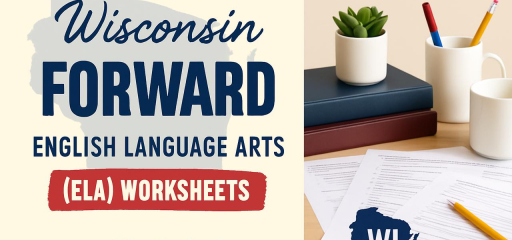
Free Grade 6 English Worksheets for Wisconsin Students
A family rents a cabin on a lake up north for a week in July, somewhere in Vilas County, somewhere off a road that turns to gravel, somewhere where the cell signal drops two minutes before the driveway. A sixth grader unloads a duffel bag, a tackle box, and three paperbacks from the back of the minivan. By Wednesday afternoon they have finished the first paperback. By Friday they are halfway through the second. The week is not test prep. The week is, by any honest measure, a vacation. But that uninterrupted reading is the kind of reading that the Forward Exam in spring is built to recognize. A kid who has spent five days inside long narratives reads differently than a kid who has not.
The school year is the rest of the equation. From September to April, a sixth grader needs short, specific practice on the named skills the Wisconsin Academic Standards for English Language Arts identify by name: citing evidence, summarizing central ideas, analyzing text structure, recognizing figurative language. The worksheets below are built for that part of the year, for the Tuesday-night, twenty-minute, kitchen-table version of growing a reader.
Forty-six PDFs. Each one aligned to a single Grade 6 Wisconsin Academic Standard. Quick Review, guided practice, plain-language answer key. Free to download, free to print, no signup.
What’s on this page
The PDFs are organized by strand the way Wisconsin’s framework arranges Grade 6 ELA. Print a single strand the teacher is working on, or rotate through them across the school year.
Reading: Literature
- Citing Textual Evidence and Drawing Inferences, [RL.6.1] name the conclusion, then quote the line that proves it
- Theme and Objective Summary, [RL.6.2] the lesson the whole story teaches, in one sentence
- Plot, Episodes, and Character Change, [RL.6.3] small scenes that quietly bend a character
- Figurative Language, Connotation, and Tone, [RL.6.4] the feeling a word carries past its definition
- Structure: How a Scene or Stanza Builds the Whole, [RL.6.5] every section earns its place in the work
- Developing the Narrator’s Point of View, [RL.6.6] how a writer puts a reader inside one mind
- Reading vs. Watching: Comparing Versions, [RL.6.7] what the page does that the screen cannot
- Comparing Stories Across Forms and Genres, [RL.6.9] same theme, different vessel
Reading: Informational Text
- Citing Evidence and Drawing Inferences in Nonfiction, [RI.6.1] pull the sentence that clinches the inference
- Central Idea and Objective Summary in Nonfiction, [RI.6.2] the article’s main point with the filler stripped
- How Ideas and Events Are Developed, [RI.6.3] introduce, elaborate, extend, connect
- Word Meaning in Nonfiction: Figurative, Connotative, Technical, [RI.6.4] three jobs a word can do at once
- Text Structure: How Sections Fit Together, [RI.6.5] cause, effect, problem, solution, sequence
- Author’s Point of View and Purpose, [RI.6.6] the writer’s angle and the writer’s reason
- Integrating Information from Text, Visuals, and Data, [RI.6.7] prose, chart, and image read as one source
- Evaluating Arguments and Claims, [RI.6.8] split the claim from the support, then weigh the support
- Comparing Two Authors on the Same Topic, [RI.6.9] different facts, different angles, same subject
Writing
- Argument Writing: Claim, Reasons, Evidence, [W.6.1] defend a position with reasons and quoted proof
- Informative and Explanatory Writing, [W.6.2] teach a reader clearly, in order
- Narrative Writing, [W.6.3] hook, pacing, dialogue, sensory detail, real ending
- Clear Writing for Task, Purpose, and Audience, [W.6.4] match writing to its actual reader
- Planning, Revising, and Editing, [W.6.5] drafts in passes, not single shots
- Short Research Projects, [W.6.7] focused question, several sources, tidy write-up
- Gathering, Evaluating, and Citing Sources, [W.6.8] which sources to trust and how to credit them
Speaking & Listening
- Collaborative Discussions, [SL.6.1] come prepared, listen, build on what was said
- Interpreting Diverse Media, [SL.6.2] what each format shows well and what it hides
- Analyzing a Speaker’s Argument, [SL.6.3] claim, reasons, weak spots
- Presenting Claims and Findings, [SL.6.4] open with the point, walk the evidence, end clean
- Adapting Speech to Context, [SL.6.6] different talk for friend, teacher, and principal
Grammar
- Pronoun Case: Subjective, Objective, and Possessive, [L.6.1a] which pronoun fits where in the sentence
- Intensive Pronouns, [L.6.1b] myself, themselves, and the emphasis they add
- Avoiding Shifts in Pronoun Number and Person, [L.6.1c] one person, one number, all the way through
- Vague Pronouns and Unclear Antecedents, [L.6.1d] every pronoun needs a noun the reader can point to
- Recognizing and Improving Non-Standard English, [L.6.1e] voice for home, school English for the essay
Conventions: Punctuation, Spelling
- Punctuation: Commas, Parentheses, and Dashes, [L.6.2a] three ways to fold extra information into a sentence
- Spelling Grade-Appropriate Words, [L.6.2b] the homophones and trouble words sixth graders miss most
Knowledge of Language and Style
- Varying Sentence Patterns for Style, [L.6.3a] combine, expand, rearrange, anything but flat
- Consistency in Style and Tone, [L.6.3b] pick a register and stay there
Vocabulary and Word Study
- Using Context Clues, [L.6.4a] slow down at the strange word and read what surrounds it
- Greek and Latin Roots and Affixes, [L.6.4b] port, dict, tele, photo, and the doors they open
- Using Dictionaries and Thesauruses Effectively, [L.6.4c] match the tool to the question
- Verifying Word Meaning, [L.6.4d] check the guess instead of trusting it
- Figurative Language: Personification and More, [L.6.5a] the moves that make writing breathe
- Word Relationships: Cause-Effect, Part-Whole, Category, [L.6.5b] patterns that link words together
- Connotation: Shades of Meaning, [L.6.5c] slim, slender, scrawny, same idea, different feel
- Academic and Domain-Specific Vocabulary, [L.6.6] cross-subject words and field-specific words
How to use these worksheets at home
Bridge the gap between summer reading and school-year practice. The week at the lake builds the long-form stamina; the Tuesday-night PDF builds the named skill. Both matter for the Forward Exam, and neither alone is enough. Starting in September, set aside two short slots a week, a Reading PDF on one weeknight, a Vocabulary or Grammar PDF on another. By Thanksgiving your sixth grader has done eighteen pages of targeted practice. By February, forty. By the time the Forward Exam window opens in spring, the named skills the test asks about will not feel like surprises.
Use the writing PDFs to rehearse the on-demand prompt specifically. Forward Exam at Grade 6 includes a writing prompt, and on-demand writing is a different muscle than the typed-up paragraph done over several days. Pull the Argument or Informative PDF on a Sunday afternoon between January and April, set a timer for thirty-five minutes, and ask for a full draft. Read it aloud at the end. Mark one sentence that worked and one that drifted. Five rounds of that is enough to make the test prompt feel routine.
Read the answer keys at the table. The keys are written so a sixth grader can read them alone, but the standard moves in much deeper when you read it together and let your kid say *oh, that’s what I missed.* A silently graded sheet teaches almost nothing. A read-aloud key teaches the standard twice.
A note about Wisconsin’s Forward Exam ELA
The Wisconsin Forward Exam at Grade 6 includes an English Language Arts test administered annually in the spring, aligned to the Wisconsin Academic Standards for English Language Arts. The Grade 6 ELA Forward Exam combines reading items drawn from literary and informational passages, language and vocabulary items, and a writing prompt that asks for an on-demand response.
The writing prompt is scored against Wisconsin’s writing rubric, which weighs purpose and focus, organization, development of ideas, language and style, and conventions. Practically, that rubric rewards a Grade 6 writer who can read the prompt accurately, plan a quick structure, sustain that structure to the end, and clean up conventions on the final pass. The Writing, Sentence Patterns, and Planning-Revising-Editing PDFs above are the most direct practice for that prompt. Every Grade 6 ELA standard in the Wisconsin Academic Standards has at least one worksheet on this page.
Want everything in one bundle?
For families who would rather have a single consolidated resource than forty-six separate PDFs, the Grade 6 ELA Preparation Bundle compiles full-length practice tests and complete answer keys into a single package. It is most useful in the six weeks before the spring Forward Exam administration, when a Wisconsin sixth grader benefits from rehearsing a complete reading set plus a timed writing prompt under realistic conditions.
Wisconsin Grade 6 ELA Preparation Bundle, four practice-test books, 26 unique full-length tests, complete answer keys with explanations.
A short closing
The week at the lake in July and the twenty minutes at the kitchen table on a Tuesday in February are the same investment, paid in two different currencies. Print one of these PDFs tonight. Let the cabin still be a cabin in summer, and let the kitchen table do the steady work the rest of the year, page by page, week by week, all the way to the spring Forward Exam.
Best Bundle to Ace the Wisconsin Forward Grade 6 ELA
Looking for the best resource to help your kid ace the Wisconsin Forward? Try this bundle, four full practice-test books (5 + 6 + 7 + 8 tests) covering the same Grade 6 reading, writing, and language skills your child is already learning. Instant PDF download, answer keys included.


Related to This Article
More math articles
- Alabama ACAP Algebra 1 Free Worksheets: 72 Printable PDFs with Step-by-Step Answer Keys
- Free Grade 5 English Worksheets for Montana Students
- Professions related to mathematics
- How to Use Graphs to Solve Equation Systems: Word Problems
- How to Manage Your Time Effectively on the ISEE Math Test?
- From Cells to Organisms: Levels of Organization
- The Circle’s Anatomy: A Closer Look at the Parts of a Circle
- 8th Grade STAAR Math Practice Test Questions
- Number Navigators: How to Select Pairs with Targeted Sums and Differences
- Using Properties to Convert Traditional and Metric Units





What people say about "Free Grade 6 English Worksheets for Wisconsin"?
No one replied yet.