How Presidential Power Has Expanded
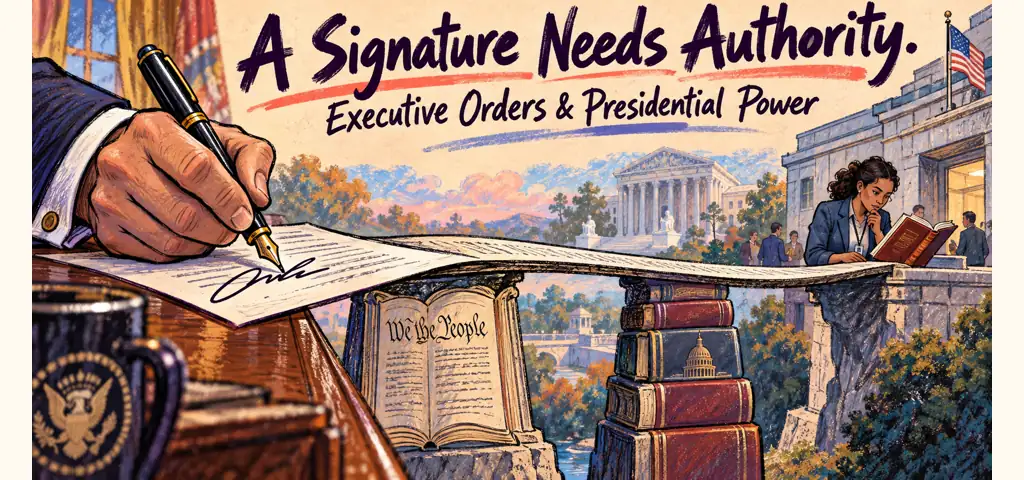
An executive order is a written presidential directive to executive officials. The document can organize administration, assign responsibilities, or implement a statute, but the label is not an independent source of power. A lawful order must rest on Article II authority, authority Congress delegated, or both. It cannot repeal a statute, appropriate money Congress did not provide, or transform a policy preference into binding law.
Justice Jackson’s Youngstown framework helps locate the order’s authority. Presidential power is strongest when Congress authorizes the action, uncertain in a zone where Congress has not spoken and powers overlap, and weakest when the order contradicts Congress. Courts may review an order in a proper case, and a later president may often revise it. Agencies carrying it out must still follow their statutes, appropriations, and required procedures. In Learning Resources v. Trump (2026), the Court held that the cited emergency statute did not authorize the challenged tariffs.
How Presidential Power Has Expanded: the working rule
Congress prohibits using an appropriation for a new domestic program. The president issues an order directing an agency to create the program with that money. The order begins in Youngstown’s lowest category because it conflicts with Congress’s spending decision. Calling the problem an emergency does not supply the missing exclusive constitutional authority.
How Presidential Power Has Expanded: limits and hard cases
Distinguish executive orders from executive agreements and signing statements. An agreement is an international commitment. A signing statement accompanies approval of a bill. An order directs executive administration. For each, ask what legal source supports the content, who must implement it, and which statute or constitutional limit controls.
A new case involving how presidential power has expanded
For Executive orders, separate an Article II power from a political role, informal resource, or action requiring Senate or congressional participation. Give one concrete example.
Check your reasoning
An executive order directs operations of the executive branch and must rest on constitutional or statutory authority. It cannot lawfully repeal a statute, and courts may review its legality. An executive agreement is an international commitment made without the Article II treaty-ratification process.
Video lesson: How Presidential Power Has Expanded
CrashCourse gives a focused explanation of this topic in Presidential Power: Crash Course Government and Politics #11.
If the player does not load, watch this lesson directly on YouTube.
Connect this lesson to the larger course
For a broader map connecting how presidential power has expanded to Congress, the presidency, the courts, and the bureaucracy, use the AP U.S. Government and Politics learning hub.

Related to This Article
More math articles
- Heredity and DNA
- DC CAPE Grade 8 Math Worksheets: 72 Free PDF Links
- What Does the CBEST Test Qualify You For?
- Chapter 2: The Articles of Confederation
- How to Use Benchmark to Compare Fractions?
- Enhanced ACT Math Pacing: Build a Plan for the Shorter Section (2027 Prep)
- Ideological groups
- Repeating Decimals
- Estimating Sums and Differences for 4th Grade
- Multiplication Facts Review for 4th Grade


















What people say about "How Presidential Power Has Expanded"?
No one replied yet.