Essential Scientific Vocabulary

Hypoglycemia looks less unfamiliar once you recognize hypo-, glyc-, and -emia. Those parts suggest low blood sugar. Scientific terms contain useful clues, but you still need the sentence and the lesson to check whether your first interpretation fits.
Definition: Scientific vocabulary becomes easier when you treat a word as evidence rather than as an isolated label. Roots, prefixes, suffixes, nearby examples, and the scientific context can narrow the meaning. After you infer a definition, check that it makes sense in the complete sentence or diagram.
For each word-part category in the diagram, supply an example from a term you have met in class. Use the context box to explain how you would check the complete meaning.
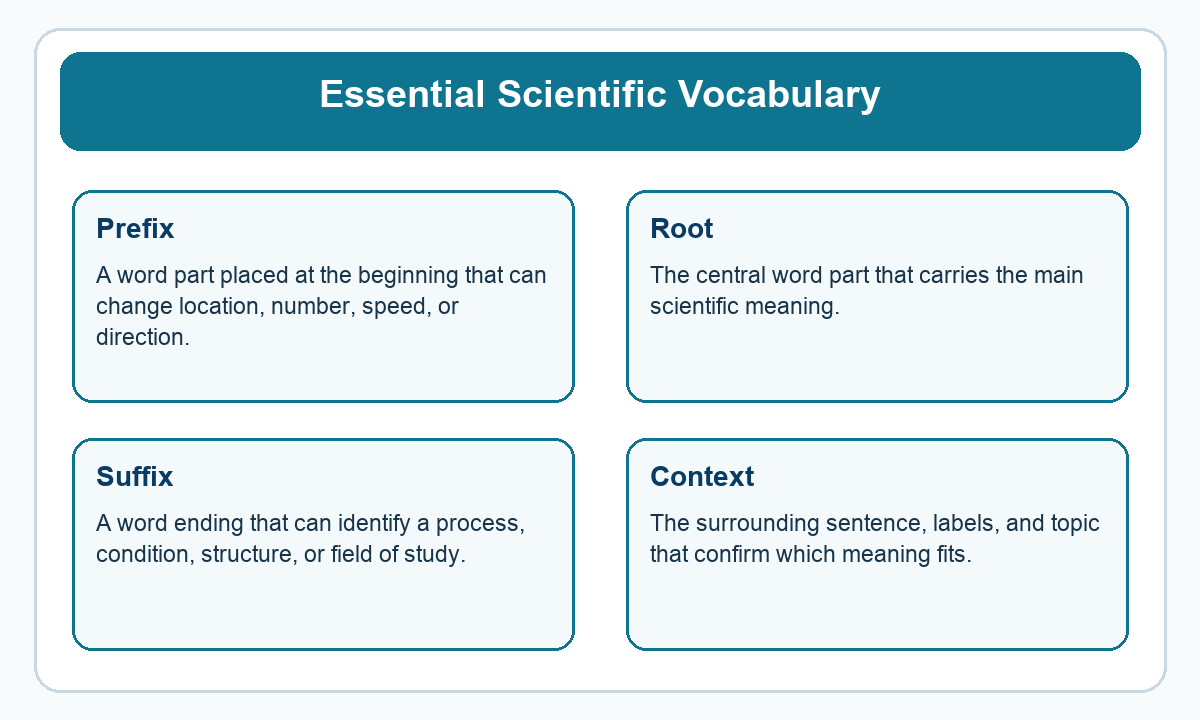
Terms used in this lesson
| Idea | What it means |
|---|---|
| Prefix | A word part placed at the beginning that can change location, number, speed, or direction. |
| Root | The central word part that carries the main scientific meaning. |
| Suffix | A word ending that can identify a process, condition, structure, or field of study. |
| Context | The surrounding sentence, labels, and topic that confirm which meaning fits. |
Work through a complete word
In hypoglycemia, hypo- suggests below normal, glyc- refers to sugar, and -emia points to a blood condition. Put those clues together. The term means low blood glucose, a meaning you can confirm when the surrounding passage discusses glucose concentration in blood.
Changing hypo- to hyper- changes the direction of the comparison. Hyperglycemia refers to high blood glucose. The shared root and ending keep the subject the same, so the prefix matters when an answer choice reverses high and low.
Use families of words
Intracellular and extracellular share cellular, but intra- points within a cell and extra- points outside it. Sketch a membrane and place the two labels on opposite sides. That small drawing connects the word parts to a boundary you will use again in transport questions.
Other endings name processes or areas of study. The -lysis in hydrolysis refers to breaking apart, and hydro- points to water. In biology, hydrolysis uses water to break a covalent bond. Learn that full definition alongside the parts because the parts alone do not describe all the chemistry.
Check a term in its scientific setting
A theory in science is a broad explanation supported by evidence, although people sometimes use the same word informally for a guess. No prefix will resolve that difference. Read how the author uses the term and check the course definition before choosing an answer.
Make a notebook entry with the term, your first inference, and the confirmed meaning. If the inference was wrong, record the clue that misled you. Grouping location words together can help you compare within, outside, above, and below without creating a long list of unrelated definitions.
Explain the sentence after decoding the word
Suppose a passage says that extracellular fluid surrounds the cells of a tissue. After identifying extra-, restate the whole sentence: the fluid is outside the cells. A diagram should place that fluid beyond the plasma membrane. This final check catches an answer that defines one word part correctly but puts the structure in the wrong location.
Some terms resist this approach. Names based on people, historical usage, or abbreviations may need direct learning. Word parts help you narrow an interpretation, and a reliable glossary supplies the meaning that your biology course expects.
Watch a short lesson
Practice identifying scientific prefixes and suffixes, then check each inferred meaning against the complete word.
Practice without looking at the answers
Write your responses before opening the answer panels.
-
What does hypo- contribute to the meaning of hypoglycemia?
Check the answer
It indicates below normal. Together with the sugar and blood-condition word parts, it points to low blood glucose.
-
Which part changes when hypoglycemia becomes hyperglycemia, and what changes in meaning?
Check the answer
The prefix changes from hypo- to hyper-. The term changes from low to high blood glucose.
-
Where would you label extracellular fluid on a cell diagram?
Check the answer
Outside the plasma membrane. Extra- indicates outside in this term.
-
What does a root contribute to a scientific word?
Check the answer
It carries the main subject or meaning. For example, glyc- points to sugar in hypoglycemia.
-
Why should you learn the full definition of hydrolysis after identifying hydro- and -lysis?
Check the answer
The full definition explains that water is used to break a covalent bond. Recognizing water and splitting does not specify the complete reaction.
-
A speaker uses theory to mean a guess. Should that definition decide a biology answer?
Check the answer
No. In scientific usage, a theory is a broad explanation supported by evidence. The scientific context determines the intended meaning.
Where does this fit in your science review?
The ATI TEAS Science Study Hub places this lesson inside the larger study skills review. Continue with these connected lessons:

Related to This Article
More math articles
- The Best Grade 8 ELA Practice Tests for Arkansas Students
- Why Prejudice and Conflict Develop
- The Warren Court and the Rights Revolution
- Randomness in Action: What Slot-Style Games Teach Us About Math
- Checks and Limits on Judicial Power
- Grade 6 Math: Prime and Composite Numbers
- Selective incorporation
- Using Algebra Tiles to Model and Solve Equations
- A Comprehensive Collection of Free CLEP College Algebra Practice Tests
- 3rd Grade Georgia Milestones Assessment System Math Worksheets: FREE & Printable

















What people say about "Essential Scientific Vocabulary"?
No one replied yet.