Anatomical Position and Body Organization
Students often see anatomical position and body organization as a cluster of new terms. A steadier route is to connect Superior and inferior with Anterior and posterior, then place Medial and lateral and Proximal and distal into the same working picture.
Definition: Anatomical position is the shared reference posture used to describe the body: standing upright, facing forward, arms at the sides, palms forward, and feet directed forward. Directional terms always refer to this position, even when a person is lying down or a diagram is rotated.
What do you need to know about anatomical position and body organization?
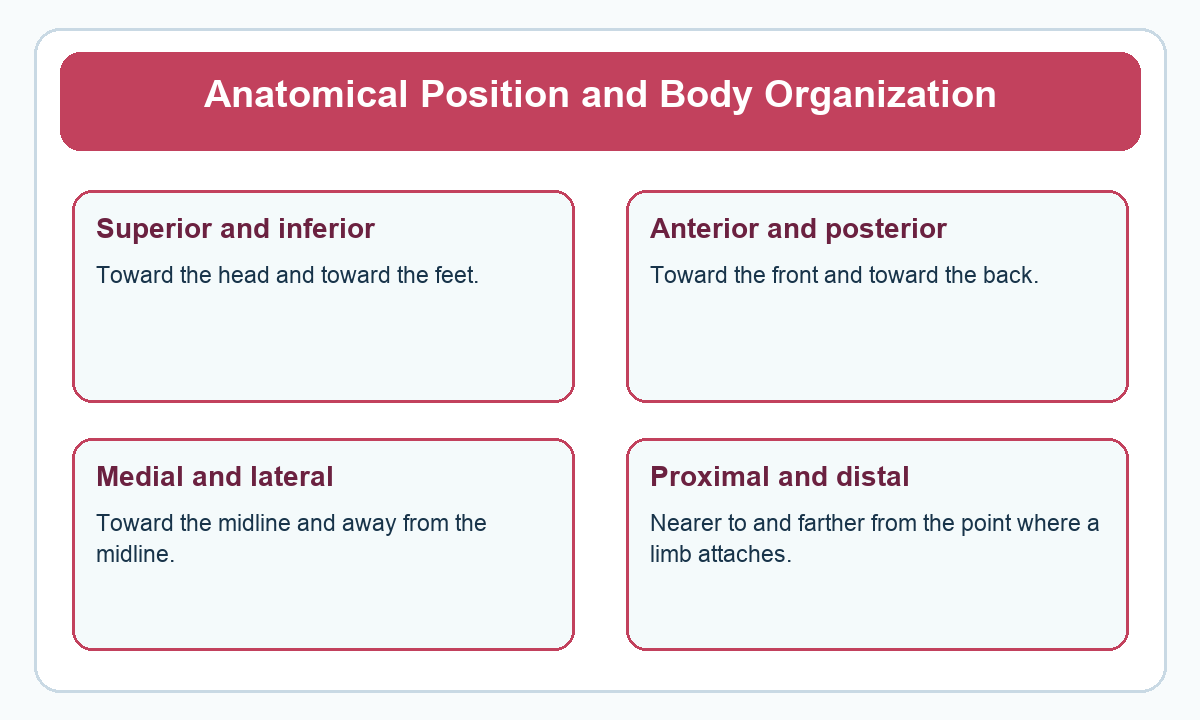
Use the visual as a recall tool: read the Superior and inferior box, cover it, and explain it from memory. Repeat that move for Anterior and posterior, Medial and lateral, and Proximal and distal; then explain how the four ideas connect.
What should you remember about anatomical position and body organization?
| Idea | What it means |
|---|---|
| Superior and inferior | Toward the head and toward the feet. |
| Anterior and posterior | Toward the front and toward the back. |
| Medial and lateral | Toward the midline and away from the midline. |
| Proximal and distal | Nearer to and farther from the point where a limb attaches. |
How can each anchor help you answer a question?
Superior and inferior as a question clue
Toward the head and toward the feet. A useful contrast is anterior and posterior: toward the front and toward the back.
Anterior and posterior as a question clue
Toward the front and toward the back. A useful contrast is medial and lateral: toward the midline and away from the midline.
Medial and lateral as a question clue
Toward the midline and away from the midline. A useful contrast is proximal and distal: nearer to and farther from the point where a limb attaches.
Proximal and distal as a question clue
Nearer to and farther from the point where a limb attaches. A useful contrast is superior and inferior: toward the head and toward the feet.
What else helps this topic make sense?
Directional terms describe relationships, so most of them need two structures. The nose is medial to the eyes, but each eye is lateral to the nose. The skin is superficial to skeletal muscle, while the muscle is deep to the skin. A hand is distal to the elbow, yet the elbow is proximal to the hand. Practicing both directions prevents a common mistake: memorizing a term as if it belonged permanently to one body part instead of describing a comparison.
How does this idea work in a real question?
The elbow is proximal to the wrist because it is closer to the shoulder, where the arm attaches to the trunk. The wrist is distal to the elbow. The relationship stays the same if the person raises an arm or lies on a table.
For this example, first identify which of the four anchors is changing or acting. Follow its effect through the situation and name the result before comparing choices. This keeps your reasoning tied to evidence rather than to a familiar-looking term.
What is a reliable way to reason through it?
- Decide whether the question is mainly about Superior and inferior, Anterior and posterior, Medial and lateral, or Proximal and distal.
- Restate the job of the named idea before reading the answer choices.
- Use the Superior and inferior, Proximal and distal map above to trace direction, cause, evidence, or outcome in the order supplied.
- Test the remaining choice against this specific warning: Left and right belong to the person being described, not to the viewer. In a front-facing diagram, the person's right side appears on the viewer's left.
What mistake should you watch for?
Left and right belong to the person being described, not to the viewer. In a front-facing diagram, the person's right side appears on the viewer's left.
If two choices survive, ask which one preserves the stated relationship between Superior and inferior and Anterior and posterior. Then check it against Medial and lateral or Proximal and distal if either appears in the prompt.
Watch a short lesson
The body-systems overview supplies a beginner-friendly map of major structures and helps place directional language in a whole-body context. Pause the lesson when a diagram or process appears and connect it with the four anchors in this page’s visual.
Can you check your understanding?
Try these six checks from memory. Open an answer only after you have said or written your own response.
-
In your own words, what is the central idea in this lesson?
Check the answer
Anatomical position is the shared reference posture used to describe the body: standing upright, facing forward, arms at the sides, palms forward, and feet directed forward. Directional terms always refer to this position, even when a person is lying down or a diagram is rotated.
-
What should you remember about superior and inferior?
Check the answer
Toward the head and toward the feet.
-
What should you remember about anterior and posterior?
Check the answer
Toward the front and toward the back.
-
What should you remember about medial and lateral?
Check the answer
Toward the midline and away from the midline.
-
What should you remember about proximal and distal?
Check the answer
Nearer to and farther from the point where a limb attaches.
-
What final check is most useful for a question about anatomical position and body organization?
Check the answer
Compare the choice with the relationship among Superior and inferior, Anterior and posterior, Medial and lateral, and Proximal and distal. Then apply this warning: Left and right belong to the person being described, not to the viewer. In a front-facing diagram, the person's right side appears on the viewer's left.
Where does this fit in your science review?
The ATI TEAS Science Study Hub places this lesson inside the larger anatomy and physiology review. Continue with these connected lessons:
- Cells, Tissues, Organs, and Homeostasis
- The Integumentary System
- The Skeletal System
- The Muscular System
Recommended ATI TEAS resources

Related to This Article
More math articles
- Senate confirmation
- SHSAT Math Worksheets: FREE & Printable
- How to Distance Teach Math with a Drawing Pad?
- Market power puts demand and MR on the same firm graph
- Top 10 Tips to Create the SAT Math Study Plan
- Political speech
- Embark on Your SHSAT Math Adventure: Introducing the “SHSAT Math for Beginners” Solution Manual
- Making Inferences From a Sentence
- Absolute Poverty, Relative Poverty, and Measurement
- The Best Grade 3 Math Book for Nebraska Students



















What people say about "ATI TEAS 7: Anatomical Position"?
No one replied yet.