CLEP U.S. History I 076: Popular Print, Minstrelsy, and Contested Mass Culture
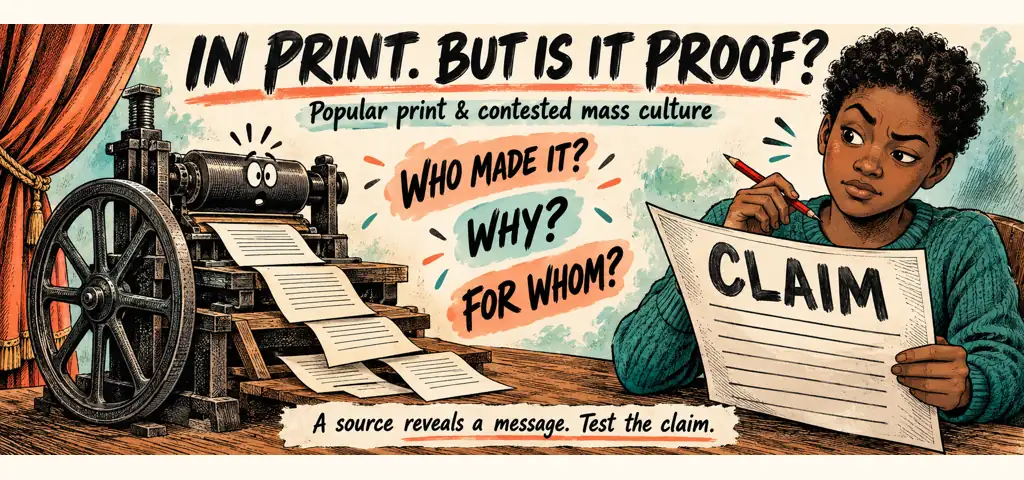
Lesson 14.3 of Chapter 14 of the U.S. History to 1877 study guide on Effortless Math covers CLEP U.S. History I 076: Popular Print, Minstrelsy, and Contested Mass Culture: the key terms, the core ideas, and worked examples showing how this topic is tested on the exam.
U.S. History to 1877 | Chapter 14 | Lesson 14.3
The same transportation and production changes that expanded markets for cloth and farm goods expanded markets for information. Faster presses reduced printing costs. Canals, railroads, and postal routes moved newspapers and books farther. Urban literacy and advertising enlarged audiences. Editors sold inexpensive newspapers to mass readers, while reform associations flooded communities with pamphlets, almanacs, petitions, and reports. Print could create a national conversation, but it did not create a neutral one.
The growth of partisan newspapers illustrates the point. Editors openly supported parties and candidates. Reports, editorials, rumors, and attacks mixed together in ways that modern readers may not expect from a newspaper. That makes a party paper valuable evidence of political language and mobilization, but poor evidence that an accusation was true simply because it appeared in print. Abolitionists used newspapers such as William Lloyd Garrison’s Liberator to expose slavery and coordinate activism. Proslavery editors answered with censorship, mob action, and arguments defending slavery. Congress’s gag rule over antislavery petitions showed that communication itself had become a political battleground.
Popular entertainment also carried power. Blackface minstrelsy became a widely consumed form in which white performers, and later some Black performers under unequal conditions, presented racist caricatures of Black speech, music, work, and family life. It borrowed from African American cultural forms while distorting them for paying audiences. Its popularity did not mean that audiences shared one motive, but the form helped make degrading stereotypes familiar and commercially profitable. A historical analysis should neither dismiss it as harmless entertainment nor assume that a stage character accurately represented Black life.
Other print forms widened participation. Women circulated reform literature, edited magazines, and wrote sentimental novels that linked private feeling to public wrong. Frederick Douglass used autobiography and oratory to make personal testimony an attack on proslavery ideology. Harriet Beecher Stowe’s Uncle Tom’s Cabin used sentimental conventions to move northern readers, though its character types could also reproduce paternalistic ideas. Mass culture was therefore contested terrain: it could challenge authority, reinforce hierarchy, and do both within the same work.
Watch the topic in context
Use this lesson from CrashCourse to review the period and its central historical problem. Pause when the video reaches the turning point named above.
Video: Race Melodrama and Minstrel Shows: Crash Course Theater #30, CrashCourse.
Check your understanding
- The growth of inexpensive newspapers before the Civil War was most directly supported by which combination?
- A ban on political writing and the end of postal service
- Declining cities and higher production costs
- Universal federal funding for newspapers
- Faster printing, wider literacy, advertising, and improved distribution
- The disappearance of political parties
- Why must a historian treat an accusation in a partisan newspaper cautiously?
- The accusation may reveal campaign strategy without proving the underlying claim.
- The paper’s partisan identity makes it unusable as evidence of political language.
- Printing a candidate’s name is sufficient to verify the accusation against that person.
- An official document is necessarily more reliable for reconstructing popular belief.
- Readers generally treated campaign accusations as literary fiction rather than political claims.
- Select all accurate statements about blackface minstrelsy.
- It commercialized racist caricatures.
- It drew selectively and often exploitatively on Black cultural forms.
- Its stage characters are reliable direct records of everyday Black life.
- Its popularity helped circulate racial stereotypes.
- It had no connection to the growth of urban mass entertainment.
- State one claim an abolitionist autobiography could support better than a plantation owner’s account, and explain why.
Write a brief response using a named fact from the lesson.
Open the answers and reasoning
Independent preparation. CLEP is a registered trademark of the College Board, which does not endorse this lesson.

Related to This Article
More math articles
- How to Factor Polynomials by Taking a Common Factor?
- The Ultimate 6th Grade Scantron Performance Math Course (+FREE Worksheets)
- Words for Quantity, Time, Description, and Place
- ISEE Middle Level Math Flashcards (Free Online: Formulas, Terms & Concepts)
- The Ultimate Adults Algebra Refresher Course (+FREE Worksheets & Tests)
- Overview of the ACCUPLACER Math Test
- 4th Grade MCAS Math Worksheets: FREE & Printable
- Scope, Purpose, and Audience
- Ageism and Population Aging
- ParaPro Math Worksheets: FREE & Printable













What people say about "Popular Print, Minstrelsy and Mass Culture"?
No one replied yet.