CLEP U.S. History I 077: Religion, Science, and Education
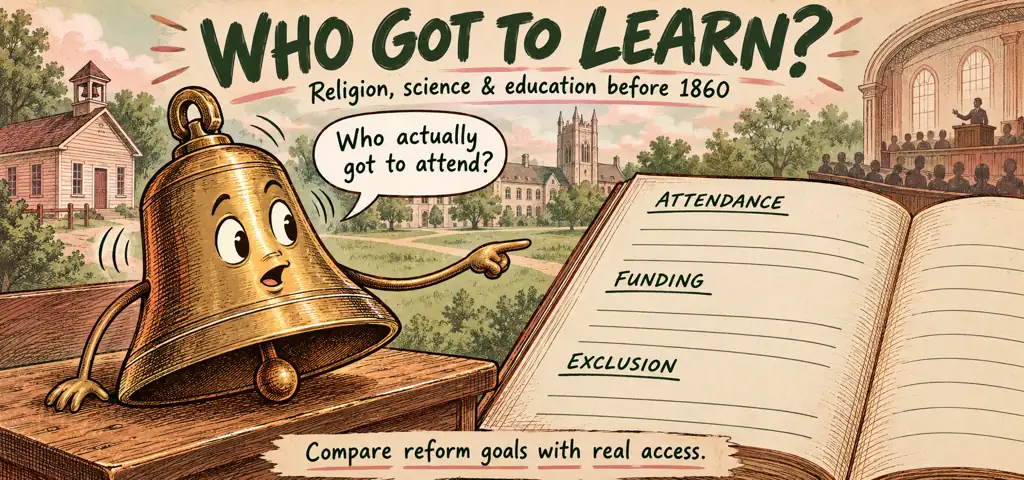
Lesson 14.4 of Chapter 14 of the U.S. History to 1877 study guide on Effortless Math covers CLEP U.S. History I 077: Religion, Science, and Education: the key terms, the core ideas, and worked examples showing how this topic is tested on the exam.
U.S. History to 1877 | Chapter 14 | Lesson 14.4
Antebellum Americans produced knowledge through institutions that sometimes competed and often overlapped. Churches founded colleges, missionary societies, and print networks. State and local governments expanded tax-supported common schools. Voluntary associations sponsored lectures and libraries. Surveyors, physicians, inventors, naturalists, and agricultural improvers collected observations that promised practical progress. There was no simple march from religion to science or from private to public education.
Horace Mann and other common-school advocates argued that public elementary schools could prepare citizens, reduce disorder, and give children shared moral habits. They promoted trained teachers, graded classes, more consistent terms, and public funding. The schools expanded access but also carried Protestant assumptions that Catholic immigrants could experience as coercive. Native children and Black children encountered different and often exclusionary systems. In the North, segregated schools were common. In much of the slave South, laws restricted teaching enslaved people to read. A claim that common schools created equal education therefore confuses an aspiration with an uneven reality.
Noah Webster’s spelling books linked education with nationalism. Standardized American spellings and civic lessons suggested that language could help bind the republic. Lyceums and public lectures created adult learning spaces where audiences heard talks about science, literature, reform, and practical improvement. These venues made expert claims more public, though participation still depended on place, race, sex, and resources.
Scientific inquiry often served expansion and economic development. Government-sponsored surveys mapped coasts, routes, mineral resources, and western lands. Inventors improved devices through cumulative experimentation and commercial networks rather than isolated flashes of genius. Samuel Morse’s telegraph joined electrical experiment, private capital, and federal support. Its near-instant messages altered business and news, yet information still had to travel along built lines controlled by organizations.
Religious movements also responded to new knowledge. Some believers treated nature as evidence of divine design. Others feared that new theories threatened inherited readings of scripture. The key point for this period is not a single science-versus-religion battle. It is the widening number of institutions claiming authority to describe the world and improve society.
A focused video lesson
Clavaket offers a visual route through this topic. As you watch, compare its explanation with the source limits in the written lesson.
Video: Education Reform in the Antebellum US, Clavaket.
Check your understanding
- Common-school reformers such as Horace Mann most often justified public education as a way to do which of the following?
- Shift school control from local districts to a national education ministry
- Limit tax-supported schooling to families that owned property
- Substitute industrial supervisors for professionally trained teachers
- Preserve immigrant languages by excluding English from instruction
- Prepare citizens and promote social order
- Which evidence would best test whether a state’s claim of universal schooling matched practice?
- A reformer’s statement of purpose alone
- One textbook’s decorative cover
- School attendance, funding, and exclusion records
- A list of European universities
- The price of cotton in Liverpool
- Select all developments that widened access to information before 1860.
- Common schools
- Lyceum lectures
- Cheaper print
- Telegraph networks
- Legal restrictions on Black literacy
- Explain why “science replaced religion” is an inadequate summary of antebellum intellectual life.
Write a brief response using a named fact from the lesson.
Open the answers and reasoning
Independent preparation. CLEP is a registered trademark of the College Board, which does not endorse this lesson.

Related to This Article
More math articles
- Complementary and Supplementary Angles: Definitions and Examples for 2026
- Microorganisms
- The Ultimate Calculus Course
- Suburbs, Highways, Redlining, and White Flight
- The Best Grade 3 ELA Practice Tests for Washington Students
- Tips and Tricks for Learning College Math
- Checks and Limits on Judicial Power
- How to Help Your 7th Grade Student Prepare for the Kansas KAP Math Test
- Utah RISE Grade 8 Math Free Worksheets: Printable Grade 8 Math Practice, Answers Included
- Grade 6 Math: Dot Plots










What people say about "Religion, Science, and Education in the 1800s"?
No one replied yet.