CLEP U.S. History I 078: National Identity and Sectional Culture
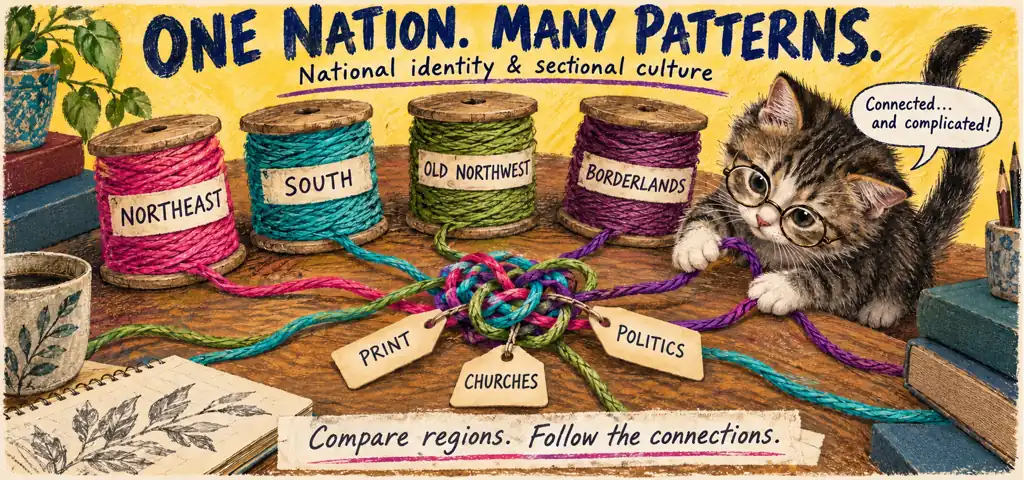
Lesson 14.5 of Chapter 14 of the U.S. History to 1877 study guide on Effortless Math covers CLEP U.S. History I 078: National Identity and Sectional Culture: the key terms, the core ideas, and worked examples showing how this topic is tested on the exam.
U.S. History to 1877 | Chapter 14 | Lesson 14.5
Americans often spoke of a single national character, but institutions and daily life differed sharply by region. The Northeast developed dense commercial cities, factories, reform networks, and wage labor alongside farms and small towns. The plantation South concentrated wealth and political power in slaveholding households even though most white southerners owned no enslaved people. The Old Northwest combined commercial farming, growing towns, and political conflicts over race and migration. Western and borderland regions contained Native nations, Mexican communities, migrants, soldiers, traders, and speculators whose claims to land did not fit a simple North-South map.
Sectional culture did not arise only from different economies, but economic systems shaped what arguments seemed urgent. Proslavery writers defended slavery as a positive good and portrayed the plantation household as orderly and paternal. Antislavery writers exposed violence, family separation, and the theft of labor. Free-labor advocates praised a society in which wage workers could supposedly rise to independent ownership. That ideal appealed to many northern voters, yet it often excluded Black workers and ignored long-term wage dependence. Each ideology selected real features of social life and arranged them into a moral story.
National institutions carried sectional conflict instead of eliminating it. Churches divided over slavery. Publishing networks circulated competing visions. National political parties strained to hold northern and southern wings together. The Mexican-American War and the territories acquired afterward made the contradiction harder to contain: would western land extend plantation slavery, free labor, Native sovereignty, Mexican property rights, or some unstable combination?
Culture also crossed sectional boundaries. Religious revivals, commercial print, popular songs, and consumer goods circulated widely. Enslaved people’s music and stories moved despite repression. Migrants brought language, food, faith, and political traditions. A useful exam strategy is therefore to avoid treating regions as sealed boxes. Ask which pattern is dominant, which groups complicate it, and which national network connects the regions.
See the history take shape
Watch this account from Bill of Rights Institute with one question in mind: which evidence makes the lesson's strongest claim hold up?
Video: National Identity In The Early 1800s | BRI's Homework Help Series, Bill of Rights Institute.
Check your understanding
- Free-labor ideology most clearly distinguished northern wage labor from slavery by emphasizing which possibility?
- Permanent hereditary labor status
- Legal mobility toward economic independence
- Federal ownership of factories
- The absence of class inequality
- A ban on western settlement
- Which development most clearly shows national institutions carrying sectional conflict?
- Every region stopped receiving national newspapers.
- Northern and southern economies became identical.
- Political parties eliminated debate about the territories.
- Major Protestant denominations divided over slavery.
- Western communities contained no prior inhabitants.
- Select all cautions that improve a regional comparison.
- Identify the dominant pattern without assuming every resident fit it.
- Consider borderlands and migration.
- Look for networks that connected regions.
- Treat free labor as proof that class inequality disappeared.
- Assume culture followed a single North-South boundary.
- Explain one limitation of the free-labor promise when compared with the experience of an actual wage worker.
Write a brief response using a named fact from the lesson.
Open the answers and reasoning
Independent preparation. CLEP is a registered trademark of the College Board, which does not endorse this lesson.

Related to This Article
More math articles
- Words for Conflict and Cooperation
- Shutdown is a short-run comparison with variable cost
- Executive Office of the President
- Political action committees
- Middle School Math Worksheets: FREE & Printable
- How to Find Domain and Range of Relations
- 4th Grade MAAP Math Worksheets: FREE & Printable
- ACT Math: Test-Taking Strategies
- Détente, China, SALT I, and the Limits of Triangular Diplomacy
- Social-Science Evidence: Psychology, Sociology, Anthropology, and Case Studies












What people say about "National Identity and Sectional Culture"?
No one replied yet.