CLEP U.S. History I 079: Texas Revolution and Annexation
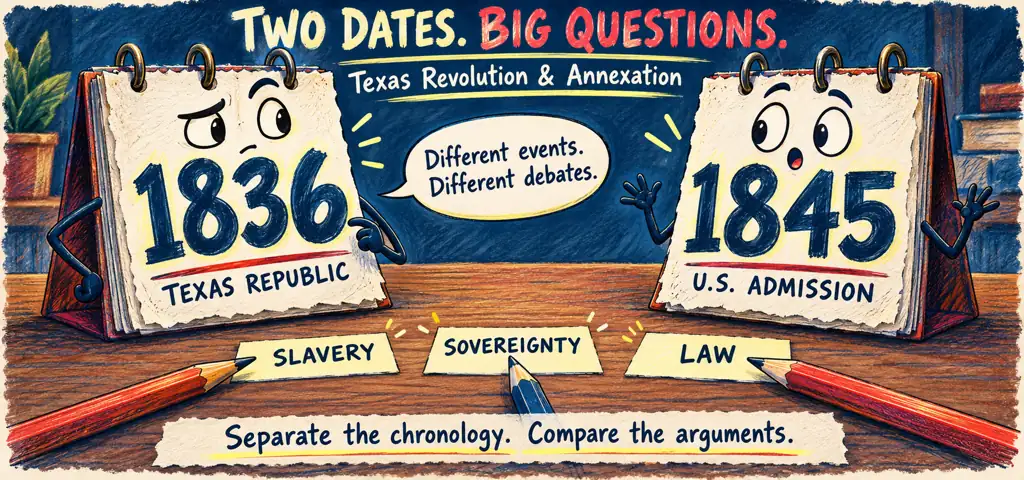
Lesson 15.1 of Chapter 15 of the U.S. History to 1877 study guide on Effortless Math covers CLEP U.S. History I 079: Texas Revolution and Annexation: the key terms, the core ideas, and worked examples showing how this topic is tested on the exam.
U.S. History to 1877 | Chapter 15 | Lesson 15.1
Mexico encouraged immigration into sparsely settled Texas after winning independence from Spain, but it expected settlers to accept Mexican law. Many migrants from the United States brought enslaved labor, maintained commercial ties across the border, and resisted changes intended to restrict immigration and slavery. Political centralization under Antonio López de Santa Anna deepened the conflict. The Texas Revolution of 1835 to 1836 produced an independent republic after battles at the Alamo, Goliad, and San Jacinto, but Mexico did not accept the loss.
The language of liberty used by Anglo-Texan rebels requires a perspective check. Mexican federalists also opposed Santa Anna’s centralization, Tejanos divided over rebellion, and the new Texas republic protected slavery while restricting the status of free Black people. Mexico had abolished slavery nationally in 1829, although Texas received a temporary exemption and settlers used labor contracts to evade restrictions. The conflict therefore joined constitutional federalism to immigration, land, race, and enslaved labor. No one slogan explains every participant.
Annexation then became a U.S. Sectional and diplomatic problem. Texas claimed land to the Rio Grande, including territory Mexico still governed. Admission could add a vast slaveholding state and possibly several future states, alarming many northerners. Presidents Andrew Jackson and Martin Van Buren hesitated partly because annexation risked war and sectional rupture. John Tyler revived the issue. After the Senate rejected an annexation treaty, Congress used a joint resolution, and Texas accepted admission in 1845.
Watch, then test the claim
This US History with Mr Rowe lesson supplies a second explanation of the same period. Note where chronology, cause, and perspective connect.
Video: The Texas Annexation, US History with Mr Rowe.
Check your understanding
- Which outcome best explains the sectional dimension of northern opposition to Texas annexation?
- Admission would give free states a larger Senate majority.
- Admission could enlarge slaveholding power in Congress.
- Texas would enter under Mexico’s antislavery law.
- Oregon would count as part of the new state.
- Congress would gain power to abolish slavery within every state.
- The immediate diplomatic danger of annexation arose chiefly because
- Britain had made Texas a protectorate during the Oregon talks.
- Mexico recognized Texas but disputed its public debt.
- the United States had guaranteed Mexico the Nueces boundary.
- Mexico still rejected Texas independence and its Rio Grande claim.
- Texas had withdrawn its claim to land south of the Nueces.
- Select all factors contributing to conflict in Mexican Texas:
- slavery,
- U.S. Immigration,
- Mexican political centralization,
- complete agreement about language and law,
- competing land and sovereignty claims.
- Explain why calling the Texas conflict only a fight for liberty leaves out essential history.
Write a brief response using a named fact from the lesson.
Open the answers and reasoning
Independent preparation. CLEP is a registered trademark of the College Board, which does not endorse this lesson.

Related to This Article
More math articles
- Conformity, Obedience, and Situational Influence
- The Best Grade 6 ELA Practice Tests for Nebraska Students
- What Does SHSAT Stand for?
- How to Solve Word Problems with Four-digit Dividends and Two-digit Divisors
- 8th Grade Wisconsin Forward Math Worksheets: FREE & Printable
- Hands-On Learning: How to Represent Subtraction of Fractions with Unlike Denominators Using Everyday Objects
- Georgia Georgia Milestones Algebra 1 Free Worksheets: Free Printable Algebra 1 PDFs Covering Every Skill
- SSAT Middle-Level Math Worksheets: FREE & Printable
- FTCE Middle Grades Math 5-9 Flashcards
- What is the Type of Tangents to Circles?


















What people say about "The Texas Revolution and Annexation"?
No one replied yet.