CLEP U.S. History I 080: Oregon, Trails, Migration, and Environment
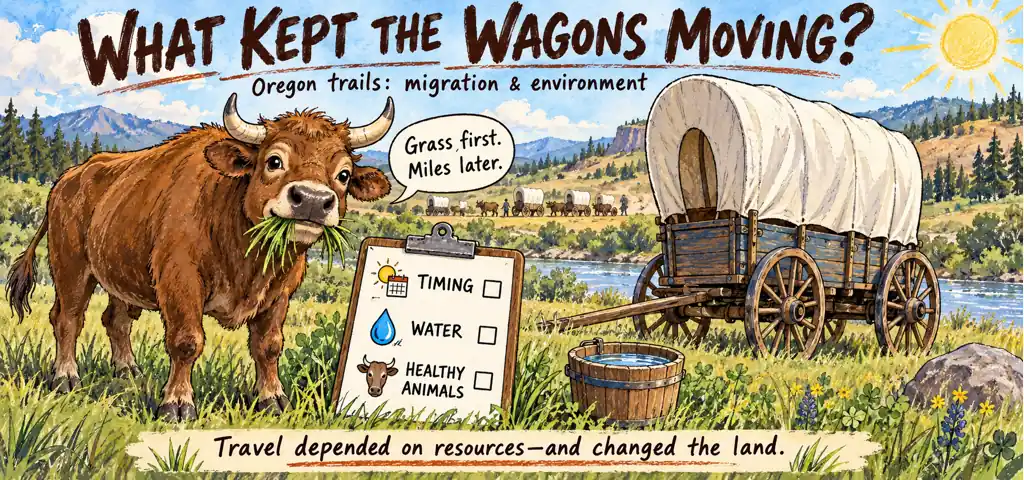
Lesson 15.2 of Chapter 15 of the U.S. History to 1877 study guide on Effortless Math covers CLEP U.S. History I 080: Oregon, Trails, Migration, and Environment: the key terms, the core ideas, and worked examples showing how this topic is tested on the exam.
U.S. History to 1877 | Chapter 15 | Lesson 15.2
The United States and Britain jointly occupied the Oregon Country while missionaries, traders, Native communities, and migrants competed and cooperated across the region. During the 1840s, thousands of migrants traveled overland. The phrase “Oregon fever” suggests excitement, but the journey depended on careful timing, healthy animals, river crossings, and access to water and grass. Disease and accidents killed far more emigrants than warfare with Native people. Migrants altered landscapes through grazing, hunting, woodcutting, and waste, and their movement exposed Native communities to epidemics and growing land pressure.
Expansionist Democrats invoked the claim to latitude 54°40′ during the 1844 campaign, but the Polk administration compromised with Britain. Article I of the Oregon Treaty of 1846 continued the boundary west on the forty-ninth parallel from the Rocky Mountains to the channel separating the continent from Vancouver Island, then turned it south through that channel and the Strait of Juan de Fuca to the Pacific. This marine turn kept all of Vancouver Island on the British side. The ambiguous channel around the San Juan Islands produced a later dispute. The agreement shows that expansion did not always mean war: leaders could pair maximal rhetoric with negotiated restraint.
Watch the topic in context
Khan Academy traces the people and chronology behind this lesson. Listen for the evidence that sharpens the written account, then try the questions below.
Video: Westward expansion: social and cultural development | AP US History | Khan Academy, Khan Academy.
Check your understanding
- The Oregon Treaty of 1846 established a boundary that
- followed the Columbia River all the way to the Pacific.
- extended joint occupation for another ten years.
- followed 49° N to a channel and left Vancouver Island British.
- gave the United States its full claim to 54°40′.
- placed Vancouver Island under the United States with British navigation rights.
- Which factor most directly determined whether an overland wagon party could keep moving?
- the number of Army forts along the entire trail.
- the toll charged at the first major river crossing.
- the party’s size regardless of its supplies.
- the speed of its passage across the Appalachians.
- its timing and access to water, grass, and healthy draft animals.
- Select all environmental effects of overland migration:
- grazing pressure,
- woodcutting,
- disease transmission,
- no change to water sources,
- increased hunting.
- What does the Oregon settlement reveal about the relationship between expansionist rhetoric and diplomacy?
Write a brief response using a named fact from the lesson.
Open the answers and reasoning
Independent preparation. CLEP is a registered trademark of the College Board, which does not endorse this lesson.

Related to This Article
More math articles
- What Kind of Math Is Taught in 10th Grade?
- The Best Grade 5 ELA Practice Tests for West Virginia Students
- Block by Block: How to Complete Decimal Division Equations
- The Ultimate MTTC Mathematics (Elementary) (089) Course (+FREE Worksheets & Tests)
- Keep short-run adjustment separate from long-run adjustment
- FREE TABE Math Practice Test
- Grade 6 Vocabulary and Word Study: Roots, Context Clues, and Academic Language That Sticks
- 10 Most Common ALEKS Math Questions
- 5th Grade Common Core Math FREE Sample Practice Questions
- SSAT Lower Level Math FREE Sample Practice Questions




















What people say about "Oregon, Trails, Migration and Environment"?
No one replied yet.