CLEP U.S. History I 081: Mexican-American War and the Treaty of Guadalupe Hidalgo
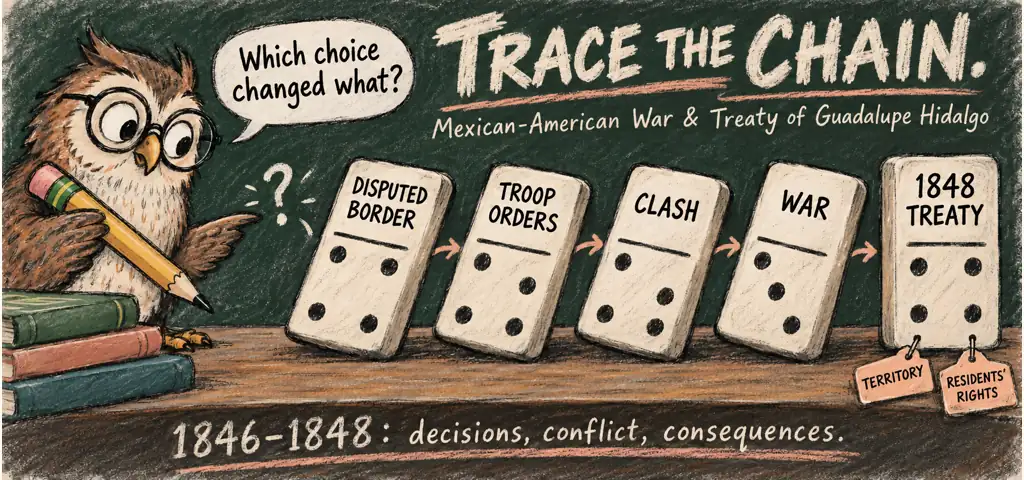
Lesson 15.3 of Chapter 15 of the U.S. History to 1877 study guide on Effortless Math covers CLEP U.S. History I 081: Mexican-American War and the Treaty of Guadalupe Hidalgo: the key terms, the core ideas, and worked examples showing how this topic is tested on the exam.
U.S. History to 1877 | Chapter 15 | Lesson 15.3
President James K. Polk wanted California and New Mexico as well as the settlement of the Texas question. After annexation, the United States treated the Rio Grande as Texas’s boundary. Mexico recognized the Nueces River farther north. Polk ordered General Zachary Taylor into the disputed zone. A clash followed, and Polk told Congress that Mexico had shed American blood on American soil. Critics, including Representative Abraham Lincoln, questioned where the blood had been shed and whether the administration had provoked war.
Domestic opposition did not equal a single antiwar position. Whigs challenged presidential candor and executive war making. Abolitionists warned that conquest might enlarge slaveholding power. Some soldiers and citizens opposed particular aims while supporting troops already in the field. Congress nevertheless approved war by large margins. These differences matter because a vote for supplies, a criticism of Polk, and a rejection of territorial acquisition are three distinct political acts.
A focused video lesson
Use this lesson from Heimler's History to review the period and its central historical problem. Pause when the video reaches the turning point named above.
Video: The MEXICAN-AMERICAN War [APUSH Review Unit 5 Topic 3] Period 5: 1844-1877, Heimler's History.
Check your understanding
- The immediate U.S.-Mexican boundary dispute concerned land between the
- Sabine River and Nueces River.
- Rio Grande and Gila River.
- Nueces River and Brazos River.
- Nueces River and Rio Grande.
- Rio Grande and Colorado River.
- The Treaty of Guadalupe Hidalgo did which of the following?
- Recognized California as an independent republic beyond Mexican control.
- Transferred California and New Mexico to U.S. control.
- Returned the Nueces-Rio Grande borderland to Mexican rule.
- Purchased Britain’s claims throughout the Oregon Country.
- Prohibited slavery throughout all territory Mexico ceded.
- Select all accurate statements about the war:
- Polk sought western territory,
- critics challenged his account of the border clash,
- U.S. forces entered Mexico City,
- the war settled the slavery question permanently,
- the peace included promises concerning Mexican residents’ rights.
- Explain why the location of the first clash mattered to the domestic debate over the war.
Write a brief response using a named fact from the lesson.
Open the answers and reasoning
Independent preparation. CLEP is a registered trademark of the College Board, which does not endorse this lesson.

Related to This Article
More math articles
- FREE ASVAB Math Practice Test
- Systems of Linear Inequalities Worksheet with Answers
- Perimeter for 4th Grade
- Free Grade 6 English Worksheets for Alabama Students
- Finding Derivatives Made Easy! Power Rule of Differentiation
- 3rd Grade PEAKS Math Worksheets: FREE & Printable
- Free Grade 4 English Worksheets for Montana Students
- The Remainder Theorem
- Metabolic Scaling: How to Compare Animal Energy Needs
- The Best Grade 8 Math Book for Oklahoma Students
















What people say about "The Mexican-American War and Guadalupe Hidalgo"?
No one replied yet.