The Best Grade 7 Math Book for Maryland Students
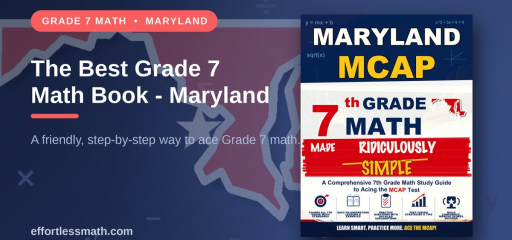
TL;DR: Maryland’s 7th grade math test is the MCAP (Maryland Comprehensive Assessment Program), aligned to the Maryland College and Career-Ready Standards (Common Core-based). The best 7th grade math book for Maryland students covers all five 7th grade Common Core strands with practice problems matched to MCAP item types.
Key takeaways:
- Maryland’s 7th grade math test is the MCAP.
- Aligned to Maryland College and Career-Ready Standards (Common Core-based).
- Topics: ratios and proportional relationships, rational-number operations, expressions and equations, geometry, statistics and probability.
- Pair a textbook with MCAP-style practice tests for the strongest preparation.
- Performance levels: Beginning, Developing, Proficient, Distinguished.
Maryland families tend to keep a close eye on math, and seventh grade is a smart year to look closely. It is the year math turns from arithmetic into real reasoning, and what a student builds here holds up Grade 8 math and Algebra 1 afterward.
Proportional thinking, fluent work with negative numbers, real equations, this is the seventh grade leap. The reassuring news is that a strong seventh grade year is within reach for every Maryland student. It is not about being a math prodigy. It is about understanding the material clearly, and a clear book makes that happen.
What seventh grade math covers in Maryland
Maryland teaches math through its College and Career Ready Standards, and seventh grade math is assessed each spring through the MCAP. The seventh grade course covers a full year of material: ratios and proportional relationships, operations with rational numbers including negatives, writing and solving equations and inequalities, geometry topics like scale drawings, angles, area, and volume, and an introduction to probability and statistics.
Much of that is new thinking, and it is the direct groundwork for Grade 8. When a Maryland seventh grader struggles, it is rarely about ability. It is usually that a new idea moved past them before it landed, and the next idea was built on the gap. Because these topics return again and again, closing the gaps now matters.
The book we recommend for Maryland seventh graders
For a Maryland student working through seventh grade math, the book we recommend is Maryland MCAP Grade 7 Math Made Ridiculously Simple.
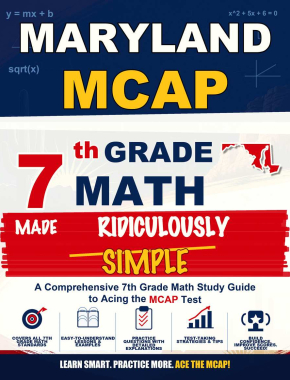
The book is built to make hard ideas feel reachable. Every topic opens with a clear, plain-language explanation. Then a worked example walks through each step with nothing skipped. Then the student practices, with answer keys for instant feedback. It is aligned to Maryland’s standards and the MCAP, and it deliberately builds the foundation Grade 8 math will draw on.
Because the explanations are complete, the book teaches the student directly, with no tutor required. That makes it a strong choice for homeschoolers, for summer catch-up, and for any student whose class has moved ahead of them.
How to study with it
The routine that makes the book pay off is short and steady:
- Short, regular sessions beat long, rare ones. Half an hour a few times a week is plenty.
- Use a pencil on every problem. Math is learned by doing it.
- Check answers as you go and study the misses. They show exactly what to practice next.
- Do not move on until a section feels easy. A weak spot left behind tends to resurface in Grade 8.
When seventh grade is done, Grade 8 math is next. Our guide to the best Grade 8 math book for Maryland students carries the same approach into the bridge year.
Questions Maryland families ask
How is seventh grade math tested in Maryland?
Seventh grade math is assessed each spring through the MCAP. The skills it checks lead directly into Grade 8 math and, beyond it, Algebra 1.
Why does seventh grade math matter so much?
It is the year math turns into reasoning. Proportions, rational numbers, and equations in seventh grade become the foundation of Grade 8 and high school math.
Can my child use this book without a tutor?
Yes. It was written to teach a student directly, with self-contained explanations and answer keys for instant feedback. It also works well alongside a tutor or a helping parent.
My child is capable but finds seventh grade math frustrating. Will this help?
Usually, yes. Capable students rarely need the math made easier. They need it explained more clearly and at a pace they can absorb.
The bottom line
Seventh grade math is the year math turns into reasoning, and in Maryland it sets up Grade 8 and everything after. Maryland MCAP Grade 7 Math Made Ridiculously Simple gives a student clear teaching and honest practice for the spring MCAP, plus a real foundation for Grade 8. Get this year right, and the math ahead gets steadily easier.
Frequently Asked Questions
What math do you take in 7th grade?
Most Maryland seventh graders take Grade 7 math, which follows the Maryland College and Career Ready Standards. Students who are ready may be placed in an accelerated course, such as a compacted 7/8 class or even Algebra 1, depending on the school system. Maryland’s 24 local school systems set their own course pathways, so ask your child’s school how placement decisions are made in your county.
What is covered in 7th grade math?
Seventh grade math in Maryland covers ratios and proportional relationships, operations with rational numbers, expressions and equations, geometry, and statistics and probability. Students find unit rates (for example, $3.60 for 4 pounds is $0.90 per pound), compute with negative numbers, solve multi-step equations, find circle area and circumference, and compare data from two samples. The spring MCAP math test checks these same strands.
Is 7th grade math pre-algebra?
In many ways, yes. Seventh grade math is built around pre-algebra ideas: variables, expressions, combining like terms, and solving equations and inequalities, and some schools even call the course Pre-Algebra. It also includes proportional reasoning, geometry and probability, so it is broader than a pure algebra class. Maryland students who finish 7th grade strong are well prepared for 8th grade math and Algebra 1.
How do you learn 7th grade math?
Take one topic at a time and practice it until it feels routine. Read a short explanation, follow a worked example step by step, then try 10 to 15 problems and check each answer. Keep a list of mistakes and redo those problems a few days later. For Maryland students, finishing with mixed MCAP-style practice helps connect each skill to the way it appears on the test.
How do you do algebra in 7th grade?
Undo the operations in reverse order. To solve 3x + 4 = 19, subtract 4 from both sides to get 3x = 15, then divide by 3 to get x = 5. Check by substituting: 3 × 5 + 4 = 19. Seventh graders also simplify expressions, such as 2(x + 6) − x = x + 12, and solve inequalities the same way, flipping the sign only when multiplying or dividing by a negative number.
Can a 7th grader take geometry?
It is unusual. A full Geometry course normally comes after Algebra 1, so most Maryland students take it in high school, and strongly accelerated students may reach it in 8th grade. Seventh grade math does include geometry topics, such as scale drawings, angle relationships, circle area and the volume of prisms. A rectangular prism measuring 4 cm by 5 cm by 6 cm, for example, has a volume of 120 cm³.
Related Lessons You May Like
- How to add and subtract integers
- How to solve proportional ratios
- How to solve percent of change
- How to solve one-step equations
- How to solve multi-step word problems
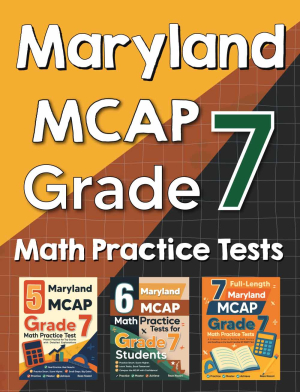
If you want a workbook for these questions, Mastering Grade 7 Math covers every Grade 7 standard. Mastering Grade 7 Math Word Problems adds word-problem practice.

Related to This Article
More math articles
- Division Dynamics: How to Solve Word Problems with Multi-digit Dividends and One-digit Divisors!”
- 8th Grade STAAR Math Worksheets: FREE & Printable
- Fourth Amendment
- VAT Calculator
- 10 Most Common TSI Math Questions
- FTCE Math FREE Sample Practice Questions
- 10 Most Common 4th Grade STAAR Math Questions
- Ratio, Proportion and Percentages Puzzle – Challenge 26
- Free Grade 7 English Worksheets for New Hampshire Students
- What Are the Applications of Inverse Trigonometric Functions?



What people say about "The Best Grade 7 Math Book for Maryland Students"?
No one replied yet.