Non-Mendelian Inheritance: Patterns and Worked Examples
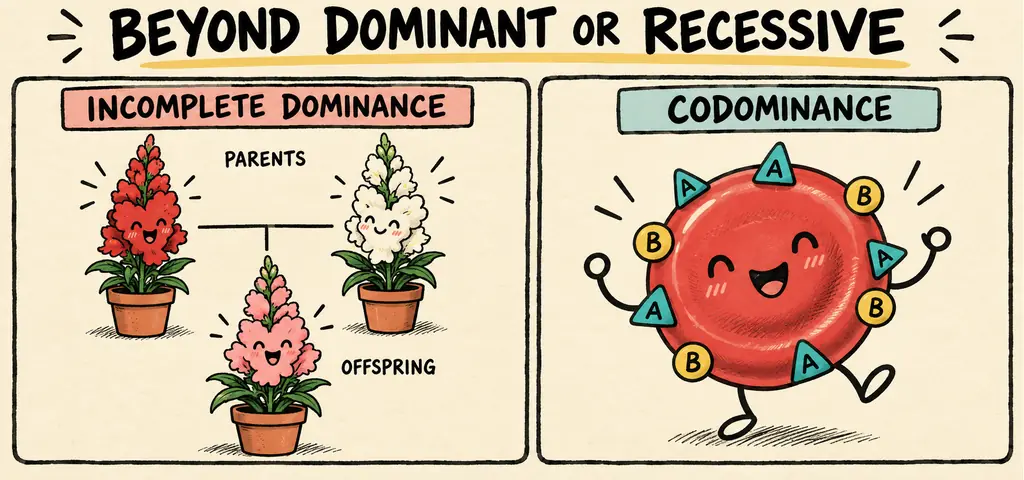
Non-Mendelian inheritance describes patterns beyond simple complete dominance. Incomplete dominance gives an intermediate heterozygote phenotype; codominance displays both allele products. Polygenic inheritance involves multiple genes, while epistasis describes an interaction between genes. Use the worked ABO and X-linked crosses below to connect genotypes with probabilities.
Try sorting everyone in a classroom into the two height categories Mendel used for his peas. Human height forms a continuous range, with most people near the middle. ABO blood types give a different pattern: A, B, AB, and O are discrete categories. To explain both, follow the route from inherited alleles to the phenotype. Some traits involve several genes, while others depend on how the products of two alleles appear in a heterozygote.
Watch the process
Incomplete Dominance, Codominance, Polygenic Traits, and Epistasis!
Mendel chose seven traits in one species that all behave as single genes with two alleles and complete dominance. Focusing on clear, contrasting phenotypes helped him identify the patterns. Most traits are less obliging. The patterns below are not exceptions to segregation; the ordinary chromosome-separation mechanism still applies, although recombination affects which chromatids carry particular alleles. They are variations in how a genotype gets expressed.
In incomplete dominance the heterozygote shows an intermediate phenotype. A red snapdragon crossed with a white one gives pink offspring, and crossing two pinks gives 1 red : 2 pink : 1 white. The genotype ratio is unchanged; what changed is that each genotype now has its own visible phenotype, so the phenotype ratio is 1:2:1 rather than 3:1. Nothing blended. Cross two pinks and red reappears, which is exactly what a blending model could not explain.
In codominance both allele products appear fully and separately in the heterozygote. The distinction from incomplete dominance is worth a moment: pink is one intermediate color, while an AB blood cell displays two distinct markers side by side.
Multiple alleles means a gene has more than two versions in the population, though an ordinary diploid individual has two allele copies at that locus. The ABO locus has three common alleles. \(I^{A}\) and \(I^{B}\) are codominant with each other and each is dominant to \(i\), so type A is \(I^{A}I^{A}\) or \(I^{A}i\), type AB is \(I^{A}I^{B}\), and type O is \(ii\).
Polygenic traits involve contributions from many genes. Additive effects combined with environmental variation often produce a nearly continuous range, although gene interactions and discrete outcomes are also possible. Human height and skin pigmentation work this way, and their bell-shaped distributions are what additive contributions from many loci look like. Pleiotropy is the reverse relationship: one gene affecting several apparently unrelated traits, as when a single allele alters hemoglobin, spleen function, and infection resistance together. A diagram can help: draw several gene arrows into one trait for polygeny, and several trait arrows from one gene for pleiotropy.
Epistasis occurs when one gene’s product masks or modifies the expression of a different gene. In Labrador retrievers, one gene determines whether pigment is black or brown, and a second gene determines whether pigment is deposited in the coat at all. A dog homozygous recessive at the second locus is yellow regardless of its alleles at the first. A dihybrid cross of two double heterozygotes then yields 9 black : 3 brown : 4 yellow instead of 9:3:3:1, because the two classes that would have been 3 and 1 collapse into one indistinguishable class of 4. A ratio such as 9:3:4 is consistent with a particular epistatic model when its assumptions hold. Merely expressing a ratio in sixteen parts does not establish epistasis or independent assortment.
Sex Linkage and the Environment
For X-linked loci outside regions shared with the Y chromosome, XY individuals generally carry only one allele copy. A recessive X-linked allele is expressed in an XY individual with no second copy to mask it, so X-linked recessive conditions such as red-green color blindness and hemophilia appear far more often in XY than in XX individuals. Trace the chromosomes rather than the labels: an XY father passes his X to every daughter and his Y to every son, so he cannot transmit an X-linked allele to a son. A heterozygous XX individual is a carrier: she has one copy of the recessive allele and is treated as unaffected in the simple fully penetrant model. In real X-linked conditions, X-inactivation can cause some heterozygotes to show signs. A heterozygous mother passes the allele with probability one-half to each child. When writing genotypes, write the chromosome as well as the allele, as in \(X^{H}X^{h}\), or you will lose track of which parent contributed what.
Extranuclear inheritance concerns genes in mitochondrial or chloroplast DNA rather than nuclear chromosomes. These organelles do contain their own genomes. In the usual human model, mitochondrial DNA comes from the egg, giving maternal inheritance; chloroplast inheritance can be maternal, paternal, or biparental depending on the plant species.
Do not equate inheriting mitochondrial DNA with always showing a trait. A mother may carry a mixture of mitochondrial DNA variants, called heteroplasmy, and offspring can inherit different proportions. Expression can depend on that proportion and tissue energy demands. A pedigree with transmission through mothers and not fathers supports mitochondrial inheritance, but affected mothers need not have all affected children. Follow any simplified transmission and expression assumptions supplied in a question.
Temperature, diet, and surrounding chemistry can also affect the phenotype produced by a genotype. For example, a temperature-sensitive enzyme can work differently in warm and cool tissues even though both tissues carry the same allele.
An ABO Cross Worked in Full
Use the standard three-allele ABO model, ignoring rare modifier loci or variants. A woman has type AB blood and a man has type O blood. Give the probability of each blood type among their children. Then explain why a type A woman and a type B man can have a type O child but this couple cannot.
Step 1: write the genotypes. Type AB has only one genotype, \(I^{A}I^{B}\), because the two alleles are codominant and both show. Type O has only one genotype, \(ii\), because \(i\) is recessive to both others and a single \(I^{A}\) or \(I^{B}\) would change the phenotype.
Step 2: list the gametes. The woman produces \(I^{A}\) and \(I^{B}\) in equal numbers, one from each homolog. The man produces only \(i\).
Step 3: combine. Every child receives \(i\) from the father. From the mother, half receive \(I^{A}\) and half receive \(I^{B}\). Each child therefore has a one-half probability of being \(I^{A}i\) and a one-half probability of being \(I^{B}i\).
Step 4: convert genotypes to phenotypes. \(I^{A}i\) is type A, since \(I^{A}\) is dominant to \(i\). \(I^{B}i\) is type B. No child is AB, because a child would need \(I^{A}\) and \(I^{B}\) from two different parents and the father has neither. No child is O, because every child receives an \(I^{A}\) or an \(I^{B}\) from the mother, and she has no \(i\) to give.
Step 5: answer the second question. A type A woman can be \(I^{A}i\) and a type B man can be \(I^{B}i\), so each can transmit a hidden \(i\), and \(\tfrac{1}{4}\) of their children are \(ii\) and type O. The AB woman has no hidden \(i\) at all. A type O child requires an available recessive allele from each parent.
Answer
One half type A and one half type B, with no AB and no O children. A type AB parent cannot produce a type O child with any partner, because AB carries no \(i\) allele.
An X-Linked Cross, Traced Chromosome by Chromosome
For this problem, use a fully penetrant X-linked recessive model of red-green color blindness, with no new mutations or chromosome abnormalities. A woman with normal vision whose father was color blind marries a man with normal vision. Give the probability that a son is color blind and the probability that a daughter is color blind.
Establish the woman’s genotype first, because the stem gives it to you indirectly. Her father was color blind, so his single X carried the recessive allele, written \(X^{c}\). A father gives his X to every daughter and his Y to every son. She therefore received \(X^{c}\) from him and, since she has normal vision, an \(X^{C}\) from her mother. She is \(X^{C}X^{c}\), a carrier.
Her husband has normal vision, so his X carries \(X^{C}\), and he is \(X^{C}Y\).
Now cross. Sons receive their single X from their mother, and she transmits \(X^{C}\) or \(X^{c}\) with equal probability, so half of the sons are \(X^{c}Y\) and color blind. Daughters receive \(X^{C}\) from their father without exception, so every daughter has at least one normal allele. Half are \(X^{C}X^{C}\) and half are \(X^{C}X^{c}\) carriers, and none is color blind.
Answer
A son has probability \(\tfrac{1}{2}\) of being color blind; a daughter has probability \(0\), though half the daughters are carriers. The asymmetry comes from the father transmitting an X to daughters only.
These patterns do not break segregation. They change how a genotype is displayed, or how many genes are involved.
One gene to one visible trait becomes one gene to several traits, several genes to one trait, or one gene overriding another.
Do not treat a non-9:3:3:1 dihybrid ratio as automatic evidence of linkage. A ratio such as 9:3:4 can reflect epistasis, but a sum of sixteen does not prove independent assortment. Check the stated cross, genotype-to-phenotype relationship, and evidence for linkage.
Read the Heterozygote Phenotype
Incomplete dominance and codominance produce different heterozygote phenotypes. An intermediate heterozygote phenotype illustrates incomplete dominance; the inherited alleles remain distinct. Two parental appearances present at once, side by side and separately identifiable, is codominance. Pink is an intermediate phenotype. Roan cattle with distinct red hairs and white hairs are not; the two colors are both there and you can point at each.
Polygenic inheritance and pleiotropy describe different relationships between genes and traits. Draw the arrows. Polygenic: many genes, one arrow each, all pointing at one trait, which can contribute to a continuous range. Pleiotropy: one gene, many arrows, pointing at several unrelated traits, which is why a single mutation can affect blood cells, spleen, and infection resistance at once. A bell-shaped distribution is consistent with polygenic inheritance, but its shape alone cannot prove how many genes are involved. If it describes one mutation with a list of unrelated symptoms, it is pleiotropy.
Reading a Modified Ratio
A cross between two double heterozygotes at independently assorting loci yields a ratio close to 9:3:4. Assume equal viability. Which genotype-to-phenotype model could explain the pattern?
Start with what the cross should have given. Two independently assorting genes with complete dominance predict 9:3:3:1 across sixteen parts. The observed ratio still totals sixteen parts and still contains a 9 and a 3, but the remaining 3 and 1 have merged into a single class of 4. In a recessive-epistasis model, one locus’s recessive homozygote masks the other locus, merging the 3/16 and 1/16 classes. This accounts for the observed pattern; the numerical total alone would not identify the mechanism.
Answer
Recessive epistasis is consistent with the pattern. Independent assortment is a supplied assumption, not a conclusion from the parts adding to sixteen.
Beyond simple dominance
Practice question 1
A type A parent and a type B parent have a child with type O blood. The parents’ genotypes must be
-
\(I^{A}I^{A}\) and \(I^{B}I^{B}\)
-
\(I^{A}i\) and \(I^{B}i\)
-
\(I^{A}I^{B}\) and \(ii\)
-
\(I^{A}i\) and \(ii\)
Practice question 2
Which observation distinguishes codominance from incomplete dominance?
-
the heterozygote shows a phenotype intermediate between the two homozygotes
-
the heterozygote displays both allele products distinctly rather than an intermediate
-
the genotype ratio of the offspring is 1:2:1
-
the trait is controlled by more than two alleles in the population
Practice question 3
A cross between two individuals heterozygous at two independently assorting loci gives a 9:3:4 phenotypic ratio. This result is best explained by
-
pleiotropy
-
linkage
-
epistasis
-
incomplete dominance
Practice answer key
1. B; 2. B; 3. C.
Practice answer explanations
-
Beyond simple dominance, Question 1. Choice B is correct. A type O child is \(ii\) and must receive an \(i\) allele from each parent, so the type A parent is \(I^{A}i\) and the type B parent is \(I^{B}i\). Choice A gives homozygous parents who have no \(i\) allele to contribute. Choice C describes type AB and type O parents, whose children are all type A or type B. Choice D lists a type O parent, but one of the parents is stated to be type B.
-
Beyond simple dominance, Question 2. Choice B is correct. Codominance shows both allele products distinctly and separately in the heterozygote, as the A and B markers both appear on a type AB cell. Choice A defines incomplete dominance, the pattern the question asks you to distinguish it from. Choice C names a genotype ratio that both patterns produce. Choice D describes multiple alleles, a separate idea about the population rather than about the heterozygote.
-
Beyond simple dominance, Question 3. Choice C is correct. Independent assortment is explicitly supplied. Recessive epistasis can merge two genotype groups into one phenotype: 9/16 show one phenotype, 3/16 a second, and the 3/16 plus 1/16 groups a third. The parts summing to sixteen does not prove independence. Choice A describes one gene affecting multiple traits. Choice B contradicts the supplied assortment model. Choice D concerns heterozygote expression at a locus, not the masking interaction producing 9:3:4.
Continue your review at the AP Biology study hub.

Related to This Article
More math articles
- Frequency Charts: How to Understanding Trends
- Ace the Math Subtests of the ASVAB Test
- Temperature, Humidity, and Airflow
- TExES Core Subjects EC-6 Math Flashcards
- Graph Points on a Coordinate Plane
- The Ultimate ISEE Upper Level Math Formula Cheat Sheet
- Free Grade 3 English Worksheets for Louisiana Students
- The Ultimate DAT Math Formula Cheat Sheet
- Triangle Calculator (Right Triangle & SSS Solver, with Diagram)
- The Best Grade 3 Math Book for Texas Students


What people say about "Non-Mendelian Inheritance: Patterns and Examples"?
No one replied yet.