Cancer and Cell-Cycle Control: Mutations and Checkpoints
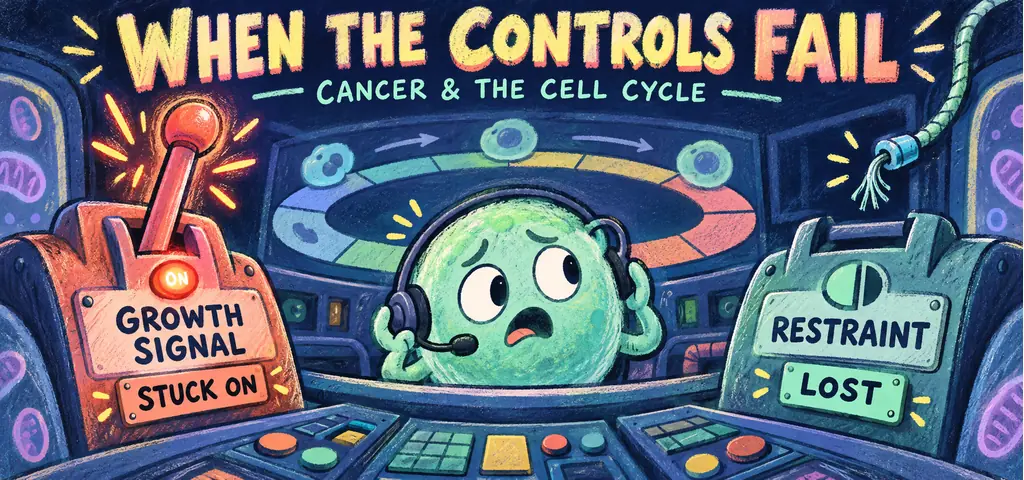
Cancer and cell-cycle control: Cancer can develop when mutations increase growth signals or weaken the controls that restrain division and remove damaged cells. Compare oncogenes, tumor-suppressor genes, and checkpoints, then use the worked predictions and three practice questions to test your reasoning.
Many normal animal cells grown on a suitable surface slow division as they become crowded. Some transformed cells continue proliferating and form layers. This comparison illustrates a loss of density-dependent growth control, not a universal culture behavior of every normal or cancer cell.
Watch the process
What is Cancer?
Cancer can involve both gains in growth-promoting activity and losses of restraint. Most cancers accumulate multiple changes that affect division, survival, and interactions with other tissues. A single abnormal pathway may contribute without being sufficient to produce a malignant tumor.
Classify a cancer-related mutation by the protein’s normal role and the way its activity changes. A proto-oncogene codes for a protein that promotes division, such as a growth-factor receptor or a relay protein in its pathway. A mutation that makes such a protein permanently active converts it to an oncogene. This is a gain-of-function change, and one activating allele can be sufficient to alter signaling, because the protein now signals whether or not the ligand is there. A receptor tyrosine kinase locked in the dimerized, phosphorylated state is the standard illustration: the cell behaves as if growth factor were bound at all times.
A tumor-suppressor gene codes for a protein that restrains division, such as p53 or a Cdk inhibitor. A mutation that destroys its function releases a brake, and because one working copy usually still applies that brake, both copies generally have to be disabled. p53 is mutated in roughly half of human cancers because it couples DNA-damage detection to both arrest and apoptosis, so losing it lets damaged cells divide and keeps them from being eliminated.
Normal cells also obey two contact-based limits. Density-dependent inhibition stops division when neighbors are crowded, and anchorage dependence requires attachment to a surface or extracellular matrix. Many transformed cells show reduced sensitivity to these limits, which is why they pile into layers in culture and why they can survive after breaking away from a tissue.
Reasoning about specific failures is the AP-level skill. Ask which control was lost and what that control was responsible for.
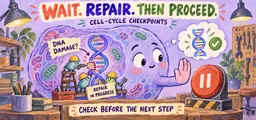
If the G\(_1\) checkpoint fails, cells enter S phase without adequate size, nutrients, growth signals, or DNA repair, increasing the chance that unrepaired lesions disrupt replication or produce mutations. If the G\(_2\) checkpoint fails, cells enter mitosis with incompletely replicated or unrepaired DNA, and chromosomes can break when the spindle pulls on them. If the spindle assembly checkpoint fails, anaphase begins before every kinetochore is attached, chromatids are distributed unevenly, and the daughter cells are aneuploid, carrying too many or too few copies of a chromosome. Loss of this attachment check increases the risk of unequal chromosome inheritance.
Two Mutations, Two Predictions
A tumor sample carries two mutations. The first leaves a growth-factor receptor permanently dimerized. The second disables both copies of the gene encoding p53. Predict the effect of each and explain why the combination is more dangerous than either alone.
Handle them separately. The receptor mutation is a gain of function in a proto-oncogene. A permanently dimerized RTK cross-phosphorylates without ligand, so the transduction pathway runs continuously, G\(_1\) cyclin is produced without a growth signal, and the restriction point is passed without the usual ligand input, provided other requirements for progression are met.
The p53 mutation is a loss of function in a tumor suppressor. Without p53, DNA damage no longer triggers Cdk inhibitor production, so p53-dependent arrest is impaired. Loss of its pro-apoptotic signaling also reduces one route for removing damaged cells; other arrest and death pathways can remain functional.
Now combine them. The first mutation increases the rate at which cells enter S phase, and every entry into S phase is an opportunity for a replication error. The second impairs p53-dependent arrest and apoptosis, reducing two safeguards against persistence of damaged cells. The combination allows inappropriate proliferation alongside weaker damage control. The size of the combined effect requires evidence; it cannot be calculated from the pathway description alone.
Answer
Continuous growth signaling can promote inappropriate entry into the cycle, while loss of p53 impairs p53-dependent arrest and apoptosis. Together these changes can permit proliferation with weaker damage control; other safeguards may remain.
Why Two Copies for One Gene and One for Another
Two genes are described. Gene M encodes a relay protein in a growth-factor pathway. Gene N encodes a Cdk inhibitor. In a survey of tumors, gene M is almost always found mutated in only one of its two copies, while gene N is almost always found damaged in both copies. Explain the pattern from what each protein does.
Start from what a mutation has to accomplish to matter. For the cell’s behavior to change, the mutation must alter the total activity in the cell, not merely alter one gene copy.
Gene M’s protein pushes the cycle forward. A mutation that makes it constitutively active, meaning active all the time whether or not a signal has arrived, adds a signal that was not there before. The normal copy keeps producing normal protein, but normal protein does not remove the abnormal signal; the two are simply present together, and the constant signal wins. One altered copy is therefore sufficient, in this example. Gain of function describes increased or altered activity; it does not mean that every such mutation is dominant or causes cancer by itself.
Gene N’s protein holds the cycle back. Damage one copy and the other still makes functional inhibitor, and inhibitor protein does its job wherever it is present. The brake is weakened but not released. Only when both copies are lost does inhibitor production stop and the restraint disappear. That is the two-hit model for this tumor suppressor, and it explains a fact about inherited cancer risk: a person who inherits one already-damaged copy of a tumor-suppressor gene needs only one further event in any cell to lose the brake there, which is why such families show cancer earlier and more often.
Answer
Gene M is a proto-oncogene, where one gain-of-function copy adds a signal the normal copy cannot cancel; gene N is a tumor suppressor, where the remaining normal copy keeps supplying the brake until it too is lost.
Review: When Cell-Cycle Control Fails
Cancer involves disrupted control of proliferation and survival, often through both activating changes and loss of restraining functions.
As controls are bypassed, cells can proliferate in situations that normally suppress division; they still depend on resources and cellular machinery.
Do not say cancer cells “divide faster.” Some divide no faster than normal cells of the same tissue. Defective responses to normal restraints, altered survival, and tissue interactions can all contribute.
Distinctions to keep clear
Faster is not the same as unregulated. Cells in your bone marrow and intestinal lining divide very fast and are entirely normal, because they divide in response to the signals and conditions that license division. A tumor cell may have a longer cycle than a normal intestinal crypt cell and still be malignant, because it divides without those conditions being met. Defective growth control can matter even when a cell’s cycle is relatively slow.
A mutation in a proto-oncogene is not a mutation in a tumor-suppressor gene, even though both promote cancer. Sort them by what the normal protein does and by what kind of mutation matters. Normal proto-oncogene protein promotes division, and the dangerous mutation is one that increases its activity. Normal tumor-suppressor protein restrains division, and the dangerous mutation is one that destroys its activity. If a stem says a protein is “permanently active,” you are in the first category; if it says a protein is “nonfunctional” or “both copies deleted,” you are in the second.
Loss of cell-cycle control
Practice question 1
A single mutation in one copy of a gene causes its protein to stimulate division continuously. This gene is best described as
-
a tumor-suppressor gene whose loss of function released a brake
-
a proto-oncogene converted to an oncogene by a gain of function
-
a gene whose product is a Cdk inhibitor
-
a gene required for apoptosis
Practice question 2
Cells with a nonfunctional spindle assembly checkpoint are most likely to produce daughter cells that
-
have an abnormal number of chromosomes, because anaphase began before all kinetochores were attached
-
have the correct chromosome number but broken chromosomes, because replication was left unfinished
-
are held in G\(_2\) until the misattached chromosome is repaired
-
have doubled their ploidy through an extra round of DNA replication
Practice question 3
Normal cells grown in a dish stop dividing once they form a single continuous layer, while cancer cells continue and pile up. The loss this observation demonstrates most directly is loss of
-
density-dependent inhibition
-
anchorage dependence
-
the G\(_2\) checkpoint
-
apoptosis after DNA damage
Practice answer key
1. B; 2. A; 3. A.
Practice answer explanations
-
Loss of cell-cycle control, Question 1. Choice B is correct. A single mutation that makes a division-promoting protein constitutively active is a gain of function that converts a proto-oncogene into an oncogene. Choice A describes the opposite category, where function is lost and a brake is released. Choice C names a protein that restrains the cycle, so a gain of its function would slow division. Choice D names a gene whose loss, not gain, contributes to cancer.
-
Loss of cell-cycle control, Question 2. Choice A is correct. Loss of the spindle checkpoint increases the risk of anaphase beginning before correct attachment, so unequal chromosome inheritance becomes more likely. Choice B concerns incomplete replication rather than the attachment check. Choice C proposes arrest at a different checkpoint without supporting evidence. Choice D requires an additional replication event not caused directly by the stated attachment-control defect.
-
Loss of cell-cycle control, Question 3. Choice A is correct. Density-dependent inhibition is the normal stop signal that crowding provides, and cancer cells that ignore it continue dividing into layers. Choice B names the other contact-based limit, the requirement for attachment to a surface, which is tested by asking whether cells can grow suspended in soft agar rather than by watching a dish fill up. Choice C would show up as division with damaged or incompletely replicated DNA, which crowding says nothing about. Choice D would show up as a failure to eliminate damaged cells, again not what a crowded dish reports.
Continue your review at the AP Biology study hub.

Related to This Article
More math articles
- DNA, Genes, and Chromosomes
- 5th Grade OST Math FREE Sample Practice Questions
- Propaganda, Wartime Civil Liberties, and Schenck
- Rates, Fertility, Mortality, and Reader-Friendly Calculations
- Cultivating a Love for Math: Parent’s Guide to Inspiring Passion
- OAR Math Worksheets: FREE & Printable
- Government, Politics, and Power
- How to choose the right laptop for online math teaching
- Multiply Two Fractions With an Area Model
- Seniority



What people say about "Cancer and Cell-Cycle Control: Mutations Explained"?
No one replied yet.