Mitosis and Cell-Cycle Data: Chromosome Counts and Examples
Mitosis and cell-cycle data: DNA replication makes sister chromatids during S phase; mitosis separates those copies into daughter nuclei. Track chromosome number separately from DNA content, and use phase counts to estimate duration only when the stated sampling assumptions allow it.
A cell about to divide has a distribution problem that is easy to underestimate. A typical diploid human cell begins with 46 chromosomes and roughly two meters of nuclear DNA. After S phase, it has twice that DNA length, organized into 46 replicated chromosomes. Two identical sets have to end up in two places, with no piece left out and no piece delivered twice, during a mitotic interval whose duration varies, inside a compartment whose contents are in constant thermal motion.
Watch the process
AP Biology: Cell Cycle; Mitosis – Investigation 7
Chromosomes condense, the spindle forms, and attachments connect sister chromatids to opposite poles before the sisters separate. Each event prepares for the next. Following those physical connections makes the sequence easier to explain.
Mitosis normally preserves chromosome number in each daughter nucleus. It occurs in both haploid and diploid life cycles. For example, one diploid parent nucleus, carrying two complete chromosome sets, produces two diploid daughter nuclei with matching genetic information apart from new mutations. A diploid cell’s chromosome number is written \(2n\), so a cell with \(2n = 6\) holds six chromosomes, three from each parent set. The daughters match because of S phase, not mitosis; the DNA was copied first, and mitosis hands out the copies.
1. Prophase: Replicated chromosomes condense and become visible as two sister chromatids joined at a centromere. The mitotic spindle begins to form from the centrosomes, which move toward opposite poles. During late prophase and prometaphase (often grouped in a simplified four-stage model), the nuclear envelope breaks down and spindle microtubules attach to kinetochores at the centromeres.
2. Metaphase: Chromosomes are moved to the metaphase plate, an imaginary plane midway between the poles, with each chromosome’s two kinetochores attached to microtubules from opposite poles. The spindle assembly checkpoint verifies those attachments here.
3. Anaphase: The connection between sister chromatids is cleaved, the chromatids separate, and each is pulled toward a pole. The instant they separate, each former chromatid counts as a full chromosome, so chromosome number transiently doubles in the one cell. Anaphase is often brief relative to chromosome alignment.
4. Telophase: Two nuclear envelopes reform, chromosomes decondense, and the spindle disassembles. Nuclear division is finished.
5. Cytokinesis: The cytoplasm divides. This overlaps telophase and is not technically part of mitosis, but it is what produces two separate cells.
Cytokinesis Differs by Cell Type, and the Cell Wall Is Why
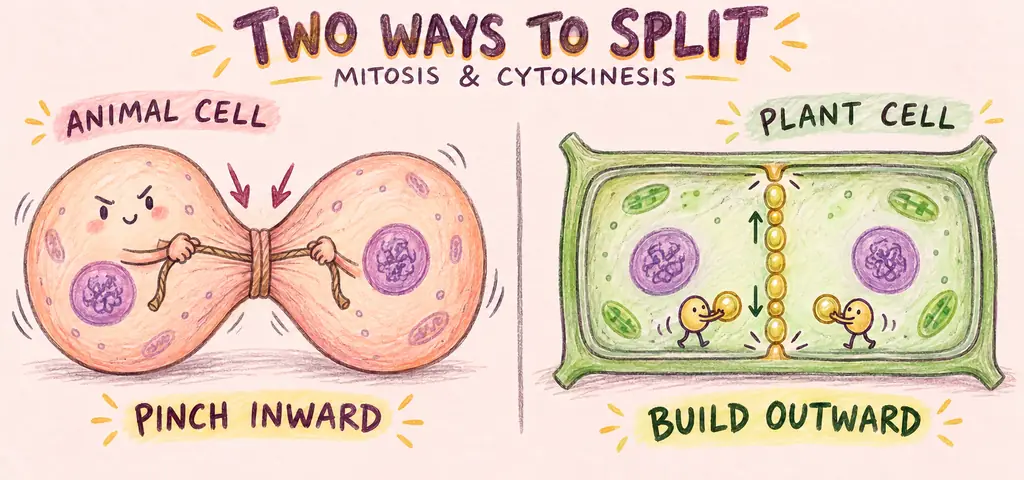
In an animal cell, a ring of actin and myosin filaments assembles just inside the plasma membrane at the former metaphase plate and contracts like a drawstring. The resulting indentation is the cleavage furrow, and it deepens until the cell is pinched in two.
A plant cell cannot be pinched, because a rigid cellulose wall surrounds it. Instead, Golgi-derived vesicles carrying cell-wall material migrate to the middle of the cell and fuse into a flattened, membrane-bounded structure called the cell plate. The plate grows outward until it fuses with the existing plasma membrane, and the wall material inside it becomes new cell wall between the two daughter cells. Building outward from the center rather than pinching inward from the edge is the structural consequence of having a wall.
Why the Order Cannot Be Rearranged
A student proposes a shortened mitosis: break down the nuclear envelope, separate the sister chromatids, then attach the spindle and move the chromatids to the poles. Explain, stage by stage, why this cannot work.
Ask what each real stage supplies to the stage after it. Attachment in prophase and metaphase supplies the physical connection between a chromatid and a specific pole. Separation in anaphase supplies free chromatids. In the real order, every chromatid is already connected to a pole before it becomes free to move.
Reverse those two and the connection is gone. Sister chromatids that separate before attachment are unattached objects in a crowded cytoplasm, without the verified attachment pattern needed for accurate segregation. There is no mechanism that later finds a loose chromatid, determines which pole its partner went to, and sends it the other way. Chromatids would be distributed at random, and with 46 chromosomes the probability that a random distribution gives both daughters a complete set is vanishingly small.
This also explains why the spindle assembly checkpoint sits exactly where it does. It is placed at the last moment before the irreversible step. Once the link between sister chromatids is cut, nothing can put it back, so verification has to happen before the cut, not after.
Answer
Attachment must precede separation because attachment is what determines a chromatid’s destination; separating first leaves chromatids with no directed way to reach a pole, and the checkpoint is placed before the irreversible cut for the same reason.
Chromosome and DNA Accounting
Chromosome counts depend on whether sister chromatids have separated. The useful counting convention is this: before sister chromatids separate, count each joined sister pair as one replicated chromosome. After separation, each former chromatid counts as an individual chromosome. The shorthand “count centromeres” refers to these chromosome units, not to counting the two copies of centromeric DNA within a joined pair.
Follow a diploid cell with \(2n=4\). In G\(_1\) it contains four unreplicated chromosomes and four double-stranded DNA molecules. After S phase, it still has four chromosomes, now made of eight chromatids and eight DNA molecules. Each sister has a centromere and kinetochore, but the joined pair remains one chromosome for this count. At anaphase, separation produces eight individual chromosomes in the still-undivided cell, with four moving toward each pole. After cytokinesis, each daughter has four chromosomes and four DNA molecules.
Ploidy describes the number of complete chromosome sets in a nucleus. DNA replication does not turn a diploid nucleus into a tetraploid one; it makes sister copies of each chromosome. Mitosis gives each daughter nucleus the original ploidy. At anaphase, state whether a question asks for the total in the undivided cell or the number at each pole. Homologous chromosomes are corresponding chromosomes from the two parental sets; their separation in meiosis I produces the reduction in ploidy that distinguishes meiosis I from mitosis.
Worked Data Interpretation: Timing the Phases
Cell counts can support estimates of phase duration under stated assumptions. The logic rests on one assumption stated in the stems: the sampled fraction in each phase approximates its fraction of total cycle time. This classroom approximation requires representative sampling of cycling cells and ignores differences in cell age frequencies, phase-specific death, and nondividing cells. A phase that lasts longer catches more cells.
Compute Phase Durations From a Cell Count
A student classifies 200 onion root-tip cells using microscopy and a DNA-labeling assay that distinguishes G\(_1\), S, and G\(_2\). Assume the sampled phase fractions approximate time fractions; an ordinary unlabelled slide cannot distinguish these three interphase stages reliably. The cell cycle length for this tissue has been measured independently as 20 hours. Determine how long the cell spends in each phase.
| Phase | Cells counted | Fraction | Duration (h) |
|---|---|---|---|
| G\(_1\) | 100 | 0.50 | 10.0 |
| S | 50 | 0.25 | 5.0 |
| G\(_2\) | 20 | 0.10 | 2.0 |
| M | 30 | 0.15 | 3.0 |
| Total | 200 | 1.00 | 20.0 |
Take the arithmetic one row at a time. The fraction for a phase is the count in that phase divided by the total number of cells scored: \[f_{\mathrm{G}_1} = \tfrac{100}{200} = 0.50, \quad f_{\mathrm{S}} = \tfrac{50}{200} = 0.25, \quad f_{\mathrm{G}_2} = \tfrac{20}{200} = 0.10, \quad f_{\mathrm{M}} = \tfrac{30}{200} = 0.15 .\] Multiply each fraction by the total cycle length to get the time spent in that phase: \[t_{\mathrm{G}_1} = 0.50 \times 20 = 10.0\ \text{h}, \quad t_{\mathrm{S}} = 0.25 \times 20 = 5.0\ \text{h}, \quad t_{\mathrm{G}_2} = 0.10 \times 20 = 2.0\ \text{h}, \quad t_{\mathrm{M}} = 0.15 \times 20 = 3.0\ \text{h}.\] Check the total: \(10.0 + 5.0 + 2.0 + 3.0 = 20.0\) hours, which matches the given cycle length. Always run that check, because it catches an arithmetic slip and a miscounted category at the same time.
The same method works one level down. Suppose the 30 M-phase cells break down as 18 prophase, 6 metaphase, 2 anaphase, and 4 telophase. Anaphase is then \(2/200 = 0.01\) of the cycle, or \(0.01 \times 20 = 0.2\) hours, about 12 minutes, while prophase is \(18/200 = 0.09\) of the cycle, or 1.8 hours. The ranking is the real result: prophase is by far the longest stage of mitosis and anaphase the shortest, for this sample. Actual stage durations vary with tissue and conditions.
Answer
G\(_1\) 10.0 h, S 5.0 h, G\(_2\) 2.0 h, M 3.0 h; the counts sum to the 20-hour cycle, and within M phase anaphase occupies about 0.2 h.
The reasoning runs backward too. If a treated root tip shows a much larger fraction of cells in M phase, a longer or blocked M phase is one possible explanation; increased entry into mitosis or changes in survival must also be considered. A phase proportion is not a total cell count or a completed-division rate.
Review: Mitosis, Cytokinesis, and Reading Cell-Cycle Data
Mitosis distributes copies that S phase already made, and it keeps chromosome number the same.
DNA content doubles during S phase, and each daughter receives half that replicated content. Normal mitosis preserves ploidy in the daughter nuclei.
Do not use “chromosome” and “chromatid” interchangeably. Before separation, count each joined sister pair as one replicated chromosome; after separation, count each former sister as one chromosome. Count DNA double helices for DNA molecules.
Distinctions to keep clear
Chromosome number versus DNA content. These change at different times. DNA content doubles during S phase, while chromosome number does not change at all, because the two sister chromatids remain joined and count as one replicated chromosome. Chromosome number doubles for a few minutes at anaphase, when the chromatids separate and each moves off with a centromere of its own, while DNA content does not change at that moment because nothing was copied. A graph of DNA per cell and a graph of chromosomes per cell across one cycle have their steps in different places, because replication and chromatid separation are different events.
Diploid versus replicated. A \(2n\) cell in G\(_2\) has twice the DNA of a \(2n\) cell in G\(_1\) and is still diploid. Doubling the DNA is not the same as doubling the ploidy. Ploidy counts complete chromosome sets. Normal mitosis preserves daughter-nucleus ploidy; meiosis I reduces it. Other events, such as fertilization or failed division, can also change ploidy.
Mitosis versus the cell cycle. Mitosis is one phase of the cycle, and it is the short one. When a stem says a drug “blocks the cell cycle,” find out where. For a drug acting specifically within mitosis, cells may still complete G\(_1\), S, and G\(_2\) normally and pile up at the point mitosis is blocked. The distinction shows up directly in the phase-count data these items are built from.
Mitosis, cytokinesis, and phase data
Practice question 1
A diploid cell with \(2n = 6\) is examined at metaphase of mitosis. The number of chromosomes and the number of DNA molecules present are
-
6 chromosomes, 6 DNA molecules
-
6 chromosomes, 12 DNA molecules
-
12 chromosomes, 12 DNA molecules
-
3 chromosomes, 6 DNA molecules
Practice question 2
Cytokinesis in a plant cell proceeds by cell-plate formation rather than by a cleavage furrow because
-
plant cells have no actin or myosin filaments to contract
-
plant cells finish mitosis without assembling a spindle
-
plant chromatids separate during telophase rather than during anaphase
-
a rigid cell wall cannot be pinched inward, so new wall is built outward from the center
Practice question 3
In a population of 400 cycling cells with a 16-hour cycle, 40 cells are in M phase. Assume the sampled phase fraction approximates its time fraction. The approximate duration of M phase is
-
0.4 hour
-
1.6 hours
-
4.0 hours
-
6.4 hours
Practice answer key
1. B; 2. D; 3. B.
Practice answer explanations
-
Mitosis, cytokinesis, and phase data, Question 1. Choice B is correct. At metaphase, each joined sister pair counts as one replicated chromosome. Six such chromosomes contain twelve chromatids, each with one double-stranded DNA molecule. Choice A omits the DNA replication. Choice C counts each still-joined sister as a separate chromosome. Choice D applies a meiotic reduction to mitosis.
-
Mitosis, cytokinesis, and phase data, Question 2. Choice D is correct. A rigid cell wall makes inward pinching impossible, so plant cells build new membrane and wall outward from the center as a cell plate. Choice A overstates the difference; plant cells have actin, they simply cannot pinch through a wall. Choice B is false, since plant mitosis uses a spindle. Choice C misstates when chromatids separate, which is anaphase in both cell types.
-
Mitosis, cytokinesis, and phase data, Question 3. Choice B is correct. The fraction in M phase is \(40/400 = 0.10\), and \(0.10 \times 16 = 1.6\) hours. Choice A divides rather than multiplies somewhere in the chain. Choice C uses a fraction of 0.25, which the counts do not support. Choice D applies the fraction to the wrong quantity entirely.
Continue your review at the AP Biology study hub.

Related to This Article
More math articles
- How to Multiply and Divide Complex Numbers in Polar Form?
- 10 Most Common 4th Grade Common Core Math Questions
- Top 10 6th Grade MEAP Math Practice Questions
- The Best Grade 3 Math Book for New Jersey Students
- Free Grade 4 English Worksheets for Texas Students
- Front-loading
- The Ultimate CLEP Calculus Course: A Comprehensive Review
- How to Factor and Simplify Trigonometric Expressions
- How to Complete a Graph and Table Linear Function
- Accuplacer Math FREE Sample Practice Questions






What people say about "Mitosis and Cell-Cycle Data: Counts and Examples"?
No one replied yet.