Cell Signaling: Reception, Transduction and Response
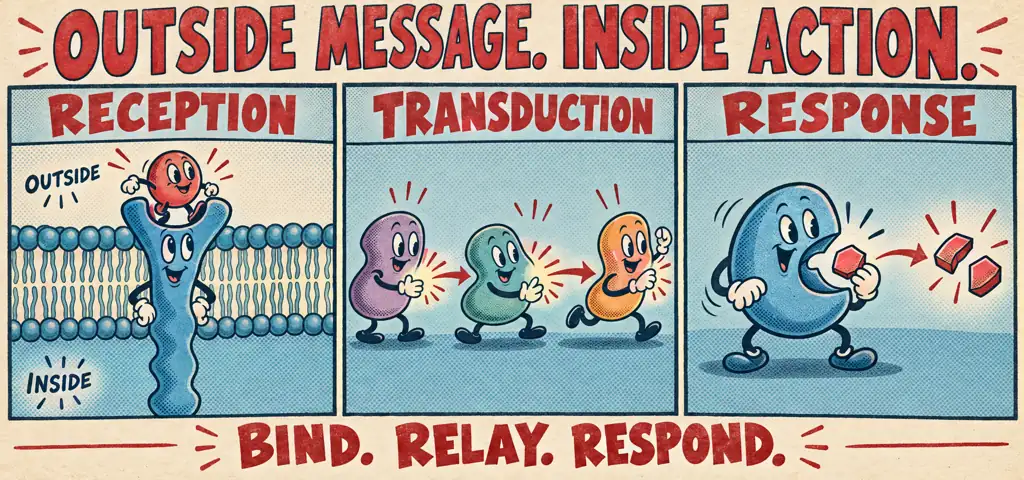
Cell signaling can be followed in three stages: reception detects a signal at a receptor; transduction relays information through molecular changes; response is the resulting change in cell activity. Distinguish the movement of information from the movement of the ligand itself.
In a pathway diagram, an arrow usually means that one component changes the activity of another. It does not mean the ligand physically travels through every protein in the chain. Name what moves: a ligand may remain outside while an intracellular protein changes shape or a second messenger spreads inside.
Watch the process
Signal Transduction Pathways
For a typical water-soluble hormone acting through a surface receptor, signaling can begin while the ligand remains outside the cell. Binding changes the receptor and starts events inside. Some receptor-ligand complexes are later internalized by endocytosis, so “signals never enter cells” is not a general rule. The key is that surface reception can transmit information across the membrane without transporting the ligand through the bilayer.
Reception, transduction, and response provide a useful framework for following a signaling pathway.
Reception is the binding of the ligand to its receptor. Binding is noncovalent and reversible, and it changes the receptor’s shape. For a surface receptor, this change initiates the internal relay. Intracellular receptors instead bind ligands that have already entered the cell.
Signal transduction is the conversion of that shape change into a series of molecular events inside the cell. Transduction is usually a multi-step relay, and each step converts information from one form into another: a shape change into an enzyme activity, an enzyme activity into a small-molecule concentration, a concentration into another enzyme activity.
Cellular response is what the cell does. A cytoplasmic response changes the activity of proteins already present, such as the enzyme that breaks down glycogen, and can begin within seconds. A nuclear response changes which genes are transcribed; effects requiring newly made proteins usually take longer. Either receptor location can lead to changes in gene expression.
Membrane Receptor Mechanisms
Many extracellular signals are hydrophilic and do not readily cross the bilayer by simple diffusion. Surface receptors let cells respond to them through an extracellular binding site connected to intracellular signaling machinery.
A G protein-coupled receptor, or GPCR, threads through the membrane and associates on the inside face with a G protein, a switch protein that is on when it holds GTP and off when it holds GDP. (GTP and GDP are built exactly like ATP and ADP but carry the base guanine in place of adenine; the important signaling distinction is that GTP binding favors the active switch conformation, whereas GDP binding favors the inactive conformation in this model.) The resting G protein holds GDP and is inactive. Ligand binding changes the receptor’s shape, the G protein exchanges GDP for GTP, and G-protein subunits can regulate a nearby enzyme or ion channel, depending on the pathway. The G protein then hydrolyzes its own GTP back to GDP and shuts itself off, an inactivation mechanism; the overall response also depends on other pathway components. GPCRs are the largest receptor family in your genome.
A receptor tyrosine kinase, or RTK, works differently and can start several pathways at once. A protein kinase is an enzyme that transfers a phosphate group from ATP onto a target protein, and attaching that phosphate changes the target protein’s shape and activity. In a common RTK model, each receptor monomer is a transmembrane polypeptide with a ligand-binding region outside and a kinase region inside that adds phosphates specifically to the amino acid tyrosine. Ligand binding causes two receptor monomers to associate into a dimer. Once paired, each half phosphorylates tyrosines on the other half, a step called cross-phosphorylation. The resulting cluster of phosphotyrosines is a docking platform: several different relay proteins recognize it and bind, each launching its own pathway. One ligand binding event can therefore trigger multiple responses from a single receptor complex. Many growth-factor receptors are RTKs. The insulin receptor is also an RTK, but its subunits are associated before insulin binds; ligand-induced dimerization is not universal. Activating changes in RTK pathways can contribute to cancer.
A third membrane type, the ligand-gated ion channel, opens a pore when its ligand binds and lets a specific ion flood down its gradient. This can produce a very rapid response. Some synapses use ligand-gated channels, while others use receptors such as GPCRs.
Intracellular Receptors for Nonpolar Signals
In the classical steroid pathway, a lipid-soluble hormone crosses the membrane and binds a receptor in the cytoplasm or nucleus. The activated receptor regulates specific DNA sequences as a transcription factor, a protein that changes transcription of particular genes. Thyroid hormones also act through nuclear receptors, but their entry into cells involves membrane transport proteins.
Making new proteins takes time, and those proteins may persist after a signal ends. However, intracellular signaling is not always slow: nitric oxide diffuses into cells and can rapidly activate an intracellular enzyme. Surface receptors can also initiate transcriptional responses. Use the mechanism supplied in a question, not receptor location alone, to predict timing.
Deciding Where a Receptor Must Be
Hormone P is a small nonpolar steroid that changes transcription through its classical receptor. Hormone Q is a charged peptide that activates a pre-existing cytoplasmic enzyme. Predict the likely receptor location for each and explain which response can begin sooner.
P can cross the bilayer and bind an intracellular receptor that regulates transcription. If its measured response requires a newly synthesized protein, transcription and translation must occur before that response appears.
Q does not readily diffuse through the lipid core. A surface receptor can relay its signal to the existing enzyme, allowing a faster response without waiting for protein synthesis.
The duration of either response also depends on ligand removal, inactivation of signaling components, and protein turnover. A response that lasts hours is not enough evidence, by itself, to identify an intracellular receptor.
Answer
P most likely uses an intracellular receptor and Q a surface receptor. Q can act sooner in this setup because it modifies an existing enzyme; P’s new-protein response requires gene expression.
Second Messengers and Cascades
A second messenger is a small non-protein molecule or ion that relays a signal inside a cell, either in the cytosol or within a membrane. In this surface-receptor pathway, the extracellular ligand is the first messenger. Cyclic AMP and calcium are two widely used second messengers.
Cyclic AMP is made from ATP by the membrane enzyme adenylyl cyclase, which a G protein activates. Cyclic AMP diffuses through the cytosol and activates protein kinase A, which phosphorylates target proteins. A second enzyme, phosphodiesterase, converts cyclic AMP back to AMP, so the messenger disappears when its production stops.
Calcium ions are the other. Cytosolic calcium is normally held very low, often thousands of times lower than outside the cell or within ER stores, by transport systems that remove calcium from the cytosol. Because the gradient is steep and already built, opening a calcium channel can rapidly raise cytosolic calcium as ions move down their electrochemical gradient. Transport systems use energy to maintain or restore the gradient. Muscle contraction, neurotransmitter release, and fertilization all use this switch.
A phosphorylation cascade connects the second messenger to the response. A protein kinase transfers a phosphate group from ATP to a target protein, and the added negative charge changes that protein’s shape and therefore its activity; most kinases in a cascade phosphorylate the next kinase in line. A protein phosphatase removes a phosphate group. Phosphorylation and dephosphorylation allow reversible regulation, but either can increase or decrease activity depending on the target protein.
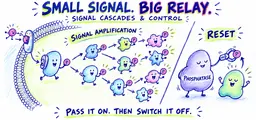
Cascades can amplify a signal and provide several points for regulation. One activated receptor can activate many G proteins; each activated enzyme makes many second-messenger molecules; each kinase phosphorylates many substrates. Multiply the branching factors and the numbers get large fast.
Count the Amplification
In a hypothetical liver-cell pathway model, one epinephrine molecule binds one receptor. That receptor activates 20 G proteins, and each activated G protein activates one molecule of adenylyl cyclase. Each activated adenylyl cyclase produces 100 molecules of cyclic AMP. For this simplified count, four cyclic AMP molecules bind one inactive protein kinase A complex and release two active catalytic subunits. Each catalytic subunit activates 50 distinct molecules of the next enzyme. Assume adequate ATP and substrate, no overlapping target counts, and negligible signal termination during the interval. Estimate how many molecules of that final enzyme are activated by the single binding event, and state what the number shows.
Work outward one step at a time, and notice that three of the four steps multiply while one divides, because the stated binding ratio is two messenger molecules per released catalytic subunit. Cyclic AMP is bound, not consumed by this activation step. \[1 \times 20 = 20 \text{ G proteins}, \qquad 20 \times 1 = 20 \text{ adenylyl cyclase molecules}\] \[20 \times 100 = 2000 \text{ cyclic AMP}, \qquad \frac{2000}{2} = 1000 \text{ kinase subunits}\] \[1000 \times 50 = 50{,}000 \text{ enzyme molecules}\] One binding event has changed the activity of fifty thousand enzyme molecules. The model illustrates how one input can produce many outputs. It does not establish a particular hormone concentration or response size in a living cell; binding, compartment volumes, signal duration and substrate limits also matter. A permanently active relay protein can sustain downstream signaling, depending on the pathway and its other controls.
Answer
About \(5 \times 10^4\) final enzyme molecules per receptor binding event; amplification is what lets a very dilute signal produce a large response.
Review: Reception, Transduction, and Response
Reception, transduction, and response are three separate conversions, and the message changes physical form at each one.
In a linear pathway with no alternate route or feedback, blocking one required conversion leaves upstream steps functional but prevents the downstream response.
Distinguish a ligand crossing the lipid bilayer from a surface receptor transmitting its signal. Follow any transport or endocytosis route actually provided in the question.
Distinctions to keep clear
First messenger and second messenger identify different molecules in a signaling pathway. The first messenger is the ligand outside the cell. The second messenger is a small, non-protein molecule or ion made, released, or redistributed inside the cell as a result of reception. Cyclic AMP is a second messenger. Epinephrine is not, no matter how many steps come after it. A G protein is also not a second messenger, because it is a protein relay, rather than a small non-protein messenger.
Receptors and transporters perform different functions. A receptor detects a ligand and initiates a response; a transporter moves a substance across a membrane. These functions can be connected but are not identical. For example, a ligand-gated ion channel binds a neurotransmitter and allows particular ions to cross. The bound neurotransmitter is not the ion moving through the pore.
Memory Hook: R-T-R and the Three Questions
Use three questions to trace a signaling pathway. Reception: did the ligand bind a receptor, and where is that receptor? Transduction: what relay carried the message, and did it amplify? Response: did the cell change an existing protein’s activity, or change which genes it transcribes? If a stem describes a defect, decide which of the three letters broke. Trace the connections shown. In a simple linear model, a block prevents downstream activation; branches and feedback can modify this prediction.
Receptors, transduction, and amplification
Practice question 1
A nonpolar steroid hormone produces a change in gene transcription in its target cell. The receptor for this hormone is most likely
-
a ligand-gated ion channel that opens when the hormone binds it
-
a G protein-coupled receptor spanning the plasma membrane
-
an intracellular protein whose hormone-bound complex acts as a transcription factor
-
a membrane transporter that carries the hormone into the cytosol
Practice question 2
A drug blocks the enzyme phosphodiesterase, which converts cyclic AMP to AMP. In a cell whose pathway uses cyclic AMP, the drug would most likely
-
prevent the ligand from binding its receptor
-
prolong the cellular response after the ligand is gone, because the second messenger is not cleared
-
prevent adenylyl cyclase from producing cyclic AMP
-
convert the pathway from a cytoplasmic response to a nuclear response
Practice question 3
An RTK normally requires ligand-induced dimerization. A mutation prevents it from forming dimers but leaves the ligand-binding site and the kinase region intact. The most direct consequence is that
-
ligand affinity is necessarily lost, even though the binding site remains intact
-
the unpaired kinase regions cross-phosphorylate normally, but relay proteins cannot enter the nucleus
-
ligand binding alone creates the phosphorylated docking sites without receptor association
-
the receptor halves cannot cross-phosphorylate normally, so phosphorylated docking sites fail to form
Practice answer key
1. C; 2. B; 3. D.
Practice answer explanations
-
Receptors, transduction, and amplification, Question 1. Choice C is correct. A classical steroid receptor is an intracellular transcription regulator. Surface receptors can also affect transcription, but the steroid identity makes C the best-supported mechanism here. Choice A requires ion-channel opening, which the stem does not establish. Choice B proposes a different receptor pathway. Choice D describes transport without the receptor-dependent regulation needed to explain the response.
-
Receptors, transduction, and amplification, Question 2. Choice B is correct. Phosphodiesterase is the enzyme that clears cyclic AMP, so blocking it leaves the second messenger elevated and the response continues after the ligand is gone. Choice A confuses termination of the signal with reception, which the drug does not touch. Choice C names the enzyme that makes cyclic AMP rather than the one that removes it. Choice D changes the class of response, which the concentration of a second messenger does not do.
-
Receptors, transduction, and amplification, Question 3. Choice D is correct. This receptor is explicitly described as requiring ligand-induced dimerization. Preventing association disrupts cross-phosphorylation and formation of relay-protein docking sites. Choice A adds a binding defect not established by the mutation. Choice B assumes normal cross-phosphorylation despite the missing association. Choice C skips the phosphorylation step: binding alone is not the docking platform.
Continue your review at the AP Biology study hub.

Related to This Article
More math articles
- Free Grade 4 English Worksheets for Vermont Students
- The Best Grade 5 ELA Practice Tests for Iowa Students
- New Jersey NJSLA Grade 4 Math Free Worksheets: Free Printable Worksheets Covering Every Skill
- Constant Rate of Change: Meaning, Formula and Examples
- 5th Grade FSA Math FREE Sample Practice Questions
- Maine Algebra 1 Free Worksheets: Printable Algebra 1 Practice for Every Skill
- Informal presidential powers
- What Kind of Math Is Taught in 8th Grade?
- The Illinois IAR Grade 5 Math Worksheet Pack — 49 Free Printable Pages with Solutions
- Choosing Bitcoin Casino Games: Dice, Slots, Live Dealer and What Fits Different Session Goals




What people say about "Cell Signaling: Reception, Transduction and Response"?
No one replied yet.