Propaganda, Wartime Civil Liberties, and Schenck
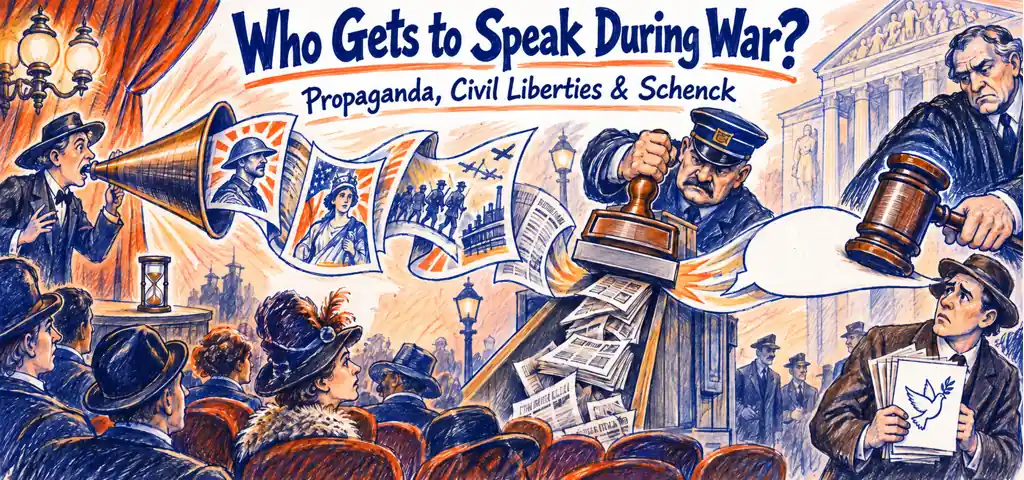
Chapter 7 of the CLEP History of the United States II study guide on Effortless Math covers Propaganda, Wartime Civil Liberties, and Schenck: the key terms, the core ideas, and worked examples showing how this topic is tested on the exam.
CLEP History of the United States II, Chapter 7
Persuasion and punishment were different instruments
The Wilson administration sought both enthusiastic participation and enforced compliance. George Creel's Committee on Public Information produced posters, pamphlets, films, news releases, and foreign-language material. Volunteer Four Minute Men delivered brief speeches in theaters. Congress separately enacted criminal and postal restrictions. Propaganda tried to shape belief and behavior through repeated stories, symbols, and social pressure; prosecution used law to punish defined conduct or expression. Both narrowed the space for dissent, but they did so through different institutions.
The CPI sold a democratic war
CPI material depicted American intervention as defense of democracy against militarism. It publicized bond drives, enlistment, conservation, and Allied suffering. Creel called the work publicity rather than propaganda, emphasizing factual persuasion, but the committee selected information and used emotionally charged images. Its vast distribution network made government a national news producer. The agency did not formally censor every newspaper; editors often cooperated voluntarily while other laws and postal powers created stronger pressure.
The Espionage Act targeted wartime interference
The Espionage Act of June 1917 punished interference with military operations, efforts to cause insubordination, and obstruction of recruitment or enlistment. It also authorized exclusion of prohibited material from the mails. Prosecutors used broad language against antiwar speakers, socialist publications, and draft opponents. The statute did not criminalize every criticism in identical terms, but wartime judges often deferred to government claims that expression threatened mobilization. Postal denial could suppress circulation without a conventional criminal trial.
The Sedition amendment widened speech offenses
The Sedition amendment of May 16, 1918, punished disloyal, profane, scurrilous, or abusive language about the government, Constitution, flag, or armed forces. It also reached words intended to obstruct bond sales or promote the enemy's cause. Keep the home-front sequence clear: the Espionage Act on June 15, 1917; Lever Food and Fuel Control Act on August 10; Trading with the Enemy Act on October 6; and Sedition amendment the following May. Congress repealed the amendment in December 1920, while the formal legal state of war continued into 1921. Repeal was a legislative policy choice, not an automatic result of battlefield fighting ending.
Schenck announced contextual danger
Charles Schenck and Elizabeth Baer distributed leaflets arguing that the draft violated the Thirteenth Amendment and urging peaceful resistance. In March 1919 the Supreme Court unanimously upheld their Espionage Act convictions. Justice Oliver Wendell Holmes wrote that speech protection depends on circumstances and asked whether words create a clear and present danger of substantive evils Congress may prevent. His famous false-fire analogy illustrated context. The decision did not establish the later, more protective imminent-lawless-action test.
Debs made prosecution politically visible
Socialist leader Eugene V. Debs praised imprisoned draft resisters in a June 1918 speech at Canton, Ohio. Convicted under the Espionage Act, he received a ten-year sentence. The Supreme Court affirmed, treating his words in context as intended to obstruct recruitment. Debs campaigned for president from prison in 1920 and received more than 900,000 votes. President Warren Harding commuted his sentence in December 1921. The sequence shows judicial approval, electoral dissent, and later executive mercy without a finding that the conviction had been unlawful.
Abrams exposed disagreement inside the Court
In Abrams v. United States (1919), Russian Jewish immigrants had scattered leaflets condemning American intervention in Russia and urging workers to resist war production. The Court upheld convictions under the Sedition amendment. Holmes, joined by Louis Brandeis, dissented, demanding an immediate danger and arguing that ideas should compete in a market unless they imminently threaten lawful aims. Holmes's position was more speech-protective than his application in Schenck, though it did not become the majority rule in 1919.
German Americans faced cultural coercion
States and communities restricted German-language instruction, orchestras altered programs, sauerkraut acquired a patriotic name, and mobs harassed people suspected of disloyalty. Some German-language newspapers lost mailing access. Congress did not revoke naturalized citizenship from German-born Americans as a class. The pressure came from a mix of law, school policy, employment rules, commercial conformity, vigilantism, and propaganda. Distinguishing those mechanisms prevents exaggerating federal statutory action while still recognizing broad coercion.
Suffrage pickets tested democratic claims
Alice Paul's National Woman's Party began picketing the White House in January 1917 and continued after entry. Officials arrested picketers on traffic charges; many were confined at the Occoquan workhouse, where guards used violence and officials force-fed hunger strikers. The women compared Wilson's language of democracy abroad with political exclusion at home. Their repression did not arise under the Espionage Act, but it belongs in the same civil-liberties history because ordinary police power could suppress conspicuous wartime dissent.
Postal power could operate as censorship
Postmaster General Albert Burleson revoked the second-class mailing privileges of publications he deemed disloyal, including the socialist Milwaukee Leader. In 1921 the Supreme Court upheld that action over dissents by Holmes and Brandeis. The mechanism mattered because cheap postal rates were essential to mass circulation. A government need not ban every copy to weaken a newspaper; denying the distribution infrastructure could accomplish much of the same practical suppression.
The doctrine changed after the war
Gitlow v. New York (1925) upheld a criminal-anarchy conviction but accepted that freedom of speech and press were liberties protected from state infringement through the Fourteenth Amendment. Decades later, Brandenburg v. Ohio (1969) permitted punishment of advocacy only when it is directed to inciting imminent lawless action and likely to produce it. That later test is narrower than Schenck's wartime danger analysis. Constitutional protection developed through changing doctrine, dissents, and incorporation.
O'Brien and Tinker test different government claims
In United States v. O'Brien (1968), the Court upheld punishment for burning a draft card because the registration-certificate law served a substantial governmental interest in administering the draft that was unrelated to suppressing O'Brien's message, and the incidental burden on expression was no greater than essential. In Tinker v. Des Moines (1969), the Court protected students wearing black armbands because school officials showed no material and substantial disruption; undifferentiated fear of disturbance was insufficient. O'Brien addresses regulation of conduct with an expressive element, while Tinker asks whether student expression materially disrupts school operations.
Conscientious objection also changed
The First World War draft recognized members of certain pacifist religious groups, but men refusing every military role could face court-martial, imprisonment, and abuse. The 1940 Selective Training and Service Act later allowed qualifying conscientious objectors opposed to all war to perform civilian work of national importance. The comparison does not mean the Second World War eliminated coercion. It shows that a later statute created a civilian alternative absent from the earlier system.
identify the channel of control
A poster urges bond purchase, a postmaster blocks a newspaper's cheap mailing rate, and police arrest a picketer for obstructing traffic.
Civil-liberties analysis requires context and precision
Wartime fear made officials treat criticism as practical assistance to the enemy. Some expression did intersect with draft resistance; much was political disagreement. Courts initially granted government wide room, while later doctrine demanded a closer link between advocacy, imminence, and likely unlawful action. A sound judgment neither assumes that every prosecution was identical nor lets patriotic purpose end the inquiry. It traces text, intent, audience, institutional power, and the danger the government claimed.
Wartime conscription survived a constitutional challenge
In the Selective Draft Law Cases (1918), the Supreme Court upheld the 1917 draft. The Court rejected claims that compulsory military service violated the Thirteenth Amendment or exceeded national power. Congress could raise armies, and citizenship carried obligations as well as rights. This holding concerns federal conscription during World War I; it is different from later disputes over who had to register or whether women could be excluded.
Watch the history in motion
This short lesson adds voices, images, and chronology to the ideas you just studied.
Video: Schenck v. United States | BRI's Homework Help Series, Bill of Rights Institute.
Try four CLEP-style questions
- What distinction best explains why a Four Minute Man and a postal official could advance the same war effort without exercising the same power?
- Both acted as municipal police officers enforcing traffic and assembly ordinances.
- The speaker prosecuted draft resisters, while the postmaster designed theatrical propaganda posters.
- Both imposed criminal sentences on dissenters after individualized federal jury trials.
- The speaker persuaded audiences; the postal official could restrict publication distribution.
- The postmaster encouraged antiwar debate, while the speaker revoked second-class mailing privileges.
- What does the December 1920 repeal of the Sedition amendment, before the United States' legal state of war ended in 1921, demonstrate?
- The armistice had already terminated the federal speech rule even while it remained in the statute book.
- Federal courts invalidated the speech rule before Congress formally removed it.
- Repeal followed the legal termination of war and removed language that had already expired.
- Congress converted the wartime speech offenses into permanent immigration law without changing their scope.
- Congress withdrew the speech rule before the formal legal end of war.
- The imprisonment of White House picketers and the conviction of Debs most strongly support which common conclusion?
- Wartime dissent was restricted only through federal espionage prosecutions.
- Traffic law supplied broader prison sentences than the Espionage Act in every case.
- Suffrage advocacy and socialism became legally identical organizations.
- Different legal channels could punish challenges to the administration's democratic wartime narrative.
- Executive clemency prevented either episode from limiting expression.
- Which comparison best captures the two-stage doctrinal change from wartime cases through Gitlow to Brandenburg?
- Federal speech protection disappeared as state governments gained exclusive prosecution authority.
- Postal licensing became the governing constitutional test for every state speech prosecution.
- Speech protection reached states, while later doctrine required likely imminent lawlessness.
- The federal Sedition Act's abusive-language standard became mandatory law in every state.
- Incorporation expanded state prosecution while making imminence irrelevant to punishable advocacy.
Check your answers and reasoning
Independent preparation. CLEP is a registered trademark of the College Board, which does not endorse this lesson.

Related to This Article
More math articles
- Career Development, Certification, and Continuing Education
- The Best Grade 2 English Worksheets for Massachusetts Kids
- Exit polls
- Maryland Algebra 1 Free Worksheets: 65 Free Printable Algebra 1 Worksheets with Worked Answers
- How to Compare Money Amounts
- Free Maine MTYA Grade 3 Math Worksheets: 49 Printable PDFs with Friendly Answer Keys
- Volume of Pyramids: Complete Guide with Video and Examples
- Vises and Clamps: Holding Work Safely
- CLEP U.S. History I 098: Emancipation as Policy and Process
- Donating money














What people say about "Propaganda, Civil Liberties, and Schenck"?
No one replied yet.