The Great Migration, Black Soldiers, and the Red Summer
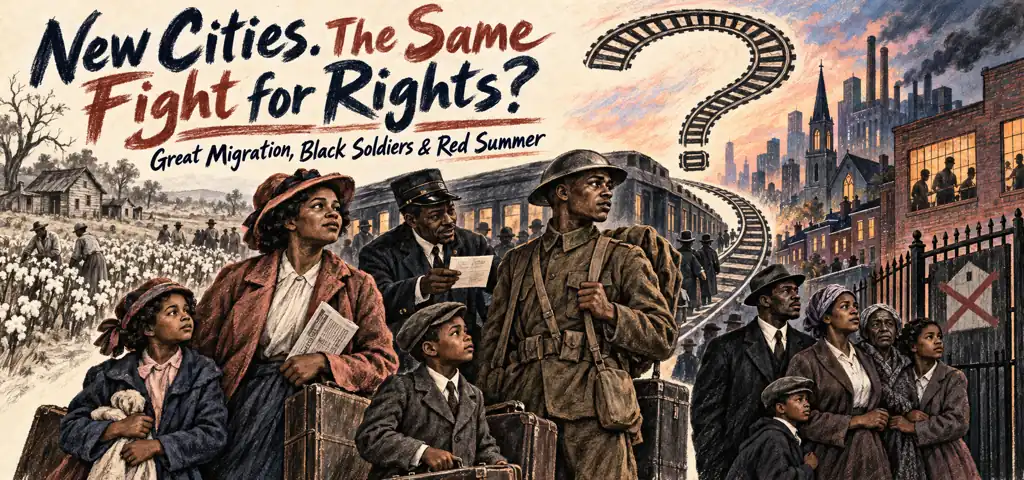
Chapter 7 of the CLEP History of the United States II study guide on Effortless Math covers The Great Migration, Black Soldiers, and the Red Summer: the key terms, the core ideas, and worked examples showing how this topic is tested on the exam.
CLEP History of the United States II, Chapter 7
Migration joined push and pull
Beginning around 1916, roughly half a million Black southerners moved to northern cities by 1919. War orders expanded jobs in steel, meatpacking, railroads, and manufacturing while European immigration fell sharply. In the South, Jim Crow, racial violence, disfranchisement, low farm income, and the boll weevil's damage to cotton pushed families from the land. Neither jobs alone nor oppression alone explains the movement. Migration became possible when information, transportation, labor demand, and the decision to leave converged.
News traveled through Black networks
Letters from relatives described wages, neighborhoods, and employers. The Chicago Defender advertised opportunity and criticized southern violence; Pullman porters carried copies into southern communities where local authorities sometimes tried to suppress them. Churches, labor agents, and family chains helped newcomers find rooms and work. These networks reduced uncertainty. They also reveal agency: employers recruited labor, but migrants evaluated information and used existing social ties to build routes north.
Opportunity met structured exclusion
Northern wages often exceeded agricultural earnings, but Black workers were channeled into dangerous jobs, excluded from many unions, and used as strikebreakers. The National Urban League helped newcomers locate industrial employment and housing and worked with urban institutions during the migration. It did not chiefly organize southern sharecroppers, finance emigration, or build the railroad porters' union. Restrictive covenants, white hostility, inflated rents, and overcrowding confined families to limited neighborhoods. Women commonly found domestic service even when industrial work had expanded for white women. Migration shifted the location of opportunity and racial conflict; it did not carry families beyond discrimination.
The army reproduced segregation
The wartime army segregated Black troops. Many served in labor battalions unloading ships, building roads, and supplying the front because commanders doubted or resisted Black combat service. The 92nd and 93rd Divisions had different combat experiences, and white officers often commanded Black units. Military service therefore joined a claim to citizenship with institutions that restricted role, promotion, and recognition. The contradiction would shape postwar protest.
The 369th fought under French command
The New York National Guard's 369th Infantry served in the 93rd Division but was attached to the French army in 1918. It used French weapons, spent extensive time in front-line sectors, and earned French decorations. American commanders placed most Black troops in labor roles, while the French used the 369th in combat. The comparison does not show an absence of French racism. It exposes how military assignment, rather than ability, structured which service could become visible heroism.
Houston revealed military and police conflict
Black soldiers of the Third Battalion, 24th Infantry, guarding Camp Logan endured repeated abuse from Houston police. After an officer beat and arrested a Black military policeman and rumors spread that he had been killed, armed soldiers marched into the city on August 23, 1917. Violence killed civilians, police, and soldiers. Courts-martial followed; nineteen Black soldiers were hanged. The episode combined local white policing, military discipline, rumor, armed resistance, and unequal justice.
The pandemic traveled through mobilization
Influenza struck military camps and migrant cities as troop trains, ships, and industrial recruitment moved people through crowded spaces. Black communities often faced segregated or inaccessible medical care, even as Black nurses and physicians served under restricted conditions. The pandemic should not be treated as the cause of the Great Migration. It was an overlapping crisis whose spread was accelerated by the same wartime movement of workers and soldiers.
The Red Summer was a national wave
In 1919 white mobs attacked Black communities in more than two dozen cities and towns. In Chicago, the drowning of Black teenager Eugene Williams after white beachgoers stoned him and a police refusal to arrest the identified attacker helped ignite days of violence. Housing boundaries, job competition, demobilization, and white resistance to Black claims intensified conflict. Black residents organized armed self-defense in several cities, making the Red Summer different from an account of passive victimhood alone.
Returning veterans changed the politics of claim
Black veterans returned in uniform after serving a democracy that had segregated them. W. E. B. Du Bois urged them to return fighting for rights, while the NAACP documented violence and expanded. White mobs sometimes targeted uniformed veterans because military service embodied a claim to equal manhood and citizenship. Service did not automatically produce reform. It supplied experience, organization, symbolism, and anger that activists could turn into a stronger challenge.
Tulsa extended postwar racial violence
On May 31 and June 1, 1921, a white mob destroyed Greenwood, Tulsa's prosperous Black business and residential district, after an accusation against a young Black man and a confrontation at the courthouse. Homes and businesses burned, residents were detained, and many people were killed. The exact death toll remains uncertain. Tulsa followed the chapter's 1920 endpoint, but it demonstrates that the forces visible in 1919 did not end with one summer.
Migration reshaped representation and culture
Concentrated Black populations in northern cities built newspapers, churches, businesses, civic organizations, and voting blocs. Oscar De Priest's 1928 election from Chicago made him the first Black representative elected from a northern state. Jacob Lawrence's sixty-panel Migration Series, completed in 1941, later represented the movement's causes, journeys, and urban consequences. These later outcomes belong to the migration's legacy, not to its original wartime trigger.
Quota-era labor demand widened migration streams
Immigration quotas in the 1920s restricted many European arrivals while northern and western employers still sought labor. Black southerners continued moving north, and Mexican workers entered agriculture, railroads, and industry. The groups faced different citizenship regimes and racial classifications. Placing them in the same labor-demand story does not make their legal experiences identical; it shows how employers and policymakers responded to a constrained international labor supply.
Military integration came much later
The First World War experience supplied a contrast for later change. During the Korean War, commanders short of replacements began placing Black soldiers in previously white units, and the Army expanded the practice under the policy framework created by Executive Order 9981. Operational necessity helped implement a commitment announced before the war. That causal sequence differs sharply from the 1918 decision to attach the 369th to the French while preserving segregation in the American force.
connect without collapsing
A prompt gives three facts: immigration declines, war production rises, and the Defender circulates south.
The war redistributed people and conflict
The Great Migration expanded wages, institutions, political influence, and cultural production. Segregated assignments and postwar mob violence exposed the limits of wartime democratic language. The most useful synthesis tracks movement across institutions: rural land to industrial work, southern repression to northern segregation, military labor to citizenship protest, and demographic concentration to political representation. Geography changed. The struggle over power moved with it.
Watch the history in motion
This short lesson adds voices, images, and chronology to the ideas you just studied.
Video: The Red Summer of 1919: Crash Course Black American History #25, CrashCourse.
Try four CLEP-style questions
- A northern city's Black population grows rapidly, but restrictive covenants confine newcomers to a small housing district where rents and crowding rise. Which explanation is strongest?
- The migrants preferred crowding because southern segregation had prohibited urban residence.
- Higher northern wages required migrants by law to occupy employer-owned housing in one district.
- Migration increased demand while racial restrictions prevented the housing supply and residential access from adjusting across the wider city.
- Federal war agencies reserved every new dwelling outside the district for returning European immigrants.
- Black newspapers directed families away from available housing so political wards would remain unchanged.
- Why did a Black veteran's return in uniform sometimes provoke white hostility after the war?
- The uniform gave veterans appointment preference and supervisory authority in local police departments.
- Federal veterans' law suspended state voting qualifications for honorably discharged servicemen.
- Service in segregated units demonstrated that military duty had already secured equal civilian treatment.
- The uniform embodied an equal-citizenship claim that challenged the existing racial hierarchy.
- Demobilization policy assigned uniformed veterans to federally supervised voter-registration campaigns.
- Which interpretation best connects the Great Migration with the Red Summer without making migration itself the cause of mob violence?
- Migration reduced urban competition by dispersing workers across rural counties.
- Demographic change challenged job and housing boundaries that white institutions defended through exclusion and violence.
- Northern cities had lacked racial segregation before migrants arrived.
- Returning soldiers directed the white mobs as part of military policy.
- The pandemic created the residential color line independently of labor and housing.
- What does the destruction of prosperous Greenwood during the Tulsa violence most directly disprove?
- That Tulsa's Black residents had built businesses and homes before 1921
- That accusations and courthouse confrontation could trigger collective violence
- That white officials detained residents after homes and businesses burned
- That the exact death toll is difficult for historians to establish
- That Black economic achievement by itself insulated a community from racial violence and dispossession
Check your answers and reasoning
Independent preparation. CLEP is a registered trademark of the College Board, which does not endorse this lesson.

Related to This Article
More math articles
- Religion and Society
- 8th Grade MCAP Math Worksheets: FREE & Printable
- Political Opportunity and Framing
- FREE 7th Grade MAP Math Practice Test
- TASC Math Formulas
- Scientific polling
- The Lorenz curve plots cumulative shares
- Is your child ready for algebra 1?
- The Ultimate 7th Grade SC Ready Math Course (+FREE Worksheets)
- House of Representatives


















What people say about "The Great Migration and the Red Summer"?
No one replied yet.