Women, Suffrage, and Wartime Social Change
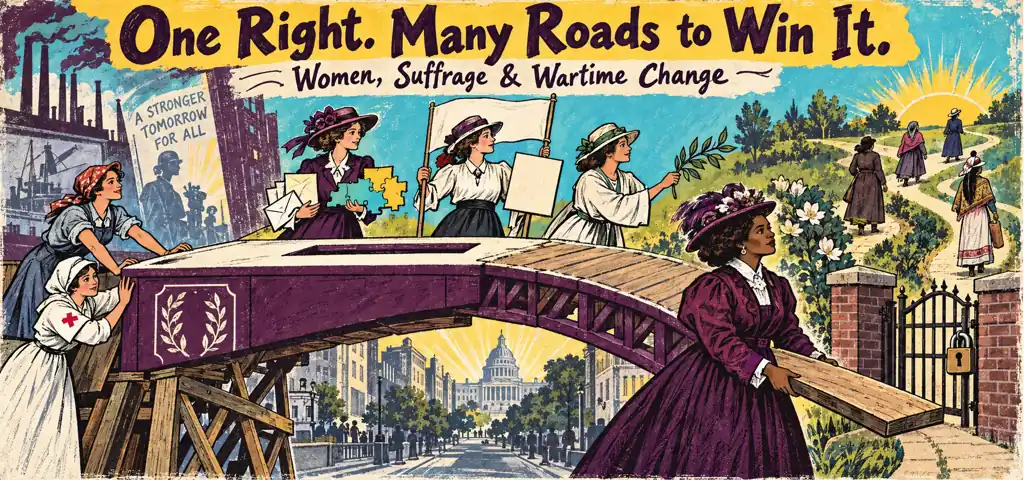
Chapter 7 of the CLEP History of the United States II study guide on Effortless Math covers Women, Suffrage, and Wartime Social Change: the key terms, the core ideas, and worked examples showing how this topic is tested on the exam.
CLEP History of the United States II, Chapter 7
The suffrage map was already uneven
Long before a federal amendment, women voted on equal terms with men in Wyoming and other mountain and Pacific states. Nine western states had full woman suffrage by 1912; Montana and Nevada raised the total to eleven by the end of 1914. Illinois allowed women to vote for presidential electors and some local offices but not every constitutional office. These victories supplied organizers, evidence, and electoral influence. They also meant that the Nineteenth Amendment nationalized an uneven right rather than creating women's political participation from nothing.
NAWSA pursued a coordinated campaign
Carrie Chapman Catt's National American Woman Suffrage Association used a "Winning Plan" that coordinated state campaigns with pressure for a federal amendment. During the war, Catt and much of NAWSA supported the administration and emphasized women's civic service. The organization cultivated legislators and both parties rather than blaming only the party in power. Its method sought respectability, coalition breadth, and cumulative institutional pressure.
The National Woman's Party used confrontation
Alice Paul and the National Woman's Party adapted militant tactics learned from British suffragists. Beginning in January 1917, Silent Sentinels picketed the White House and held Wilson's party responsible for federal inaction. They continued after American entry, displayed the president's democratic language back to him, and endured arrest, workhouse confinement, force-feeding, and public hostility. The NWP and NAWSA wanted the same amendment but used different theories of political accountability.
Peace activism linked votes and diplomacy
Jane Addams presided over the Woman's Peace Party, founded in Washington in January 1915. It called for continuous mediation by neutral nations, limits on armaments, democratic control of foreign policy, and woman suffrage. Addams later attended the international women's congress at The Hague. Peace activists argued that political inclusion would change international priorities. Once the United States entered the war, their dissent could be treated as disloyal even though it grew from reform networks.
War work widened visibility unevenly
Women entered offices, transportation, industry, agriculture, and voluntary relief as men mobilized. The navy enlisted women as Yeomen (F) for clerical work, and nurses served in military medical systems. Black women faced severe occupational segregation and often remained concentrated in domestic and service work. New jobs demonstrated capacity and raised wages for some, but many positions were temporary and employers pushed women out after demobilization. Wartime work changed arguments and experience more reliably than it permanently erased job segregation.
Service strengthened one suffrage argument
Suffragists claimed that women who conserved food, sold bonds, staffed hospitals, and sustained production had earned equal citizenship. Wilson endorsed the federal amendment in 1918, presenting suffrage partly as a war measure. Service was politically useful evidence, but it was not the amendment's legal basis, and decades of organizing preceded it. A rights claim grounded only in emergency usefulness could imply that citizenship depended on proving a designated social contribution.
Congress and states completed different steps
The House first passed the amendment in January 1918, but the Senate fell short. Both chambers approved it in 1919 and sent it to the states. Tennessee became the thirty-sixth ratifying state in August 1920, completing the required three-fourths. The amendment forbade the United States or any state from denying or abridging the right to vote on account of sex. Ratification created a constitutional rule; registration, citizenship, residency, taxes, violence, and administration still affected practical access.
The amendment did not erase racial exclusion
Black suffragists such as Ida B. Wells-Barnett and Mary Church Terrell organized for the vote while confronting segregation within the movement. After ratification, southern Black women faced literacy tests, poll taxes, intimidation, white primaries, and official obstruction also used against Black men. Native American women who lacked U.S. citizenship and Asian immigrant women barred from naturalization faced different barriers. Sex could no longer be the stated ground for denial, but other exclusionary systems remained.
Women did not vote as one bloc
Politicians predicted a unified women's vote that would transform party competition. During the 1920s women's turnout generally lagged behind men's, and women divided by party, class, race, region, religion, and issue much as male voters did. Lower early turnout reflected registration habits, information networks, and institutional barriers as well as individual choice. The absence of one bloc does not mean the amendment lacked consequence; it means sex alone did not determine political preference.
The Women's Bureau built administrative voice
Congress created the Women's Bureau in the Department of Labor in June 1920. It investigated the conditions of wage-earning women and recommended employment standards. The bureau did not enforce a universal national wage or guarantee equal access to occupations. It gathered data, advised policy, and gave women reformers an institutional foothold. Voting rights and administrative expertise were different forms of power that could reinforce each other without being interchangeable.
Maternal policy entered federal grants
The Sheppard-Towner Act of 1921 offered matching grants to states for maternal and infant health clinics, visiting nurses, and education. Often called the first federal social welfare grant program, it emerged from women's reform networks and new electoral attention. It did not provide universal medical insurance, and organized physicians attacked federal involvement. The program demonstrates how maternalist arguments could channel public resources while continuing to define women's public importance through motherhood.
The 1920s did not overturn marriage and work
Young women gained cultural visibility in offices, colleges, advertising, and entertainment, but married women did not become a majority of all women working for wages during the decade. Occupational sex segregation and marriage bars persisted. The "new woman" described a contested cultural image, not a complete labor-market census. Wartime change, suffrage, consumer culture, and employment must be measured separately rather than fused into one story of instant liberation.
separate right, access, and effect
A state ratifies the amendment, a registrar obstructs Black women, and parties find no unified women's bloc.
Wartime citizenship arguments carried a tension
War service helped persuade officials who valued demonstrated public contribution. Confrontational picketing exposed hypocrisy more sharply. Peace activists questioned whether war should define good citizenship at all. The final amendment stated a rule of political equality rather than a reward for service, yet its implementation reflected older hierarchies. A full account therefore joins movement strategy, emergency opportunity, constitutional change, and the unequal institutions awaiting new voters.
Watch the history in motion
This short lesson adds voices, images, and chronology to the ideas you just studied.
Video: How WWI Changed America: Women in WWI, National WWI Museum and Memorial.
Try four CLEP-style questions
- NAWSA supported the war, the National Woman's Party kept picketing Wilson, and the Woman's Peace Party urged neutral mediation. What does the range show?
- Suffrage organizations had abandoned the federal amendment strategy before wartime mobilization began.
- Peace advocacy required women to oppose suffrage until international mediation had succeeded.
- Shared suffrage goals did not dictate one war position or political method.
- White House picketing signified support for the administration's intervention and diplomatic policy.
- Western voting rights prevented enfranchised women from joining national suffrage and peace organizations.
- What limitation follows from arguing that women's war service earned the ballot?
- It guaranteed women permanent industrial employment and equal wages after wartime demobilization.
- It established that civilian peace activists surrendered their First Amendment claims during wartime.
- It made state ratification unnecessary after women sold bonds and entered war industries.
- It persuaded through contribution but made citizenship appear conditional on approved service.
- It treated western state suffrage victories as invalid under the federal Constitution.
- After ratification, women divide their votes among several parties and disagree over labor law, peace, and racial justice. What does this pattern demonstrate?
- The amendment required women to organize a separate national political party before voting.
- Ratification transferred party affiliation from husbands to federal administrators.
- Women entered elections only through organizations that had supported the war.
- Enfranchisement expanded political participation without creating a single women's interest or automatic voting bloc.
- The new electorate voted uniformly until the Women's Bureau began studying employment.
- Why were the Nineteenth Amendment and the Women's Bureau complementary rather than duplicate reforms?
- One changed political membership; the other built research and advocacy for working women.
- Both required a unified women's political party controlling congressional committees and state governments.
- One applied to married women, while the other established voting qualifications for unmarried women.
- Both enforced a national employment code through federal court orders and workplace inspections.
- The bureau ratified the amendment by conducting federal elections inside industrial workplaces.
Check your answers and reasoning
Independent preparation. CLEP is a registered trademark of the College Board, which does not endorse this lesson.

Related to This Article
More math articles
- 7th Grade STAAR Math Practice Test Questions
- Free Grade 3 English Worksheets for Michigan Students
- Heat Transfer, Phase Changes, and Thermodynamics
- The Best Grade 7 ELA Practice Tests for Wyoming Students
- Heron’s Formula Calculator — Area from 3 Sides
- How to Solve Multi-step Addition Word Problems
- ASVAB Math Practice Test PDF with Answers (2026 Guide)
- How Can You Use Math for Calculating Your Winning?
- CLEP U.S. History I 105: Black Codes and the Civil Rights Act of 1866
- Protest and civil disobedience














What people say about "Women, Suffrage, and Wartime Change"?
No one replied yet.