The Solar System
Our corner of space is called the solar system — the Sun and everything held by its gravity, including eight planets, their moons, and smaller bodies like asteroids and comets. Knowing how it is organized answers a whole set of space-science questions.
The Sun and the Planets
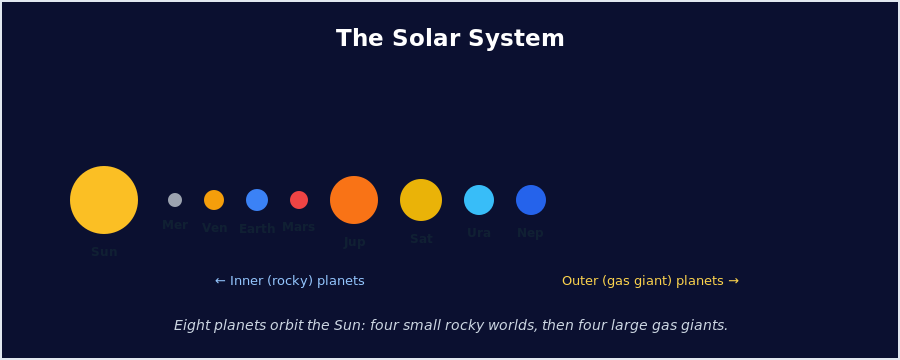
At the center is the Sun, a star whose gravity holds everything in orbit and whose light and heat power the solar system. Eight planets orbit it, in order from the Sun: Mercury, Venus, Earth, Mars, Jupiter, Saturn, Uranus, and Neptune. The four closest are small and rocky (the terrestrial planets); the four farthest are large balls of gas (the gas giants).
What Else Is Out There
Beyond the planets, the solar system holds many smaller objects. Moons orbit planets (Earth has one; Jupiter has dozens). Asteroids are rocky chunks, most found in a belt between Mars and Jupiter. Comets are icy bodies that grow glowing tails when they near the Sun. Gravity from the Sun keeps this whole collection orbiting in the same general plane.
Gravity Holds It Together
The reason planets orbit the Sun rather than flying off into space is gravity — the pull between objects with mass. The Sun’s enormous mass gives it a strong gravitational pull that keeps the planets circling. The same force keeps moons orbiting their planets. When a question asks what holds the solar system together, the answer is the Sun’s gravity.
Watch: A Short Video Lesson
National Geographic walks through this skill clearly in a few minutes. It is a helpful companion to the reading above:
A Routine for Solar System Questions
- The Sun is a star at the center; its gravity holds everything in orbit.
- Eight planets: four inner rocky, four outer gas giants.
- Smaller bodies include moons, asteroids, and comets.
- Gravity is what keeps planets and moons in their orbits.
Practice
- What is at the center of the solar system?
- How many planets are there?
- What are the four inner planets called as a group?
- What are the four outer planets called?
- Where are most asteroids found?
- What force keeps the planets orbiting the Sun?
Answers
- The Sun (a star).
- Eight.
- Terrestrial (rocky) planets.
- Gas giants.
- In the belt between Mars and Jupiter.
- Gravity.
Where This Fits in Your Science Prep
The solar system leads into the Earth, Moon, and Sun and out to stars, galaxies, and the universe. See all topics on the Science Topics Hub.

Related to This Article
More math articles
- Fourteenth Amendment
- Probing, Dilating, and Suctioning Instruments
- How to Solve Composition of Functions? (+FREE Worksheet!)
- How to Tell If a Graph Is a Function: Vertical Line Test
- The Best Grade 3 Math Book for Colorado Students
- Point of View, Bias, and Propaganda
- Cloture
- How to Remove Discontinuities?
- Mechanical Cleaning: Washers, Ultrasonics, and Cart Washers
- Free Grade 4 English Worksheets for Missouri Students













What people say about "The Solar System"?
No one replied yet.