Free Grade 6 English Worksheets for Florida Students
Three times a year, Florida sixth graders sit down in front of a screen and meet a test that pays attention to them. The questions get harder when the answers come easy and ease back when they do not. By the third sitting in May, the test has built a portrait of a reader. Most parents only see the score that lands in the mail. The work of building the reader behind that score happens between the testing windows, in the long quiet weeks when nobody is watching.
That, more than anything, is the strange shape of sixth grade English in Florida. The F.A.S.T. ELA Reading assessment runs three times, PM1 in late August or September, PM2 in December, and PM3 in the spring, which means there is no single sprint. There is fall practice, winter practice, and spring practice, each one tying back to the Florida B.E.S.T. Standards that quietly drive every passage and question. The families who do well here are the ones who treat the year like a long rhythm rather than three separate exams.
This page is built for that rhythm. Forty-six free worksheets, each one targeting a single B.E.S.T. Skill, designed so you can pull one out the night before a PM window or six weeks before, with the same effect. There is no calendar to follow. You print the page when the skill comes up.
What’s on this page
Every PDF here covers one Grade 6 ELA skill aligned to the Florida B.E.S.T. Standards. The pages open with a short Quick Review your sixth grader can read solo, move into short practice items, and finish with an answer key that explains each correct response in plain language. The explanations are written for the student, not the parent, which matters in sixth grade, when the goal is to hand more of the homework back to the kid.
No signup. No email gate. Print and go.
Reading: Literature
- Citing Textual Evidence and Drawing Inferences, [ELA.6.R.1.1] pull the line that earns the answer
- Theme and Objective Summary, [ELA.6.R.1.2] what the whole story is teaching, said in one sentence
- Plot, Episodes, and Character Change, [ELA.6.R.1.1] small scene-by-scene shifts that change a character
- Figurative Language, Connotation, and Tone, [ELA.6.R.3.1] the mood a word carries past its definition
- Structure: How a Scene or Stanza Builds the Whole, [ELA.6.R.1.3] every chunk does a job for the bigger piece
- Developing the Narrator’s Point of View, [ELA.6.R.3.3] how a writer makes you see through one character’s eyes
- Reading vs. Watching: Comparing Versions, [ELA.6.R.2.2] what the page gives you that the screen cannot
- Comparing Stories Across Forms and Genres, [ELA.6.R.1.1] same theme, different vehicle
Reading: Informational Text
- Citing Evidence and Drawing Inferences in Nonfiction, [ELA.6.R.2.2] quote the article sentence that clinches the conclusion
- Central Idea and Objective Summary in Nonfiction, [ELA.6.R.2.2] the article’s main point with the fluff cut out
- How Ideas and Events Are Developed, [ELA.6.R.2.3] how a writer introduces a point and then unpacks it
- Word Meaning in Nonfiction: Figurative, Connotative, Technical, [ELA.6.V.1.3] one word, three jobs
- Text Structure: How Sections Fit Together, [ELA.6.R.2.1] problem, cause, effect, comparison, sequence
- Author’s Point of View and Purpose, [ELA.6.R.2.3] the angle the writer takes and why
- Integrating Information from Text, Visuals, and Data, [ELA.6.R.2.1] combine the prose, the chart, and the photo
- Evaluating Arguments and Claims, [ELA.6.R.2.4] tell the claim from the support and rate the support
- Comparing Two Authors on the Same Topic, [ELA.6.R.3.2] different facts, different angles, same subject
Writing
- Argument Writing: Claim, Reasons, Evidence, [ELA.6.C.1.3] defend a position with reasons and quoted proof
- Informative and Explanatory Writing, [ELA.6.C.1.4] teach a reader something cleanly
- Narrative Writing, [ELA.6.C.1.2] hook, scene, dialogue, sensory detail, ending
- Clear Writing for Task, Purpose, and Audience, [ELA.6.C.1.5] match writing to who is reading
- Planning, Revising, and Editing, [ELA.6.C.5.1] drafts in passes, not single shots
- Short Research Projects, [ELA.6.C.4.1] focused question, multiple sources, clean write-up
- Gathering, Evaluating, and Citing Sources, [ELA.6.C.4.1] which sources deserve your trust
Speaking & Listening
- Collaborative Discussions, [ELA.6.C.2.1] come prepared, listen, build on what was said
- Interpreting Diverse Media, [ELA.6.R.2.2] what each format does well and what it leaves out
- Analyzing a Speaker’s Argument, [ELA.6.R.2.4] find the claim, the reasons, the soft spots
- Presenting Claims and Findings, [ELA.6.C.2.1] open with the point, walk the evidence, end clean
- Adapting Speech to Context, [ELA.6.C.3.1] talking to a friend is not talking to a principal
Grammar
- Pronoun Case: Subjective, Objective, and Possessive, [ELA.6.C.3.1] I, me, my, and when each one belongs
- Intensive Pronouns, [ELA.6.C.3.1] myself and themselves for emphasis
- Avoiding Shifts in Pronoun Number and Person, [ELA.6.C.3.1] pick one and stay there
- Vague Pronouns and Unclear Antecedents, [ELA.6.C.3.1] give every it and they a clear noun
- Recognizing and Improving Non-Standard English, [ELA.6.C.3.1] when to keep your voice, when to switch into school English
Conventions: Punctuation, Spelling
- Punctuation: Commas, Parentheses, and Dashes, [ELA.6.C.3.1] three ways to slip in extra information
- Spelling Grade-Appropriate Words, [ELA.6.C.3.1] homophones and the most-missed sixth-grade words
Knowledge of Language and Style
- Varying Sentence Patterns for Style, [ELA.6.C.1.5] combine, expand, rearrange, anything but flat
- Consistency in Style and Tone, [ELA.6.C.1.5] pick a register and hold it
Vocabulary and Word Study
- Using Context Clues, [ELA.6.V.1.3] slow down at the strange word, look around it
- Greek and Latin Roots and Affixes, [ELA.6.V.1.2] port, dict, tele, photo, and the doors they open
- Using Dictionaries and Thesauruses Effectively, [ELA.6.V.1.3] match the tool to the question
- Verifying Word Meaning, [ELA.6.V.1.3] check the guess, do not trust it
- Figurative Language: Personification and More, [ELA.6.R.3.1] the moves that make writing breathe
- Word Relationships: Cause-Effect, Part-Whole, Category, [ELA.6.V.1.2] patterns that link words to each other
- Connotation: Shades of Meaning, [ELA.6.V.1.2] slim, slender, scrawny, same idea, different feel
- Academic and Domain-Specific Vocabulary, [ELA.6.V.1.1] the cross-subject words and the field-specific ones
How to use these worksheets at home
Florida sixth graders live with three test windows on the horizon, which is great news for parents who like a plan. Build a rough loop. Six weeks before each PM window, pull two reading worksheets and one writing worksheet. The week before, pull one vocabulary page. Then put it down, overstudy in the final stretch costs more than it earns at this age.
When your child gets a question wrong, do not correct the answer first. Ask them to circle the part of the passage they used to choose it. Nine times out of ten, sixth graders pick from memory or vibe rather than from the text. Pointing at the wrong line is more useful than naming the wrong answer; it shows where their attention slipped.
Print on the paper side, work in pencil, save the answer key for last. The mechanical act of writing, not typing, slows a sixth grader down enough to catch their own thinking. Save the screen practice for the F.A.S.T. Windows themselves; the everyday work goes better on paper.
A note about F.A.S.T. ELA Reading
F.A.S.T. ELA Reading is computer-adaptive, which means the test adjusts its question difficulty to your child’s responses as it goes. Each Grade 6 student takes it three times during the school year: PM1 in the fall (typically late August through September), PM2 in the winter (around December), and PM3 in the spring. Only PM3 is the high-stakes administration that produces the official achievement level, but PM1 and PM2 produce scaled scores that families and teachers use to track growth across the year.
The whole assessment is built on the Florida B.E.S.T. Standards for English Language Arts. The reading sections lean hard on textual evidence, central idea, word meaning in context, and author’s purpose. Because the test is adaptive, your child will see a different set of items than the kid next to them. There is no single “study list.” The worksheets on this page are designed for that reality: they target the underlying B.E.S.T. Skills the algorithm draws from, not specific questions.
Want everything in one bundle?
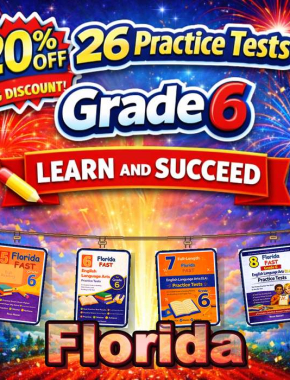
Some Florida families want one consolidated resource rather than a long single-skill page. The Grade 6 ELA Preparation Bundle is built for those families. It collects full-length practice tests, answer keys, and explanations into one stack, useful in the weeks before any PM window when you want your sixth grader to rehearse the whole shape of the assessment, not just one piece.
Florida Grade 6 ELA Preparation Bundle, four practice-test books, 26 unique full-length tests, complete answer keys with explanations.
A short closing
Three windows. One reader being built. The work is small and steady, a worksheet on a Tuesday, an answer key read out loud, a quiet question over the kitchen counter about what a word really means. Bookmark this page and come back to it as each PM rolls around. The reader you are raising shows up in the score because they showed up in the practice.
Best Bundle to Ace the Florida FAST Grade 6 ELA
Looking for the best resource to help your kid ace the Florida FAST? Try this bundle, four full practice-test books (5 + 6 + 7 + 8 tests) covering the same Grade 6 reading, writing, and language skills your child is already learning. Instant PDF download, answer keys included.

Related to This Article
More math articles
- Free Grade 5 English Worksheets for Tennessee Students
- The Federal Reserve and Monetary Policy
- How to Solve the Absolute Value of Rational Numbers?
- 2nd Grade Math Worksheets: Free Printable PDFs
- 7th Grade Math Worksheets: Free Printable PDFs by Topic
- What Is a Passing Score on the CBEST Math?
- How to Find Midpoint? (+FREE Worksheet!)
- Taft-Hartley, the Fair Deal, and the Election of 1948
- How to Prepare for FTCE General Knowledge Math Test?
- How to Order Integers and Numbers? (+FREE Worksheet!)





What people say about "Free Grade 6 English Worksheets for Florida"?
No one replied yet.