Grade 7 Vocabulary and Word Study: Roots, Context Clues, and Academic Language That Sticks
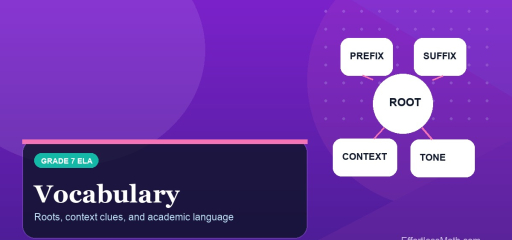
Vocabulary instruction in Grade 7 works best when it moves beyond memorizing isolated definitions. Students at this level need words that travel. They need language that helps them understand a science article, interpret a novel, explain a claim, participate in discussion, and write with more precision. That means effective vocabulary growth comes from a combination of wide reading, targeted word study, active use, and repeated exposure. If a word is only seen once on a worksheet, it is unlikely to stay.
The goal of this article is to make Grade 7 vocabulary work more practical. You do not need a huge program to help a student improve. You need a few high-value habits that keep words connected to meaning. For the full collection of linked literacy resources, use the Grade 7 ELA Online Center. Here, we will focus on the kinds of vocabulary and word study routines that actually stick.
What changes about vocabulary in Grade 7
By middle school, students are expected to handle more abstract language. They see academic words such as analyze, infer, significant, contrast, evidence, and interpret. They also encounter longer content-area words built from Latin and Greek roots, especially in science and social studies. In literature, they may need to interpret figurative language, connotation, tone, and subtle differences between similar words. This means vocabulary is no longer about simple naming. It is about precision.
Why memorization alone does not work
Students can study a list on Monday, pass a quiz on Friday, and forget most of it by the following week. That happens because vocabulary requires multiple kinds of knowledge: meaning, pronunciation, usage, nuance, and context. A word becomes useful only when a student can recognize it while reading, explain it roughly in their own words, and use it appropriately in speech or writing. This is why repeated exposure matters more than short-term cramming.
Use roots and affixes as meaning tools
Word study becomes much more powerful when students learn to notice meaningful parts inside words. Common prefixes such as pre-, sub-, inter-, and anti-, along with suffixes such as -tion, -able, and -ology, give students clues they can use across subjects. Latin and Greek roots help even more. A student who knows that struct relates to build, port relates to carry, and spect relates to look can unlock many unfamiliar words without guessing blindly.
At home or in class, a simple routine works well: choose one root or affix for the week, collect words that contain it, discuss how the meaning shifts slightly in each word, and ask students to use one or two of those words in context. This is more useful than copying definitions because it builds pattern recognition.
Teach context clues carefully
Context clues are important, but students often misuse them by grabbing any nearby word and making a random guess. Strong context-clue work asks students to look for specific signals: examples, synonyms, antonyms, contrast words, restatements, or the overall tone of the sentence. After guessing a meaning, students should ask, “Does this guess actually fit the sentence and the paragraph?” If not, they revise it.
This habit matters especially in Grade 7 reading assessments, where vocabulary questions often ask what a word means as it is used in the passage, not the first dictionary definition that comes to mind. For a broader test-readiness perspective, see our Grade 7 ELA tests parent guide.
Build academic language intentionally
Some of the most important Grade 7 words are not flashy. They are the academic verbs and connectors students need in discussion and writing: analyze, summarize, justify, contrast, support, reveal, consequence, significant, and therefore. These words appear across subjects and help students sound more precise when explaining their thinking.
A practical routine is to collect academic words from class assignments and keep them visible for a week. Ask students to use the words in sentence stems such as:
- The author reveals the theme by…
- One significant detail is…
- This example supports the claim because…
- The two texts contrast in the way they…
When students use words in meaningful frames, those words become tools rather than trivia.
Do not ignore figurative language and nuance
Grade 7 vocabulary work also includes understanding connotation, figurative language, and subtle word differences. Students should be able to notice when slim and skinny technically relate to the same idea but carry different tones, or when a metaphor intensifies meaning in a poem or narrative. These are higher-order vocabulary tasks because they involve interpretation, not just definition.
One helpful question is: “Why did the author choose this word instead of a simpler one?” That question opens the door to tone, voice, and purpose, which connect vocabulary study directly to literary and informational analysis.
Move vocabulary into speech and writing
Words grow stronger when students use them. Encourage your child to work new words into discussions, quick writes, summaries, or even small oral explanations. If the goal word is contrast, ask them to compare two characters or two articles using that word. If the focus word is significant, ask them to explain why one detail matters. Usage strengthens memory and shows whether the student really understands the word.
Create short review cycles instead of one-time study
Vocabulary sticks when students meet the same words repeatedly over time. A good review cycle might look like this:
- Day 1: meet the words in a text
- Day 2: discuss meanings and parts
- Day 3: use the words in speaking or writing
- Day 4: revisit the words in a new context
- Day 5: reflect on which words now feel natural
This kind of repetition is far more effective than reviewing twenty unrelated terms the night before a quiz.
Connect vocabulary to reading and writing goals
Vocabulary should not live in a separate box. It should support what students are already doing. If your child is working on literary analysis, focus on words such as theme, motivation, conflict, reveal, and symbol. If the focus is informational reading, use claim, evidence, structure, central idea, and counterargument. If writing is the immediate priority, collect transition words, revision verbs, and sentence-building language. This makes vocabulary feel useful right away.
That is also why vocabulary study pairs so well with our overview of Grade 7 writing modes and the grammar and revision article.
What families can do without overcomplicating it
You do not need flashcards every night. Try these simpler moves:
- Notice one interesting word from daily reading.
- Ask what clues helped reveal the meaning.
- Talk about a root or prefix inside the word.
- Use the word once in a new sentence that day.
- Return to it later in the week.
This takes only a few minutes and builds far more transfer than memorizing detached definitions.
Where to go next
Vocabulary growth is slow in the best way: steady, cumulative, and deeply connected to real reading and writing. To place that work inside a larger Grade 7 plan, return to the Grade 7 ELA Online Center, then continue with informational reading strategies, text evidence support, or the four-week ELA study plan. Students do not need to know every difficult word they meet. They need good habits for unlocking, using, and remembering the ones that matter most.

Related to This Article
More math articles
- The Best Grade 3 ELA Practice Tests for Oklahoma Students
- Louisiana LEAP Algebra 1 Free Worksheets: Free Algebra 1 PDF Worksheets with Clear Answer Keys
- Resource Mobilization
- GACE Elementary Education Math (501) Worksheets: FREE & Printable
- Compute comparative advantage
- Manual Cleaning: Disassembly, Sinks, and Aerosol Control
- The Best Grade 4 Math Book for Hawaii Students
- The Best Grade 7 Math Book for Texas Students
- Pardon power
- How to Order Fractions: Step-by-Step Guide






What people say about "Grade 7 Vocabulary and Word Study"?
No one replied yet.