Seventh Grade Writing: Argument, Informative, and Narrative Expectations Explained
By seventh grade, writing expectations become noticeably sharper. Teachers are no longer satisfied with loosely connected ideas, vague evidence, or endings that simply repeat the opening sentence. Students are expected to organize their thinking more deliberately, use evidence more strategically, explain their reasoning more clearly, and revise with a stronger sense of audience and purpose. For families, that can be confusing because a child may seem “fine at writing” in everyday life but still struggle when asked to produce an academic paragraph, an argument essay, or a well-developed narrative for school.
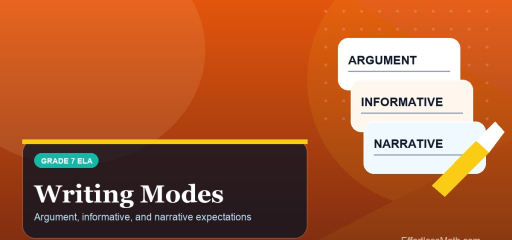
This article explains the three major writing modes most seventh graders encounter: argument, informative/explanatory, and narrative. The exact assignments will vary by district and teacher, but the broad expectations are surprisingly consistent. If you want one place to connect this article with other Grade 7 literacy resources, use the Grade 7 ELA Online Center as your starting point.
What changes in Grade 7 writing
The biggest shift is that students are expected to do more than state an idea. They need to develop it. That means introducing a clear claim or controlling idea, choosing relevant evidence or details, explaining how those details support the point, using transitions to connect ideas, and revising sentences so the whole piece sounds deliberate rather than rushed. Grade 7 writers also need a better sense of audience. They should begin to understand when a formal tone is appropriate, when narrative voice matters, and when a sentence needs more precision.
Argument writing in Grade 7
Argument writing asks students to take a position and support it with reasons and evidence. In middle school, this does not mean being loud or emotional. It means being clear, organized, and convincing.
What teachers usually expect
- A clear claim that answers the prompt directly
- Logical reasons that support the claim
- Relevant evidence from a text, article, or source set when required
- Explanation showing how the evidence connects to the claim
- Transitions that help the reader follow the line of reasoning
- A conclusion that reinforces the argument rather than repeating it word-for-word
Where students often struggle
Many seventh graders can state an opinion but struggle to build a case. Some list evidence without explaining it. Others write a strong opening sentence and then drift into summary. A common problem is the “floating quote” or unsupported example: the detail is there, but the student never tells the reader why it matters. That is why evidence-based writing practice matters so much. If your child needs support with this, our post on citing text evidence in Grade 7 is a strong companion.
How to practice argument writing at home
Keep practice short and specific. Give a simple prompt such as “Should school start later?” or “Which character made the most responsible choice?” Then ask for three parts: claim, one piece of evidence or example, and explanation. That small structure builds the foundation for longer essays.
Informative or explanatory writing in Grade 7
Informative writing asks students to explain a topic clearly and accurately. The purpose is not to argue but to help the reader understand something. In Grade 7, this often includes summarizing information, organizing ideas into logical sections, defining terms, comparing concepts, or explaining how a process works.
What teachers usually expect
- A focused topic or controlling idea
- Relevant facts, examples, definitions, and details
- Clear organization, often with grouped paragraphs or subtopics
- Accurate language and subject-specific vocabulary
- Transitions that show comparison, sequence, or cause and effect
- A conclusion that ties the explanation together
Where students often struggle
Students sometimes confuse informative writing with copying facts. Strong explanatory writing is selective. The writer chooses details that help a reader understand the topic and organizes them in a way that makes sense. Another common issue is weak structure. A student may know several facts but present them in a random order. This is where outlining helps. Even a quick list of “introduction, main point one, main point two, main point three, conclusion” can improve clarity immediately.
How to practice informative writing at home
Ask your child to explain something they actually know: a game strategy, a science concept, how a school routine works, or the difference between two related ideas. Encourage them to define important terms, group details logically, and imagine a reader who knows less than they do. That audience mindset is one of the biggest upgrades in middle school writing.
Narrative writing in Grade 7
Narrative writing is still part of the curriculum in Grade 7, but expectations are more sophisticated than in elementary school. Teachers are looking for purposeful storytelling: pacing, dialogue, description, reflection, and a sense that the writer understands how to shape an experience for a reader.
What teachers usually expect
- A clear situation, conflict, or moment worth telling
- Thoughtful sequencing and pacing
- Dialogue and description that reveal character or mood
- Specific details instead of generic language
- A meaningful ending, reflection, or thematic connection
Where students often struggle
Seventh graders often rush through the most important part of the story. They may spend half the piece on background, then summarize the main event in three sentences. Others rely on vague wording such as “it was awesome” or “I was really sad” instead of showing the reader what happened. Good narrative writing slows down the key moment and uses detail to make meaning visible.
How to practice narrative writing at home
Start with a narrow prompt: “Write about one moment when you changed your mind,” or “Describe a time you had to make a quick choice.” Narrow prompts help students focus. Encourage them to zoom in on one scene, use sensory detail selectively, and show what they were thinking as the moment unfolded.
What all three writing modes have in common
Although argument, informative, and narrative writing look different on the surface, strong Grade 7 writing shares a common core:
- Purpose: the writer knows what the piece is trying to do
- Organization: ideas are arranged in a way the reader can follow
- Development: details are explained, not dropped in carelessly
- Precision: word choice is specific enough to carry meaning
- Revision: the writer improves the piece after the first draft
That is why grammar instruction should not stay isolated. Grammar matters most when it helps a student communicate more clearly. For that reason, our article on grammar and revision habits fits naturally beside any writing practice plan.
How teachers often assess Grade 7 writing
Teachers commonly use a rubric, even when students do not see every category spelled out. The rubric usually checks some mix of ideas, organization, evidence or development, style, and conventions. A student may think a draft is “done” because it answers the prompt, while the teacher sees missing explanation, weak transitions, repetitive wording, or an underdeveloped conclusion. Showing students the likely categories helps them revise more intelligently.
A simple weekly writing routine that works
If your child needs more writing fluency, do not assign long essays every week. That usually creates dread. Instead, try a light routine:
- Day 1: Read a short prompt and brainstorm ideas
- Day 2: Draft one strong paragraph or opening
- Day 3: Add evidence, details, or dialogue
- Day 4: Revise for clarity, transitions, and stronger sentences
- Day 5: Edit conventions and reflect on one improvement
This kind of routine builds writing stamina without making every assignment feel enormous. It also connects well with the broader pacing in our Grade 7 ELA study plan.
Where to go next
If your student needs stronger support in one specific area, pair this article with the next best resource: text evidence and paragraph analysis, grammar and revision skills, or the Grade 7 ELA tests parent guide. For the full collection, return to the Grade 7 ELA Online Center. Good writing in Grade 7 is not about sounding fancy. It is about thinking clearly, organizing purposefully, and revising enough to make that thinking visible.

Related to This Article
More math articles
- Printable Algebra 1 Worksheets with Answers (Free PDFs)
- Students Effective Use of Math Skills in Other Academic Disciplines
- The Best Grade 3 ELA Practice Tests for Arkansas Students
- Reflection, Refraction, and Color
- Units, Measurement, and Conversions
- Population Regulation: How to Understand Density
- The Ultimate PERT Math Course (+FREE Worksheets & Tests)
- Balancing Chemical Equations: Coefficients and Conservation
- SSAT Lower Level Math Flashcards (Free Online: Formulas, Terms & Concepts)
- Executive privilege











What people say about "Seventh Grade Writing Expectations Explained"?
No one replied yet.