Citing Text Evidence in Grade 4: How to Move from Vague Answers to Clear Explanations
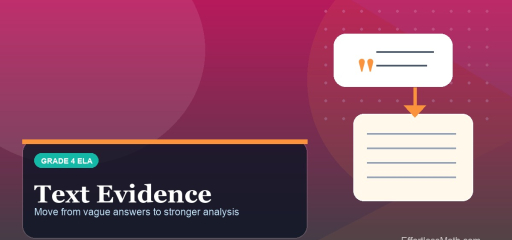
One of the most common Grade 4 ELA frustrations sounds like this: a student understands the reading fairly well, but the written response still comes back with comments such as “needs more evidence,” “explain your thinking,” or “too vague.” This happens because comprehension and explanation are not identical skills. Many fourth graders can form an idea about a text, but they have not yet learned how to prove that idea clearly with the right detail and enough commentary. That is why citing text evidence becomes such an important Grade 4 bridge skill.
Strong evidence use is not about stuffing quotes into every sentence. It is about selecting the most relevant detail, presenting it clearly, and explaining how it supports the answer or idea. Students need to learn that the best answer is not the longest answer. It is the answer that makes the reasoning visible. If you want a wider set of supports around this article, the Grade 4 ELA Online Center connects evidence work with reading, writing, grammar, and study planning.
Why vague answers happen in Grade 4
Vague answers usually come from one of four sources. First, the student may not fully understand the text. Second, the student may understand it but choose weak evidence. Third, the student may choose good evidence but fail to explain it. Fourth, the student may rush and assume the teacher can “see what they mean” without full explanation. Each problem needs a slightly different fix, but all of them improve when students use a clear response routine.
Start with a focused answer or opinion
Before students look for evidence, they need to know what answer or opinion they are trying to support. A focused answer should respond to the prompt directly and stay narrow enough to support. For example, “The character changes” is too broad. “The character becomes more honest after seeing the harm caused by earlier choices” is stronger because it gives the paragraph a direction.
When students start with a fuzzy answer, they usually collect random details. When they start with a clear answer, they can judge evidence more intelligently.
How to choose strong evidence
Not every true detail is useful evidence. Strong evidence is relevant, specific, and closely tied to the answer. Students should ask:
- Does this detail directly support my point?
- Is this the strongest moment, line, or example available?
- Will I be able to explain why it matters?
Sometimes the best evidence is a short quote. Sometimes it is a paraphrase of a key event or idea. In nonfiction, it may be a statistic, example, or explanation from the text. Students do not always need quotation marks to use evidence well. They do need accuracy and focus.
Quote, paraphrase, or summarize?
Grade 4 students benefit from understanding the difference:
- Quote when the exact wording matters, especially in literary analysis or when a phrase is especially revealing.
- Paraphrase when the idea matters more than the exact language and the student can restate it accurately.
- Summarize briefly when background context is needed, but the paragraph should not get trapped in retelling.
This flexibility matters because some students think evidence always means a long quote. That leads to cluttered writing and very little explanation.
The explanation is the real work
If a student includes evidence and stops, the response is incomplete. The explanation is where the writer tells the reader how the evidence supports the answer. A useful set of follow-up questions is:
- What does this detail show?
- Why is it important?
- How does it connect to the character, theme, main idea, or author’s point?
For example, if a student quotes a line showing hesitation, the explanation should clarify whether that hesitation reveals fear, guilt, doubt, or growth. Evidence becomes meaningful when the writer names the significance.
A paragraph frame that helps without becoming a crutch
Some students need a temporary scaffold. A simple evidence paragraph can follow this pattern:
- Answer: respond to the question clearly.
- Evidence: include one quote or paraphrased detail.
- Explanation: show how the evidence supports the answer.
- Extension: connect the idea to a larger theme, main idea, or comparison if appropriate.
This works for both literary and informational text. Over time, students can make the structure sound more natural, but the underlying logic should remain.
How evidence looks in literary responses
In literature, evidence often comes from dialogue, actions, internal thoughts, repeated imagery, or changes across scenes. Students may need to show how a specific moment reveals character growth, conflict, mood, or theme. That means the explanation should move beyond “this shows the character is sad.” Stronger explanation sounds like, “This moment reveals the character’s guilt because she pauses before answering, which shows that she knows the truth but is afraid to say it.”
For more support in this area, pair this article with our Grade 4 literary analysis guide.
How evidence looks in informational responses
In nonfiction, evidence often comes from examples, definitions, statistics, expert statements, or explanations of cause and effect. Here the student may need to explain how a fact supports the main idea or how a piece of reasoning strengthens the author’s point. The same principles apply: choose the strongest detail, present it accurately, and explain its function. If nonfiction is the challenge, continue with our informational reading strategies post.
Common evidence mistakes in Grade 4
Problem 1: The evidence is too general
Students may write “the text shows this many times” without naming one clear example. Strong writing zooms in.
Problem 2: The quote is too long
When a quote takes over the paragraph, the student’s own reasoning disappears. Short, targeted evidence usually works better.
Problem 3: The explanation repeats instead of explaining
Some students reword the quote but do not explain its significance. Real explanation adds meaning, not just rephrasing.
Problem 4: The response never returns to the answer
Students may include an interesting detail but fail to connect it back to the original question. Teach them to ask, “How does this prove my point?”
How to practice evidence skill without writing full essays
Short practice is often best. Try this routine two or three times a week:
- Read one short passage or excerpt.
- Ask one focused question.
- Have the student choose one strong piece of evidence.
- Write three to five sentences: answer, evidence, explanation.
Because the task is short, the student can concentrate on quality. Over time, those small responses build the skill needed for essays and tests. This also connects naturally with home reading routines and the three major Grade 4 writing modes.
Why this skill matters so much on Grade 4 assessments
Grade 4 ELA tests often reward students who can slow down, locate evidence, and explain their reasoning clearly. A student may eliminate weak multiple-choice answers more effectively when they can point to the best supporting detail. On written responses, evidence and explanation are often the difference between a partial answer and a strong one. That is why evidence work should be part of any test-prep plan, not an optional extra. For the larger test picture, visit our Grade 4 ELA parent guide.
Where to go next
Evidence-based writing improves through repetition, not mystery. Students need repeated chances to make an answer, choose one strong detail, and explain why it matters. For the full network of Grade 4 resources, return to the Grade 4 ELA Online Center. Then continue with literary analysis, grammar and revision habits, or the four-week study plan. The goal is not to make students sound robotic. It is to help them prove their thinking clearly and confidently.

Related to This Article
More math articles
- The Best Grade 6 ELA Practice Tests for Massachusetts Students
- How to Use the Associative and Commutative Properties to Multiply
- The Best Grade 4 Math Book for Tennessee Students
- How to Ace the PSAT Math Test?
- 3rd Grade IAR Math Worksheets: FREE & Printable
- Idaho Algebra 1 Free Worksheets: 64 Free Algebra 1 PDF Worksheets, One Skill at a Time
- Electricity, Magnetism, and Nuclear Science
- Merton’s Strain Theory and Adaptations
- The Best Grade 4 ELA Practice Tests for Colorado Students
- Hit Frequency vs. RTP: Two Numbers That Tell Different Stories











What people say about "Citing Text Evidence in Grade 4"?
No one replied yet.