Other Topics Puzzle – Math Challenge 101
This is another perfect math puzzle that can be solved without even using a pen and paper! Paying attention to the details is the key to solving this fascinating Math puzzle!
The Absolute Best Book to challenge your Smart Student!

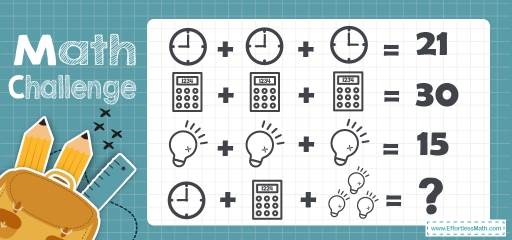
The correct answer is 30.
First, notice that the clocks show different times. The first two clocks show 9 and the third one shows 3. Then: \(9+9+3=21\)
The three calculators sum up to 30. So, each one represents number 10.
The third equation, each lamp represents number 5. \((5+5+5=15)\)
Now, let’s solve the last equation. The clock represents number 9. This calculator is different from the calculators in the second equation. The numbers in the previous calculators are 1, 2, 3, and 4. We know that the calculators represent number 10. So, \(1+2+3+4=10\)
The calculator on the last equation had numbers 1, 2, 2, and 4. So, the calculator represents number 9: \(1+2+2+4=9\)
Now, notice that the lamps on the last equation are different from the lamp in the third equation. That lamp has 5 bars on it, but these lamps have 4 bars on them. The lamp on the third equation represents number 15. So, 5 bars on the lamp represent 15. Then, each of the lamps with 4 bars represent \(12 \ (4×3=12)\).
Now, let’s solve the last equation.
\(9+9+12=30\)
Solving Strategies for Math Puzzles
Math puzzles require systematic thinking and creative problem-solving. This section builds your puzzle-solving toolkit with proven strategies applicable to the puzzle above and similar challenges.
Key Puzzle-Solving Strategies
Strategy 1: Work Backwards Start from the goal or answer and trace back to the beginning. This often reveals the required steps more clearly than forward thinking.
Strategy 2: Look for Patterns Many puzzles involve sequences or repeated structures. Identify patterns to predict unknown values.
Strategy 3: Organize Information Create tables, diagrams, or lists to structure what you know. Organization prevents missed relationships.
Strategy 4: Try Simpler Cases First If the puzzle is complex, try smaller versions to understand the mechanics before tackling the full problem.
Strategy 5: Use Algebra When Possible Translate words and logic into equations. Algebraic solutions are often cleaner than trial-and-error.
Hints Structure
Hint 1 (Mild): Reread the puzzle carefully. Ensure you understand every constraint and what’s being asked.
Hint 2 (Moderate): Organize known information. Create a table or diagram showing relationships.
Hint 3 (Substantial): Apply one of the strategies above. If visual, try drawing. If logical, list possibilities.
Hint 4 (Near Solution): Check your work against all constraints. Does your answer satisfy every condition in the puzzle?
Related Puzzle Types
Logic Puzzles: Require deductive reasoning and systematic elimination (e.g., “A, B, and C have different ages…”)
Number Puzzles: Involve arithmetic and algebraic manipulation (e.g., cryptarithmetic, magic squares)
Geometry Puzzles: Test spatial reasoning and geometric properties
Pattern Puzzles: Involve sequences and rule-finding
Combinatorial Puzzles: Ask “how many ways” or “what’s the best arrangement”
Learning Objectives
By working through puzzles like this one, you develop:
Logical Thinking: Ability to follow chains of reasoning and identify contradictions.
Problem Decomposition: Breaking complex problems into manageable parts.
Persistence: Willingness to try multiple approaches and learn from failed attempts.
Mathematical Insight: Recognizing when algebraic or geometric tools apply.
Communication: Explaining your reasoning clearly to others.
Frequently Asked Questions
Q: How long should I spend on a single puzzle?
A: Start with 15-20 minutes. If stuck, take a break and return fresh. Sometimes the solution becomes clear after time away from the puzzle.
Q: Should I look at the solution if I get stuck?
A: Try using the hints first. Reading the full solution immediately deprives you of the learning that comes from struggle. Use hints to guide you toward the solution.
Q: Do I need special mathematical knowledge for puzzles?
A: Most puzzles require only basic arithmetic and logic. Creativity and systematic thinking matter more than advanced mathematics.
Q: How do puzzles help me in standardized tests?
A: Puzzles build the flexible thinking and problem-solving mindset that standardized tests assess. They improve your ability to approach unfamiliar problems.
Q: Are there puzzle collections I can use for more practice?
A: Absolutely! Explore Martin Gardner’s books, chess puzzle sites, or logic puzzle archives online. Regular puzzle practice accelerates improvement.
Solving Strategies for Math Puzzles
Math puzzles require systematic thinking and creative problem-solving. This section builds your puzzle-solving toolkit with proven strategies applicable to the puzzle above and similar challenges.
Key Puzzle-Solving Strategies
Strategy 1: Work Backwards Start from the goal or answer and trace back to the beginning. This often reveals the required steps more clearly than forward thinking.
Strategy 2: Look for Patterns Many puzzles involve sequences or repeated structures. Identify patterns to predict unknown values.
Strategy 3: Organize Information Create tables, diagrams, or lists to structure what you know. Organization prevents missed relationships.
Strategy 4: Try Simpler Cases First If the puzzle is complex, try smaller versions to understand the mechanics before tackling the full problem.
Strategy 5: Use Algebra When Possible Translate words and logic into equations. Algebraic solutions are often cleaner than trial-and-error.
Hints Structure
Hint 1 (Mild): Reread the puzzle carefully. Ensure you understand every constraint and what’s being asked.
Hint 2 (Moderate): Organize known information. Create a table or diagram showing relationships.
Hint 3 (Substantial): Apply one of the strategies above. If visual, try drawing. If logical, list possibilities.
Hint 4 (Near Solution): Check your work against all constraints. Does your answer satisfy every condition in the puzzle?
Related Puzzle Types
Logic Puzzles: Require deductive reasoning and systematic elimination (e.g., “A, B, and C have different ages…”)
Number Puzzles: Involve arithmetic and algebraic manipulation (e.g., cryptarithmetic, magic squares)
Geometry Puzzles: Test spatial reasoning and geometric properties
Pattern Puzzles: Involve sequences and rule-finding
Combinatorial Puzzles: Ask “how many ways” or “what’s the best arrangement”
Learning Objectives
By working through puzzles like this one, you develop:
Logical Thinking: Ability to follow chains of reasoning and identify contradictions.
Problem Decomposition: Breaking complex problems into manageable parts.
Persistence: Willingness to try multiple approaches and learn from failed attempts.
Mathematical Insight: Recognizing when algebraic or geometric tools apply.
Communication: Explaining your reasoning clearly to others.
Frequently Asked Questions
Q: How long should I spend on a single puzzle?
A: Start with 15-20 minutes. If stuck, take a break and return fresh. Sometimes the solution becomes clear after time away from the puzzle.
Q: Should I look at the solution if I get stuck?
A: Try using the hints first. Reading the full solution immediately deprives you of the learning that comes from struggle. Use hints to guide you toward the solution.
Q: Do I need special mathematical knowledge for puzzles?
A: Most puzzles require only basic arithmetic and logic. Creativity and systematic thinking matter more than advanced mathematics.
Q: How do puzzles help me in standardized tests?
A: Puzzles build the flexible thinking and problem-solving mindset that standardized tests assess. They improve your ability to approach unfamiliar problems.
Q: Are there puzzle collections I can use for more practice?
A: Absolutely! Explore Martin Gardner’s books, chess puzzle sites, or logic puzzle archives online. Regular puzzle practice accelerates improvement.
Strategic Approaches to Solving Math Puzzles
Math puzzles require systematic thinking and creative problem-solving approaches. Rather than relying on brute force or random guessing, successful puzzle solvers use proven strategies. This section builds your comprehensive puzzle-solving toolkit with proven techniques applicable to the challenge above and similar mathematical puzzles.
Fundamental Puzzle-Solving Strategies
Strategy 1: Work Backwards from the Goal Start from the desired outcome or answer and trace the path backward to the beginning. This often reveals the required steps more clearly than forward thinking. Ask yourself: “If this were true, what must have been true before it?”
Strategy 2: Look for Patterns and Repetition Many puzzles involve sequences, cycles, or repeated structures. Identify these patterns to predict unknown values without exhaustive calculation. Look at how numbers or objects change from one step to the next.
Strategy 3: Organize Information Systematically Create tables, diagrams, lists, or matrices to structure what you know. Organization prevents missed relationships and reveals connections that weren’t obvious in text form.
Strategy 4: Try Simpler Cases First If the puzzle is complex, attempt smaller or simpler versions first to understand the mechanics. Understanding how the system works at small scale helps tackle larger problems.
Strategy 5: Use Algebra When Possible Translate words and logical constraints into algebraic equations. Algebraic solutions are often cleaner and faster than trial-and-error approaches.
Structured Hints for Problem Solving
Hint 1 (Mild Guidance): Reread the puzzle very carefully. Ensure you understand every constraint, every given piece of information, and exactly what is being asked. Misunderstanding the problem is the most common reason for incorrect solutions.
Hint 2 (Moderate Guidance): Organize the known information into a clear structure. Create a table showing relationships, draw a diagram showing spatial arrangement, or list all constraints explicitly. This prevents overlooking important details.
Hint 3 (Substantial Guidance): Apply one of the strategies listed above. If the puzzle is visual, try drawing. If it’s logical, create a systematic listing of possibilities. If it involves computation, set up equations.
Hint 4 (Nearly Complete): Check your proposed solution against all constraints mentioned in the puzzle. Does your answer satisfy every single condition? Double-check your work.
Related Puzzle Categories and Approaches
Logic Puzzles: Require deductive reasoning and systematic elimination (e.g., “Person A, B, and C have different ages and professions; given these clues, determine who is whom”)
Number Puzzles: Involve arithmetic and algebraic manipulation (e.g., cryptarithmetic where letters represent digits, magic squares where all rows/columns sum to the same number)
Geometry Puzzles: Test spatial reasoning and application of geometric properties (e.g., finding areas, determining angles, visualizing rotations)
Pattern Puzzles: Involve identifying sequences and discovering underlying rules (e.g., “What comes next in this sequence?”)
Combinatorial Puzzles: Ask “How many ways?” or “What’s the best arrangement?” often involving factorials and combinations.
Core Learning Objectives from Puzzle Work
By working through puzzles like the one above, you develop critical thinking skills:
Logical Thinking: Ability to follow chains of reasoning, identify contradictions, and recognize when something doesn’t make sense.
Problem Decomposition: Skill in breaking complex problems into manageable, solvable parts rather than being overwhelmed by the whole.
Persistence and Resilience: Willingness to try multiple approaches, learn from failed attempts, and maintain effort when initial solutions don’t work.
Mathematical Insight: Recognizing when algebraic, geometric, or probabilistic tools apply and choosing appropriate solution methods.
Clear Communication: Explaining your reasoning and solution process clearly to others so they can follow your logic and learn from your approach.
Frequently Asked Questions About Math Puzzles
Q: How long should I spend attempting a single puzzle before looking for help? A: Start with 15-20 minutes of focused effort. If truly stuck, take a break and return with fresh perspective. Sometimes solutions become clear after time away from the puzzle.
Q: Should I immediately look at the solution if I cannot solve it? A: Try using the hints structure first. Reading the full solution immediately deprives you of the deep learning that comes from struggling productively. Use hints to guide yourself toward the solution.
Q: Do I need advanced mathematical knowledge to solve puzzles? A: Most puzzles require only basic arithmetic and logical thinking. Creativity and systematic problem-solving approaches matter far more than advanced mathematics knowledge.
Q: How do puzzle-solving skills transfer to standardized tests? A: Puzzles build the flexible thinking and creative problem-solving mindset that standardized tests assess. They improve your ability to approach unfamiliar problems with confidence.
Q: Are there puzzle collections I can practice with? A: Absolutely! Explore Martin Gardner’s books, chess puzzle websites, online logic puzzle archives, or sudoku collections. Regular puzzle practice accelerates improvement.
Strategic Approaches to Solving Math Puzzles
Math puzzles require systematic thinking and creative problem-solving approaches. Rather than relying on brute force or random guessing, successful puzzle solvers use proven strategies. This section builds your comprehensive puzzle-solving toolkit with proven techniques applicable to the challenge above and similar mathematical puzzles.
Fundamental Puzzle-Solving Strategies
Strategy 1: Work Backwards from the Goal Start from the desired outcome or answer and trace the path backward to the beginning. This often reveals the required steps more clearly than forward thinking. Ask yourself: “If this were true, what must have been true before it?”
Strategy 2: Look for Patterns and Repetition Many puzzles involve sequences, cycles, or repeated structures. Identify these patterns to predict unknown values without exhaustive calculation. Look at how numbers or objects change from one step to the next.
Strategy 3: Organize Information Systematically Create tables, diagrams, lists, or matrices to structure what you know. Organization prevents missed relationships and reveals connections that weren’t obvious in text form.
Strategy 4: Try Simpler Cases First If the puzzle is complex, attempt smaller or simpler versions first to understand the mechanics. Understanding how the system works at small scale helps tackle larger problems.
Strategy 5: Use Algebra When Possible Translate words and logical constraints into algebraic equations. Algebraic solutions are often cleaner and faster than trial-and-error approaches.
Structured Hints for Problem Solving
Hint 1 (Mild Guidance): Reread the puzzle very carefully. Ensure you understand every constraint, every given piece of information, and exactly what is being asked. Misunderstanding the problem is the most common reason for incorrect solutions.
Hint 2 (Moderate Guidance): Organize the known information into a clear structure. Create a table showing relationships, draw a diagram showing spatial arrangement, or list all constraints explicitly. This prevents overlooking important details.
Hint 3 (Substantial Guidance): Apply one of the strategies listed above. If the puzzle is visual, try drawing. If it’s logical, create a systematic listing of possibilities. If it involves computation, set up equations.
Hint 4 (Nearly Complete): Check your proposed solution against all constraints mentioned in the puzzle. Does your answer satisfy every single condition? Double-check your work.
Related Puzzle Categories and Approaches
Logic Puzzles: Require deductive reasoning and systematic elimination (e.g., “Person A, B, and C have different ages and professions; given these clues, determine who is whom”)
Number Puzzles: Involve arithmetic and algebraic manipulation (e.g., cryptarithmetic where letters represent digits, magic squares where all rows/columns sum to the same number)
Geometry Puzzles: Test spatial reasoning and application of geometric properties (e.g., finding areas, determining angles, visualizing rotations)
Pattern Puzzles: Involve identifying sequences and discovering underlying rules (e.g., “What comes next in this sequence?”)
Combinatorial Puzzles: Ask “How many ways?” or “What’s the best arrangement?” often involving factorials and combinations.
Core Learning Objectives from Puzzle Work
By working through puzzles like the one above, you develop critical thinking skills:
Logical Thinking: Ability to follow chains of reasoning, identify contradictions, and recognize when something doesn’t make sense.
Problem Decomposition: Skill in breaking complex problems into manageable, solvable parts rather than being overwhelmed by the whole.
Persistence and Resilience: Willingness to try multiple approaches, learn from failed attempts, and maintain effort when initial solutions don’t work.
Mathematical Insight: Recognizing when algebraic, geometric, or probabilistic tools apply and choosing appropriate solution methods.
Clear Communication: Explaining your reasoning and solution process clearly to others so they can follow your logic and learn from your approach.
Frequently Asked Questions About Math Puzzles
Q: How long should I spend attempting a single puzzle before looking for help? A: Start with 15-20 minutes of focused effort. If truly stuck, take a break and return with fresh perspective. Sometimes solutions become clear after time away from the puzzle.
Q: Should I immediately look at the solution if I cannot solve it? A: Try using the hints structure first. Reading the full solution immediately deprives you of the deep learning that comes from struggling productively. Use hints to guide yourself toward the solution.
Q: Do I need advanced mathematical knowledge to solve puzzles? A: Most puzzles require only basic arithmetic and logical thinking. Creativity and systematic problem-solving approaches matter far more than advanced mathematics knowledge.
Q: How do puzzle-solving skills transfer to standardized tests? A: Puzzles build the flexible thinking and creative problem-solving mindset that standardized tests assess. They improve your ability to approach unfamiliar problems with confidence.
Q: Are there puzzle collections I can practice with? A: Absolutely! Explore Martin Gardner’s books, chess puzzle websites, online logic puzzle archives, or sudoku collections. Regular puzzle practice accelerates improvement.

Related to This Article
More math articles
- Administrative Discretion and Rulemaking
- Natural and Artificial Selection
- 5 Best Laptops for Math Students
- Tracing an Argument
- How to Use Models to Place Decimal Numbers in Order
- The Best Grade 8 Math Book for Michigan Students
- Decimals in Action: How to Master Multiplication and Division
- The Best Grade 7 ELA Practice Tests for North Carolina Students
- The Best TASC Math Worksheets: FREE & Printable
- Three-Hour Pacing and Marking Questions for Review






What people say about "Other Topics Puzzle - Math Challenge 101"?
No one replied yet.