The AEF, the Armistice, and the Human Cost of War
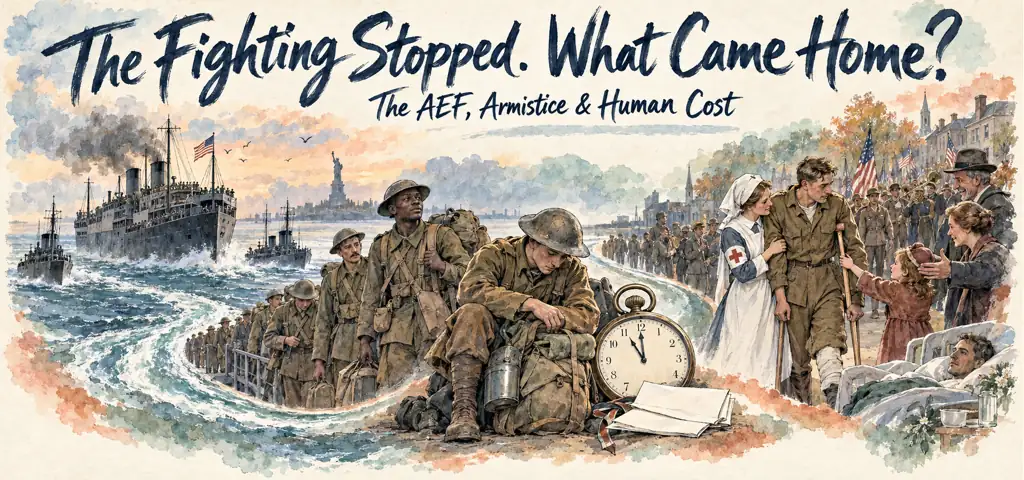
Chapter 7 of the CLEP History of the United States II study guide on Effortless Math covers The AEF, the Armistice, and the Human Cost of War: the key terms, the core ideas, and worked examples showing how this topic is tested on the exam.
CLEP History of the United States II, Chapter 7
The United States had to build an army overseas
When Congress declared war, the regular army was too small to decide the conflict quickly. The draft, training camps, convoyed troopships, port construction, and an immense supply system created the American Expeditionary Forces. American troops began arriving in significant numbers in 1918. Their value lay partly in fresh manpower and partly in convincing exhausted Allies and German planners that the balance would worsen. Mobilization speed mattered even before every division reached combat.
Convoys concentrated protection around shipping
Unrestricted submarine warfare made isolated merchant vessels easy targets. The convoy system assembled cargo and troop ships under destroyer and patrol escort, reducing the number of scattered targets that escorts had to find and defend. A U-boat approaching a convoy faced lookouts, depth charges, coordinated maneuver, and several warships rather than one merchant captain alone. Convoys moved only as fast as their slower ships and created scheduling and collision problems, but losses fell sharply after the system expanded. The mechanism was concentrated protection, not merchant ships outrunning submarines or summoning help after an attack began.
Pershing resisted amalgamation
British and French commanders wanted arriving American soldiers fed into their depleted units. General John J. Pershing accepted temporary attachments and training but insisted on building a separate American army under American command. He believed national control would improve coherence, morale, and American influence over the peace. The choice delayed the fullest immediate use of some troops and depended on Allied experience and equipment. Command independence was both a military preference and a diplomatic claim.
American operations grew in scale
American units fought at Cantigny, Château-Thierry, and Belleau Wood, then conducted the largely American St. Mihiel offensive in September 1918. The Meuse-Argonne offensive, beginning later that month and continuing to the armistice, involved more than a million American soldiers and became the largest American operation of the war. Difficult terrain, inexperienced units, congestion, and machine-gun defenses produced heavy casualties. Numbers alone do not prove tactical excellence; they reveal operational scale and pressure.
Black service exposed command inequality
Most Black troops in the AEF performed labor and supply work under segregation, while the 369th Infantry and other units of the 93rd Division fought attached to the French. Their service sustained the army whether or not commanders granted combat recognition. The contrast matters for human cost because dangerous labor, disease exposure, and discriminatory discipline do not appear fully in battle narratives. Military effectiveness depended on a broad workforce whose citizenship claims were treated unequally.
Intervention extended into Russia
American troops landed at Archangel and Vladivostok in 1918. Wilson's July aide-mémoire described limited aims: guarding Allied supplies, assisting the Czechoslovak Legion's exit, and supporting efforts against Germany rather than choosing Russia's government. In practice the intervention entered the Russian Civil War's confused geography and lasted after the western armistice. Limited official aims could still create armed contact with Bolshevik forces and fuel later distrust.
Disease killed on a military timetable
Influenza swept camps and troopships during the decisive mobilization. The United States recorded about 116,500 military deaths in the war; roughly 53,400 were battle deaths and more than 63,000 resulted from other causes, with influenza and pneumonia central. Exact totals vary by accounting, but disease deaths exceeded battle deaths. Human cost therefore belongs to barracks, hospitals, ships, and families as well as to trenches.
German leaders sought Wilson's terms
In October 1918 Germany asked Wilson for an armistice rather than appealing first to the Allied governments. German leaders hoped a settlement based on the Fourteen Points would be milder than terms dictated in London or Paris. Wilson exchanged notes demanding political and military assurances. The appeal gave his program bargaining force, but Britain and France still had their own security aims and armies on the field. Requesting Wilson's mediation did not bind all victors to his preferred peace.
The armistice stopped fighting under conditions
The November 11 armistice required German evacuation of occupied territory, surrender of weapons and transportation equipment, Allied occupation west of the Rhine, and continuation of the blockade. It did not set an immediate fixed reparations sum, settle every border, or admit Germany to a League. An armistice is an agreement to stop fighting under military conditions. The Treaty of Versailles, negotiated later, established the formal peace terms.
Victory and trauma returned together
Veterans brought disabilities, grief, influenza, and expectations of recognition home. The federal War Risk Insurance system provided compensation and insurance but struggled with administration. Communities built memorials and welcomed troops while workers encountered inflation and demobilization. The American Legion, founded in Paris in 1919, advocated veterans' interests and later supported adjusted compensation. A victory parade and a disability claim were parts of the same return.
The bonus chronology belongs to a longer aftermath
Congress enacted adjusted compensation over President Calvin Coolidge's veto in 1924, with certificates generally payable in 1945. During the Depression, veterans camped in Washington in 1932 to demand early payment, forming the Bonus Army. This later sequence begins with First World War service but belongs primarily to Depression politics. Keeping Selective Service in 1917, the Legion in 1919, bonus legislation in 1924, and the encampment in 1932 prevents a common chronology collapse.
distinguish cease-fire from settlement
A document orders evacuation, surrender of artillery, and an end to fighting but does not assign colonies or a final reparations amount.
Human cost changes strategic interpretation
The AEF helped make continued German resistance untenable, but American power did not arrive costlessly or operate alone. Allied armies had absorbed years of fighting; Black soldiers faced unequal assignments; influenza moved through the mobilization system; and intervention in Russia outlasted the western battle. Strategy asks how force changed the outcome. Human-cost analysis asks who supplied that force, what institutions exposed them, and which consequences continued after victory.
Watch the history in motion
This short lesson adds voices, images, and chronology to the ideas you just studied.
Video: APUSH Online: 7.5b.i – WWI: Military & Diplomacy (Fighting the War), Crossno – History.
Try four CLEP-style questions
- Why did Pershing's insistence on a separate American army have political significance beyond battlefield organization?
- It guaranteed Allied governments would accept Wilson's entire peace program after victory.
- National command supported an independent American voice on war aims and peace.
- It placed the American draft and training system under permanent French military law.
- It removed American formations from battlefield cooperation with British and French forces.
- It transferred American supply lines, ports, and transport permanently to British ownership.
- American troop arrivals rise rapidly in 1918 even though many of the new divisions have not yet entered major combat. Why could the arrivals still affect German strategy?
- They signaled fresh reserves that worsened Germany's expected future military balance.
- Each division entered an existing British or French formation as soon as it landed.
- The arriving formations were already positioned to sever German railroads behind the western front.
- Troop transport forced the Allies to suspend the naval blockade until the soldiers reached combat.
- The arrivals proved American forces could operate without Allied equipment, training, or coordination.
- Why could the Russian intervention create long-term suspicion even if Wilson described its purposes as limited?
- Guarding supplies confined American troops to ports and prevented influence on civil-war factions.
- Recognition of anti-Bolshevik local authorities made the intervention politically neutral.
- Armed presence in a civil war could shape power beyond announced logistical aims.
- Aiding the Czechoslovak Legion transferred American command to Russia's provisional government.
- Withdrawal before the civil war ended kept the operation from shaping later Russian perceptions.
- A victory parade occurs while hospitals continue treating veterans with disabling wounds and psychological trauma. What conclusion best follows?
- Public celebration demonstrates that postwar disability had ceased to require family or government support.
- Military success and lasting human damage could coexist, creating obligations and conflicts that continued after battlefield victory.
- Formal victory converted every service-related injury into a short-term medical condition.
- The armistice required hospitals to discharge wounded veterans before a peace treaty was negotiated.
- Psychological injury affected civilians but not soldiers returning from industrial warfare.
Check your answers and reasoning
Independent preparation. CLEP is a registered trademark of the College Board, which does not endorse this lesson.

Related to This Article
More math articles
- Reveal the Secrets: “TSI Math for Beginners” Detailed Solution Manual
- GED Math Prep Books: Compare Study Guides and Formats
- Top 10 Tips to Create a PERT Math Study Plan
- Supply Distribution Systems Basics
- Bureaucratic hierarchy
- Citing Text Evidence in Grade 6: How to Move from Vague Answers to Strong Analysis
- How Traditional News Media Shapes Politics
- Best Calculators for CA Exams
- The Best Grade 5 Math Book for Maryland Students
- 5th Grade NHSAS Math Worksheets: FREE & Printable






















What people say about "The AEF, the Armistice, and the Cost of War"?
No one replied yet.