Kennedy’s New Frontier and Cold War Development Policy
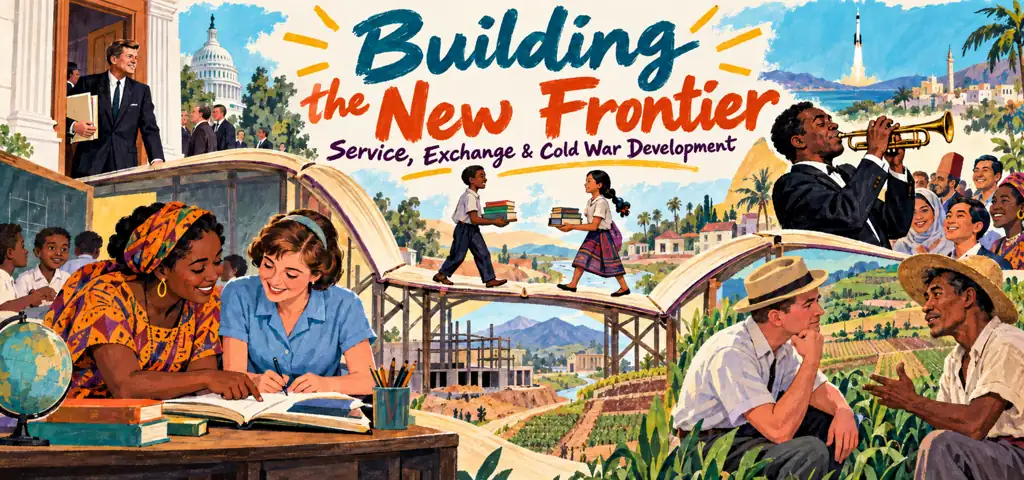
Chapter 11 of the CLEP History of the United States II study guide on Effortless Math covers Kennedy’s New Frontier and Cold War Development Policy: the key terms, the core ideas, and worked examples showing how this topic is tested on the exam.
CLEP History of the United States II, Chapter 11
A narrow victory met a divided governing system
John F. Kennedy defeated Richard Nixon in 1960 by a very small popular-vote margin while Democrats retained Congress. Party labels did not guarantee a liberal majority: southern committee chairs and conservative Republicans could combine against domestic proposals. Kennedy called his agenda the New Frontier, linking economic growth, public investment, civil rights, and scientific ambition. Congress raised the minimum wage and supported area redevelopment, but blocked or diluted major education, medical-care, and civil-rights measures. The gap between presidential rhetoric and legislation reflected coalition structure, not simply a lack of proposals.
Development policy joined economics to Cold War strategy
Kennedy's advisers believed poverty and political instability could make newly independent societies vulnerable to revolution or communist influence. Modernization theory proposed that societies moved through stages toward industrial production, mass consumption, and representative institutions. Economist Walt Rostow gave that expectation a memorable staged model. Policymakers treated capital, technical knowledge, education, and administration as levers of change. Critics noted that the model generalized from western experience, underestimated land inequality and colonial legacies, and could mistake political opposition for a technical development problem.
The Foreign Assistance Act reorganized instruments
The Foreign Assistance Act of 1961 separated military and nonmilitary programs more clearly and created the Agency for International Development. AID administered loans, grants, technical projects, and humanitarian assistance. Reorganization did not make development apolitical: Congress attached conditions, recipient governments selected priorities, contractors implemented projects, and strategic alliances influenced allocation. An agency chart reveals authority, but project records reveal whose needs were translated into budgets and whose were excluded.
The Peace Corps relied on service and host cooperation
Created by executive order and then statute in 1961, the Peace Corps sent American volunteers to work at the request of participating countries in teaching, health, agriculture, and community development. It sought useful service, mutual understanding abroad, and greater American understanding of other societies. Volunteers were civilians rather than soldiers or intelligence officers. Their effectiveness depended on language, local knowledge, host institutions, and relationships that could not be commanded from Washington. The program's symbolic value sometimes exceeded the scale of any single project.
Fulbright exchange worked through reciprocity rather than broadcast
The Fulbright Program began under 1946 legislation sponsored by Senator J. William Fulbright. It used proceeds from the sale of wartime surplus property abroad to support students, teachers, and scholars traveling in both directions. Kennedy expanded the place of educational and cultural exchange within foreign policy. Unlike a radio service sending a message to an unseen audience, an exchange program created sustained contact among institutions and participants. Its influence was indirect: experience and professional networks could shape attitudes without guaranteeing agreement with American policy.
The Alliance for Progress promised reform as well as growth
Announced in 1961, the Alliance for Progress sought a decade of cooperation with Latin American governments. It linked outside investment and technical assistance to targets such as economic growth, education, housing, health, tax reform, and more equitable landholding. The program responded partly to the Cuban Revolution by offering a noncommunist path to social change. Results were uneven. Some indicators improved, but population growth, elite resistance, debt, administrative weakness, and American support for authoritarian anticommunist regimes undercut the reform message.
Earlier programs supplied continuity
Truman's Point Four program had already framed technical assistance as a way to raise production and counter instability. Food for Peace legislation under Eisenhower used American agricultural surpluses for concessional sales, grants, and emergency aid. Kennedy expanded and repackaged such instruments rather than inventing development diplomacy from nothing. Continuity matters because presidents often rename, reorganize, or enlarge an existing policy family. To identify change, compare funding scale, geographic emphasis, administrative structure, and the conditions attached to assistance.
Cultural diplomacy carried a domestic contradiction
The State Department sponsored tours by jazz musicians including Dizzy Gillespie, Louis Armstrong, and Duke Ellington. Improvisation and artistic innovation could represent American freedom more persuasively than an official lecture. Yet Black musicians and foreign audiences could also point to segregation and racial violence inside the United States. Cultural diplomacy therefore did not simply conceal domestic conflict. Performers sometimes used their international visibility to criticize inequality, making the message credible precisely because the government did not fully control it.
Education served both opportunity and strategic capacity
The National Defense Education Act had responded to Sputnik with support for science, mathematics, languages, guidance, and student loans. Kennedy connected education to space, growth, and international competition, while opponents resisted general federal aid to schools over cost, religion, and local control. Development programs abroad made similar assumptions about human capital. In both settings, education was presented as individual opportunity and national capacity; disputes concerned who would fund it, administer it, and define useful knowledge.
Metrics can clarify achievement and hide distribution
A program may report roads built, teachers trained, loans issued, or national income growth. Those indicators show activity, but they do not reveal whether landless workers gained bargaining power, whether rural communities controlled the project, or whether benefits concentrated in cities. Conversely, political disappointment does not prove every clinic or literacy campaign failed. A sound evaluation matches evidence to the claimed outcome and separates aggregate growth, distribution, institution building, and diplomatic alignment.
distinguish three channels of influence
A question groups Voice of America, Fulbright scholarships, and Peace Corps teaching.
Development partnerships contained bargaining and power
Recipient governments were not blank spaces on which Americans wrote policy. They requested some projects, redirected funds, defended local elites, or played competing powers against one another. Volunteers and advisers also adapted plans when standardized techniques failed. Yet the United States controlled substantial financing and sometimes prioritized anticommunist stability over promised reform. Calling a program a partnership describes an aspiration and an institutional form; it does not establish equal bargaining power.
The New Frontier enlarged expectations before legislation caught up
Kennedy used the presidency to set goals in space, development, public service, and civil rights, but many domestic measures awaited the larger congressional majorities and political conditions of the Johnson years. This does not make the New Frontier merely rhetorical. Executive reorganization, foreign assistance, the Peace Corps, space commitments, and cultural programs created institutions and expectations. Its record is best measured across law, administration, budget, and agenda setting rather than by counting enacted campaign promises alone.
Watch the history in motion
This short lesson adds voices, images, and chronology to the ideas you just studied.
Video: 30-1 JFK and The New Frontier, jgatfhs.
Try four CLEP-style questions
- Which evidence would best test whether an Alliance for Progress project reduced inequality rather than merely increasing output?
- A presidential speech listing the program's hemispheric security objectives
- The number of diplomatic notes exchanged directly before the project was announced
- A map showing participating countries eligible to request assistance from Washington
- A comparison of income, land access, and public services across social groups
- A biography of an adviser that provides no information about recipients
- Why did Fulbright exchanges operate differently from an international radio broadcast?
- Broadcast audiences selected grant recipients through nationwide public elections.
- Exchange students received military commissions before beginning academic study.
- Radio stations transferred ownership of universities to the United States government.
- Fulbright law prohibited scholars from returning to their country of citizenship.
- Exchanges created reciprocal, sustained contact among participants and institutions.
- A Peace Corps report counts classrooms opened but claims that the program created mutual understanding. What additional evidence is most relevant?
- The retail price of radios manufactured in the United States that year
- Commodity prices in countries that did not participate in the program
- A list of congressional districts with no volunteers serving overseas
- The number of military divisions assigned to defend each host government
- Participants' and host communities' accounts of contact, adaptation, and trust
- What most directly weakened the Alliance for Progress claim that development and democratic reform reinforced each other?
- Literacy and public-health projects produced measurable gains under elected governments.
- Private investment increased alongside publicly financed roads and utilities.
- Support for authoritarian anticommunist allies could conflict with promised reform.
- Agricultural modernization increased export output in several participating countries.
- Local tax reforms raised revenue available for schools and housing.
Check your answers and reasoning
Independent preparation. CLEP is a registered trademark of the College Board, which does not endorse this lesson.

Related to This Article
More math articles
- Battle of the Decimals: Using Grids for Easy Comparisons
- Social class
- Cleaning, Disinfection, and Sterilization
- Reference Angle Calculator (with Coterminal Angles)
- How to Study for a Math Test in 7 Easy Steps
- 4th Grade OST Math Practice Test Questions
- Free Grade 5 English Worksheets for Rhode Island Students
- Adding Fractions with Like Denominators for 4th Grade
- The Ultimate ISEE Upper-Level Math Course (+FREE Worksheets & Tests)
- How to Master Calculus: A Beginner’s Guide to Understanding and Applying Limits



















What people say about "Kennedy's New Frontier and Development Policy"?
No one replied yet.