Taft-Hartley, the Fair Deal, and the Election of 1948
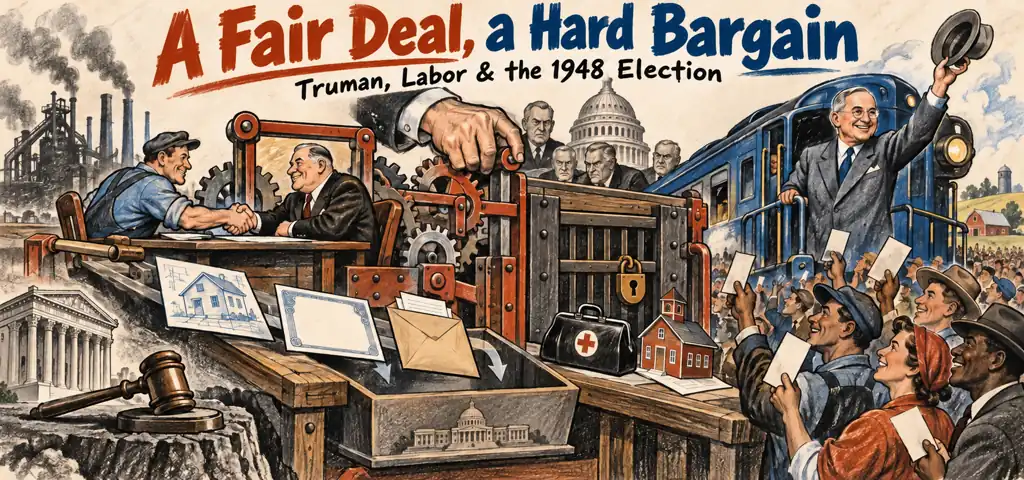
Chapter 11 of the CLEP History of the United States II study guide on Effortless Math covers Taft-Hartley, the Fair Deal, and the Election of 1948: the key terms, the core ideas, and worked examples showing how this topic is tested on the exam.
CLEP History of the United States II, Chapter 11
Reconversion revived distributional conflict
Victory ended federal war contracts, released millions of service members, and shifted factories toward civilian goods. Pent-up demand met shortages and inflation while workers tried to preserve wartime earnings. In 1946 strikes spread through steel, coal, railroads, automobiles, and electrical manufacturing. These disputes did not simply continue wartime mobilization: price controls were weakening, the War Labor Board had disappeared, and unions now bargained over how the gains and costs of reconversion would be divided. The strike wave also gave conservatives a powerful argument that New Deal labor policy had made unions too strong.
Truman's rail intervention revealed executive pressure short of seizure
When a nationwide railroad strike threatened in May 1946, President Truman announced that the government would operate the railroads and asked Congress for authority to draft striking workers into the armed forces. Union leaders ended the walkout before Congress completed that proposal. The episode illustrates both presidential pressure and its limits. Truman could invoke emergency administration, public opinion, and threatened legislation, but he could not permanently rewrite collective-bargaining law by announcement. It also strained his relationship with organized labor even though unions remained central to the Democratic coalition.
Taft-Hartley revised rather than repealed the Wagner system
The Labor Management Relations Act of 1947, commonly called Taft-Hartley, passed over Truman's veto. It retained collective bargaining and the National Labor Relations Board but prohibited specified union unfair labor practices, authorized presidential requests for eighty-day injunctions in disputes threatening national health or safety, outlawed the closed shop, and permitted union shops only under regulated conditions. Union officers had to file noncommunist affidavits to use NLRB procedures. The law therefore narrowed union power within the existing statutory system rather than abolishing federally supervised bargaining.
Section 14(b) shifted one choice to the states
Taft-Hartley's Section 14(b) allowed states to prohibit union-security agreements, including arrangements requiring represented workers to pay dues after hiring. States adopting such laws called them right-to-work measures; unions described them as free-rider rules because employees could receive negotiated benefits without supporting representation. The provision produced regional variation inside one national labor framework. On a CLEP question, distinguish a federal guarantee of collective bargaining from a federal permission allowing states to restrict a particular union-security device.
The Eightieth Congress also reorganized the postwar state
Republicans controlled both houses in 1947-1948. Congress enacted Taft-Hartley, revised presidential succession, and proposed the Twenty-second Amendment. The bipartisan Hoover Commission, active from 1947 to 1949, studied the sprawling executive branch and recommended consolidation and clearer management. The Reorganization Act of 1949 authorized presidential reorganization plans that would take effect unless either chamber disapproved within the statutory review period. The Presidential Succession Act of 1947 placed the Speaker and president pro tempore ahead of cabinet officers after the vice president. The Twenty-second Amendment, ratified in 1951, limited elected presidents to two terms.
The Fair Deal sought a wider social-democratic settlement
After winning a full term, Truman asked Congress for national health insurance, expanded Social Security, federal aid to education, housing, a higher minimum wage, civil-rights legislation, and repeal of Taft-Hartley. Congress raised the minimum wage, expanded Social Security coverage, and enacted a major housing law, but rejected national health insurance and most civil-rights bills. The label Fair Deal therefore names both a programmatic vision and a mixed legislative record. It extended New Deal commitments while adapting them to full employment, suburban growth, and postwar inflation.
The Employment Act preserved a goal while weakening the mechanism
Liberals originally sought a Full Employment Bill that would declare a right to useful work and require federal spending sufficient to close employment gaps. The Employment Act of 1946 instead made maximum employment, production, and purchasing power federal objectives. It created the Council of Economic Advisers and required an annual presidential economic report, but did not guarantee an individual job or install an automatic spending formula. The distinction is a recurring legislative pattern: Congress may accept a goal while reducing the enforceable instrument proposed to achieve it.
The Treasury-Federal Reserve Accord ended the wartime peg
During the Second World War the Federal Reserve held Treasury-security rates low so federal borrowing would remain cheap. Continuing that peg after the war required the central bank to buy government debt even when inflation made tighter policy desirable. The conflict sharpened during the Korean War. In March 1951 the Treasury and Federal Reserve reached an accord that ended the binding peg and restored the central bank's freedom to conduct monetary policy apart from routine debt management. The institutions remained separate; neither received authority to set the other's policies.
Civil rights widened the fractures inside the Democratic Party
Truman's civil-rights commission issued To Secure These Rights in 1947. In 1948 he ordered equality of treatment and opportunity in the armed services through Executive Order 9981 and barred racial discrimination in federal employment through Executive Order 9980. Southern delegates resisted the party's civil-rights plank, and Strom Thurmond led the States' Rights Democratic ticket. On the left, Henry Wallace's Progressive Party criticized Cold War policy and called for broader economic and racial reform. The election was thus a four-way contest shaped by distinct regional and ideological defections.
The 1948 upset depended on institutions as well as polling error
Most national reporters expected Republican Thomas Dewey to win. Truman campaigned against the "do-nothing" Republican Congress, defended selected New Deal achievements, and linked farm prosperity and labor rights to Democratic policy. Wallace and Thurmond won votes that would otherwise have been assumed Democratic, yet their support was geographically uneven. Truman retained enough urban workers, farmers, Black voters, and border-state support to assemble an Electoral College majority. National vote totals alone do not explain the result; coalition geography and state-by-state rules do.
Operation Dixie exposed the limits of labor's postwar reach
The Congress of Industrial Organizations launched Operation Dixie in 1946 to organize southern textile and other industrial workers. Employers used racial division, community pressure, weak labor-law enforcement, and anti-communism against the drive. Organizers also struggled with segregated institutions and with the suspicion that national unions threatened local authority. The campaign's limited gains helped preserve a low-union South and later encouraged firms to relocate there. Its failure was not proof that industrial unionism could never cross regional lines; it shows how law, race, employer strategy, and local institutions shaped organizing costs.
Anti-communist requirements changed union politics
Taft-Hartley's affidavit requirement denied NLRB access to unions whose officers refused to swear they were not communists. CIO leaders also expelled several communist-led unions in 1949-1950 amid Cold War pressure and internal disputes. These actions weakened some experienced organizers and narrowed the acceptable political spectrum, while supporters argued that communists subordinated union decisions to an external party line. The causal point is not that every militant union was communist. Anti-communism operated through legal eligibility, federation discipline, employer campaigns, and reputational risk.
Landrum-Griffin regulated internal union government
After Senate investigations exposed embezzlement and rigged elections in the Teamsters and other unions, Congress enacted the Labor-Management Reporting and Disclosure Act of 1959, commonly called Landrum-Griffin. It guaranteed union members a bill of rights that included speech at meetings and secret-ballot elections, limited trusteeships, and required unions and officers to file financial reports with the Department of Labor. It also tightened restrictions on secondary boycotts. These rules concerned member rights, disclosure, and union governance; they did not repeal Taft-Hartley's Section 14(b), create the duty to bargain in good faith, or establish federal pension insurance.
Youngstown marked a constitutional boundary in an emergency
During the Korean War, a wage dispute threatened a steel strike. Truman ordered the secretary of commerce to seize and operate most steel mills in 1952, arguing that uninterrupted production was essential. In Youngstown Sheet & Tube Co. v. Sawyer, the Supreme Court rejected the seizure because neither the Constitution nor a statute authorized it. Justice Robert Jackson's influential concurrence explained that presidential power is strongest with congressional authorization, uncertain when Congress is silent, and weakest when the president acts against Congress's expressed or implied will. Emergency conditions did not themselves supply legislative power.
identify what changed and what survived
Suppose a source calls Taft-Hartley "the end of the Wagner Act."
Postwar liberalism combined durable institutions with blocked ambitions
By 1952 Americans lived under a strengthened presidency, a national-security establishment, collective-bargaining law, economic-policy planning, Social Security, and federal housing programs. Yet Congress had limited union bargaining power, rejected national health insurance, and blocked most civil-rights legislation. Truman sometimes expanded policy through administration or executive orders, but Youngstown demonstrated that executive initiative could encounter judicial limits. The era cannot be summarized as either an uninterrupted New Deal or a complete conservative reversal.
Watch the history in motion
This short lesson adds voices, images, and chronology to the ideas you just studied.
Video: #4 Truman and the Fair Deal, 1948 1952, Flippen American History Classes.
Try four CLEP-style questions
- Why is Taft-Hartley best understood as a revision of the Wagner framework?
- It transferred every labor dispute from federal agencies to state criminal courts.
- It guaranteed closed shops nationwide while eliminating emergency labor injunctions.
- It abolished union elections but retained only federal wage-and-price controls.
- It replaced private unions with compulsory employee organizations run by employers.
- It preserved collective bargaining and the NLRB while restricting specified union practices.
- Even without guaranteeing a job, what durable governing practice did the Employment Act of 1946 establish?
- Judicial appointment of workers whenever private employment fell below its wartime peak
- Automatic appropriations controlled directly by the Council of Economic Advisers
- Recurring executive economic analysis and a presidential report to Congress
- A constitutional right to employment enforceable against a private business
- State veto power over every federal change in interest rates or taxation
- Why could third-party defections hurt Truman without necessarily determining the 1948 outcome?
- Every third-party vote was returned to the Democrats before the Electoral College met.
- Their support was geographically uneven, so the remaining coalition could still win decisive states.
- Wallace and Thurmond competed only in states that cast no electoral votes that year.
- Federal law combined all four tickets into one national popular-vote plurality contest.
- Dewey withdrew from every state in which either minor party appeared on the ballot.
- Why could Taft-Hartley's Section 14(b) produce regional differences in union strength?
- It required each state to create a separate National Labor Relations Board.
- It assigned wage-setting to governors in states with large industrial unions.
- States could restrict union-security agreements, changing organizing conditions across state lines.
- It prohibited collective bargaining only in states admitted after the Second World War.
- States gained authority to suspend federal minimum-wage law during a labor dispute.
Check your answers and reasoning
Independent preparation. CLEP is a registered trademark of the College Board, which does not endorse this lesson.

Related to This Article
More math articles
- How to Find Complementary and Supplementary Angles? (+FREE Worksheet!)
- What Does the CBEST Test Qualify You For?
- Top 10 Free Websites for ATI TEAS 7 Math Preparation
- Mobility, Opportunity Structures, and Mobility Tables
- Number Properties Puzzle – Challenge 17
- The Best Grade 2 Math Worksheets for Kentucky Students
- How to Solve the Absolute Value of Rational Numbers?
- Unit Converter (Length, Mass, Volume, Temperature & More)
- 10 Most Common 8th Grade MAP Math Questions
- Free Grade 4 English Worksheets for ACT Aspire Students
















What people say about "Taft-Hartley, the Fair Deal, and 1948"?
No one replied yet.