Loyalty Programs, HUAC, McCarthyism, and Civil Liberties
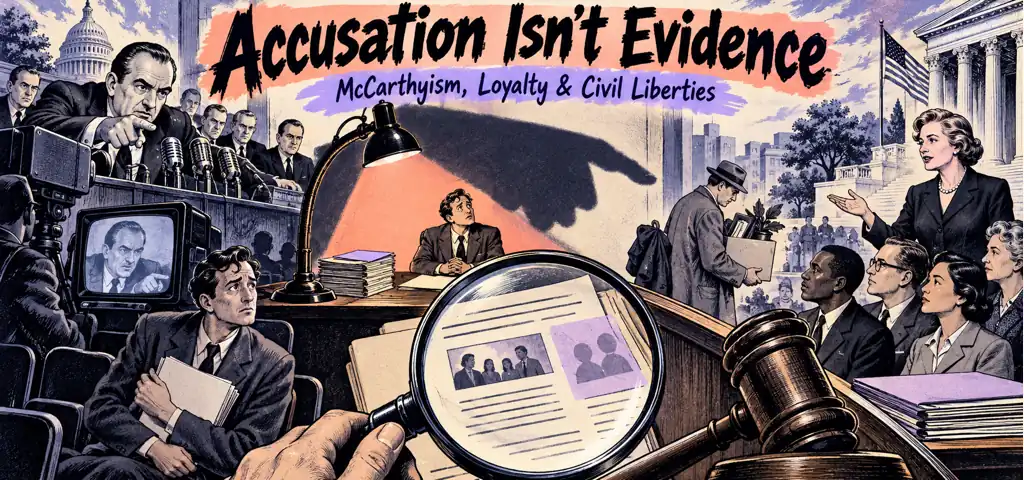
Chapter 11 of the CLEP History of the United States II study guide on Effortless Math covers Loyalty Programs, HUAC, McCarthyism, and Civil Liberties: the key terms, the core ideas, and worked examples showing how this topic is tested on the exam.
CLEP History of the United States II, Chapter 11
Real espionage and political fear occupied the same landscape
The Soviet Union did conduct espionage, and Communist Party members sometimes placed loyalty to an international movement above ordinary party politics. At the same time, officials and politicians used broad association tests, secret evidence, and public accusation against people never convicted of espionage. Accurate history must avoid two errors: denying genuine security breaches and treating every disputed belief, organization, or personal identity as proof of disloyal action.
The federal loyalty program screened association
Executive Order 9835 established loyalty boards for federal employees in 1947. Investigations considered membership, affiliation, and information from security agencies; employees could lose jobs even without a criminal conviction. The program answered Republican charges that Truman was soft on communism as well as administrative concerns. Loyalty screening differed from a prosecution because the government claimed wider discretion as employer, while the employee often lacked the procedural protections of a criminal trial.
HUAC made hearings a public political instrument
The House Un-American Activities Committee investigated alleged subversion. In 1947 it questioned film-industry witnesses about Communist Party membership. Ten writers and directors who refused to answer were cited for contempt of Congress, convicted, and blacklisted by studios. The committee did not conduct a criminal espionage trial. A hearing could generate publicity and employment consequences before or apart from proof of a substantive security offense.
Hiss and the Rosenbergs involved different charges
Whittaker Chambers accused former State Department official Alger Hiss of espionage-related activity, but the limitations period barred an espionage charge. Hiss was convicted of perjury for denying relevant conduct under oath. Julius and Ethel Rosenberg were convicted of conspiracy to commit espionage under the Espionage Act, not treason. Public debate over evidence and punishment continues, but the legal offense in each case must be named precisely.
The Smith Act moved from conspiracy to a narrower boundary
The Smith Act of 1940 prohibited advocacy of violent overthrow and organizing or belonging to groups devoted to it. In Dennis v. United States (1951), the Supreme Court upheld convictions of Communist Party leaders for conspiracy to advocate overthrow, weighing gravity against probability. In Yates v. United States (1957), the Court required proof of advocacy of concrete action rather than abstract doctrine. The later decision narrowed prosecution without declaring all incitement protected.
The Internal Security Act used registration
The McCarran Internal Security Act of 1950 required Communist organizations to register and disclose information through an enforcement board, authorized emergency detention provisions, and tightened exclusion and deportation rules. Truman vetoed it as repressive and ineffective; Congress overrode him. The Communist Control Act of 1954 went further in denying the party legal rights and passed by overwhelming bipartisan margins. Domestic anticommunism cannot be explained as the property of McCarthy or one party.
McCarthy converted unproved charges into power
Senator Joseph McCarthy claimed in 1950 that Communists infested the State Department, repeatedly changing numbers and exploiting secrecy. His investigations and accusations damaged careers even when evidence failed. Senator Margaret Chase Smith's Declaration of Conscience condemned reckless charges from within the Republican Party. McCarthy's influence grew because television, partisan incentives, war in Korea, espionage cases, and public anxiety gave accusation a receptive setting. He amplified the climate; he did not create it alone.
The Army hearings exposed the method
In 1954 televised hearings examined charges and countercharges between McCarthy's committee staff and the Army. Viewers watched bullying, evasions, and attorney Joseph Welch's rebuke. The Senate later censured McCarthy for conduct unbecoming a senator. Censure did not invalidate every anticommunist law or end loyalty programs. It destroyed one senator's authority while broader institutions and fears continued.
Courts set limits on investigation and compelled belief
In Watkins v. United States (1957), the Supreme Court held that Congress could not expose private affairs without a clear legislative purpose and adequate notice of an inquiry's scope. Earlier, West Virginia State Board of Education v. Barnette (1943) had rejected compelled flag salutes, overruling a 1940 decision. Together these cases show civil liberties applying to procedure and belief even amid wartime or Cold War demands for unity.
Barenblatt narrowed Watkins through balancing
In Barenblatt v. United States (1959), the Court upheld a HUAC contempt conviction after finding that the committee had made the subject and pertinence of its questions sufficiently clear. The majority balanced the witness's First Amendment associational interest against Congress's asserted legislative interest in Communist activity and favored the latter. The decision did not erase all associational protection or overrule Watkins; it showed how a clearer inquiry and judicial balancing could narrow that earlier protection.
The Lavender Scare targeted identity as risk
A 1950 Senate report labeled homosexual employees security risks, and Executive Order 10450 in 1953 made "sexual perversion" a ground for exclusion or dismissal. Thousands lost federal jobs over subsequent decades. Officials often assumed susceptibility to blackmail without individualized proof. The purge encouraged secrecy and discrimination while also provoking early homophile organizing. Anticommunist security administration expanded into policing sexuality and gender conformity.
Arendt supplied a theory of totalitarian rule
Hannah Arendt's The Origins of Totalitarianism (1951) treated Nazism and Stalinism as a new form of domination using mass movements, totalizing ideology, terror, and atomized society. Her comparison shaped American Cold War thought but did not claim the two regimes had identical histories or policies. An analytical category can identify structural similarities without erasing distinct origins and victims.
identify the burden of proof
A file lists organizational membership, an anonymous allegation, refusal to answer a committee, and evidence of transmitted documents.
Civil liberty depends on institutional distinctions
Criminal courts, loyalty boards, congressional committees, employers, and political speeches imposed different sanctions. Anticommunism protected genuine secrets and also rewarded accusation, conformity, and discriminatory exclusion. The central historical skill is precise classification: offense, forum, evidence, penalty, and later legal limit. Without it, all security action looks either fabricated or justified.
Watch the history in motion
This short lesson adds voices, images, and chronology to the ideas you just studied.
Video: McCarthyism & the Red Scare, US History with Lennox.
Try four CLEP-style questions
- Why could a federal employee lose a job under the loyalty program without being convicted of espionage?
- Loyalty boards possessed authority to impose federal prison sentences.
- Employment screening used association standards broader than criminal proof.
- The order converted political membership into constitutional treason.
- Congress required courts to affirm each personnel decision in advance.
- Every dismissal followed a public jury trial under the Smith Act.
- Why was a senator's 1950 Declaration of Conscience a political challenge rather than a legal judgment?
- It reversed criminal convictions entered under the Smith Act and McCarran Act.
- The declaration amended the Constitution after approval by three-fourths of the states.
- The speech abolished HUAC through a binding order of the Senate judiciary committee.
- It compelled the executive branch to restore employees dismissed by loyalty boards.
- It condemned accusation without proof but did not decide prosecutions or personnel cases.
- Dismissal records from the Lavender Scare show thousands removed as alleged security risks. What conclusion requires additional evidence?
- Employment rules treated sexuality as a basis for administrative exclusion.
- Security policy produced extensive personal and occupational consequences.
- Dismissal totals can be studied separately from criminal convictions for espionage.
- Those dismissed had actually transmitted classified information to foreign governments.
- The policy helped stimulate organization against discrimination in federal employment.
- Why does McCarthy's 1954 censure not mark the end of domestic anticommunism?
- Broader laws, investigations, employment rules, and public fears continued.
- Censure applied only because McCarthy supported the Communist Party.
- Every loyalty and registration program ended before the vote.
- The Senate transferred his committee powers to the Soviet embassy.
- The Supreme Court restored McCarthy's Senate influence the next year.
Check your answers and reasoning
Independent preparation. CLEP is a registered trademark of the College Board, which does not endorse this lesson.

Related to This Article
More math articles
- The Best TASC Math Worksheets: FREE & Printable
- Overview of the PERT Mathematics Test
- Let’s Do the Math on Tesla’s Electric Cars
- Senate confirmation
- Measuring Length Change: Definite Integrals in Continuous Growth Analysis
- The Best Grade 4 Math Book for Pennsylvania Students
- What are the 12 Algebraic Formulas?
- Division Dynamics: How to Solve Word Problems with Multi-digit Dividends and One-digit Divisors!”
- How to Use Four Operations to Find the Rule of Input/Output Tables
- Free Grade 4 English Worksheets for Maryland Students



















What people say about "Loyalty Programs, HUAC, and McCarthyism"?
No one replied yet.