Nervous and Endocrine Control of Movement
Nervous and Endocrine Control of Movement: this Effortless Math guide explains the topic in plain language, shows how it works through solved examples, and gives you free practice to try immediately, so the idea sticks instead of staying abstract.
Touching something unexpectedly hot can trigger withdrawal before you consciously decide to move.
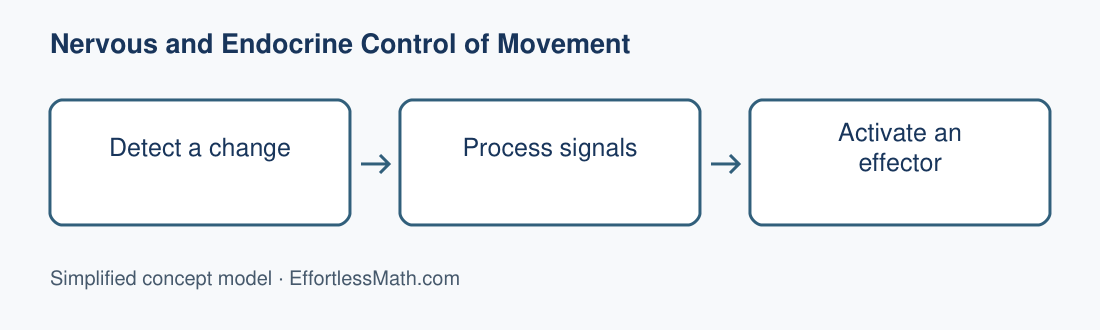
The response still requires organized signaling: receptors detect a change, neural circuits process it, and muscles act.
Body control depends on detecting conditions, processing information, and activating effectors. Nervous signaling uses electrical changes and communication between cells, often producing rapid targeted responses. Endocrine signaling uses hormones released into body fluids. Only responsive target cells with suitable receptors respond, and the two systems frequently coordinate rather than work separately.
How does a neuron communicate?
A neuron receives signals that can raise or lower the likelihood of reaching threshold. An action potential travels along an excitable membrane; its size is not a simple measure of stimulus strength. At a typical chemical synapse, neurotransmitter release affects receptors on another cell. Electrical synapses also exist, so not every neural connection uses that same chemical step.
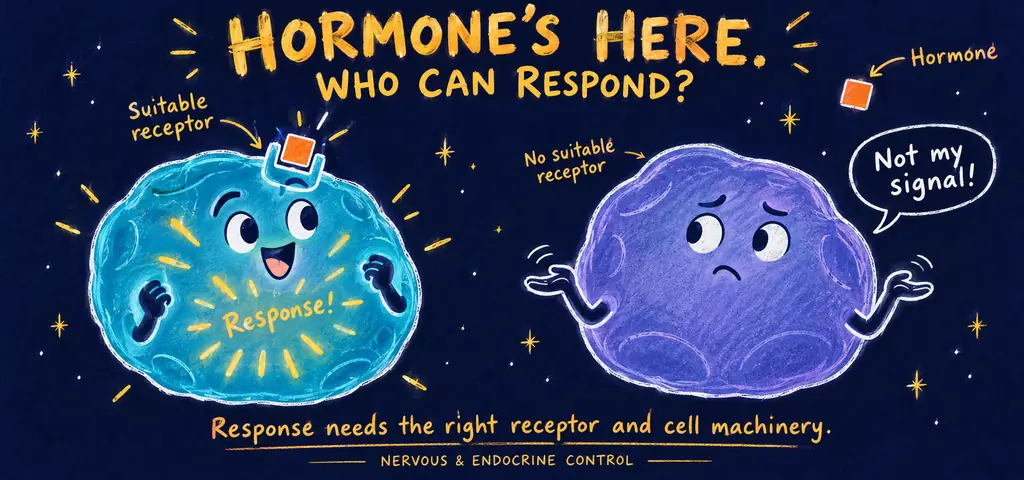
Why does a hormone affect some cells but not others?
A circulating hormone can pass many cells, but a response depends on suitable receptors and cellular machinery. Hormonal effects can be rapid or prolonged; “slow and permanent” is not a reliable definition. Negative feedback reduces a deviation, while positive feedback reinforces a process until a separate event or limit ends the cycle.
How does a muscle pull a bone?
In skeletal muscle, actin and myosin interact in a cycle that uses ATP. Sarcomeres shorten as filaments slide past one another; the filaments themselves do not need to shrink. Tendons transmit muscle force to bones. Because muscles actively pull rather than push, opposing muscles or muscle groups can produce opposite movements around a joint.
Which process does each term describe?
| Term | Meaning in this lesson |
|---|---|
| Receptor | Detects a stimulus or receives a signal |
| Integrating center | Processes information and coordinates a response |
| Effector | Produces the response, such as a muscle or gland |
How can you reason through an example?
In a simplified withdrawal reflex, a sensory neuron carries information from the skin to a spinal circuit. Interneurons help coordinate motor output, and motor neurons activate muscles. Information also reaches the brain. “Spinal reflex” does not mean the brain never receives the signal, nor does it mean every reflex in the body is organized in the spinal cord.
- Find the stimulus and receptor.
- Trace the signal to a processing circuit or hormonal control system.
- Identify the effector and explain how its action changes the condition.
Can you apply the ideas?
Answer these six questions before opening the explanations.
- Does a stronger stimulus normally make each action potential taller?
- Why might a cell ignore a circulating hormone?
- What links skeletal muscle to bone?
- Do actin filaments become shorter during contraction?
- Must every reflex pass through the spinal cord?
- Does negative feedback always stop the controlled process entirely?
Check the six answers and explanations
- No. Stimulus intensity can be represented through firing patterns and recruited neurons rather than larger individual action potentials.
- It may lack the appropriate receptor or response machinery.
- A tendon.
- No. Filaments slide so the sarcomere shortens.
- No. Some reflex circuits involve the brainstem or other locations.
- No. It counteracts a deviation and adjusts activity toward regulated conditions.
What does the video explain?
Watch Endocrine System by Amoeba Sisters. It develops one part of this lesson; return to the reading for the other connections.
Where does this lesson fit?
Use the Biology Learning Hub to choose your next topic. Related lessons explain cells, tissues, and homeostasis, how body systems cooperate, DNA, RNA, and protein synthesis.
Further reading: OpenStax Biology 2e topic reference. Lesson text and diagrams are original educational material; examples marked hypothetical are teaching scenarios.
Recommended study resources
The algebra bundle below supports quantitative skills used in science, including reading relationships, working with units, and solving for unknown quantities.


Related to This Article
More math articles
- 3rd Grade WY-TOPP Math Worksheets: FREE & Printable
- How to Score High in SAT Math?
- Place Value: The Hidden Foundation of All Math
- Top 10 Tips to Create a CLEP College Mathematics Study Plan
- How to Solve Rational Exponents and Radicals?
- The Ultimate CLEP Calculus Course: A Comprehensive Review
- The Best Grade 3 ELA Practice Tests for Hawaii Students
- How to Discover the Key to Math Mastery: “TABE Math for Beginners” Solution Manual Unveiled
- Algebra Puzzle – Challenge 43
- Relative Deprivation




















What people say about "Nervous and Endocrine Control of Movement"?
No one replied yet.