Geometry Puzzle – Challenge 73
A square with perimeter 13 cm has side 13/4 cm. An equilateral triangle with perimeter 7 cm has side 7/3 cm. The difference of the sides: 13/4 - 7/3 = 39/12 - 28/12 = 11/12 cm.
Key takeaways:
- Side of square = perimeter / 4 = 13/4 cm.
- Side of equilateral triangle = perimeter / 3 = 7/3 cm.
- Common denominator: 13/4 = 39/12, 7/3 = 28/12.
- Difference: 39/12 - 28/12 = 11/12 cm.
- Get all fractions to common denominators before subtracting.
Time for another great math challenge for those who enjoy solving mathematics and critical thinking challenges.
Challenge:
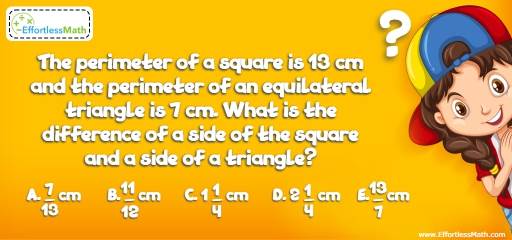
The perimeter of a square is 13 cm and the perimeter of an equilateral triangle is 7 cm. What is the difference of a side of the square and a side of a triangle?
A- \(\frac{7}{13}\) cm
B- \(\frac{11}{12}\) cm
C- \(1\frac{1}{4}\) cm
D- \(2\frac{1}{4}\) cm
E- \(\frac{13}{7}\) cm
The Absolute Best Book to Challenge Your Smart Student!

The correct answer is B.
Original price was: $27.99.$17.99Current price is: $17.99.
The perimeter of a square is 13cm. Therefore, one side of the square is \(\frac{13}{4}\) cm.
The perimeter of the equilateral triangle is 7cm. Therefore, one side of the triangle is \(\frac{7}{3}\) cm.
The difference of a side of the square and a side of a triangle is:
\(\frac{13}{4} – \frac{7}{3} = \frac{39-28}{12} = \frac{11}{12}\) cmThe Best Books to Ace Algebra
Frequently Asked Questions
How do I find one side of a square from its perimeter?
Divide by 4. A square has 4 equal sides, so side = perimeter / 4. For perimeter 13: side = 13/4 = 3.25 cm.
How do I find one side of an equilateral triangle from its perimeter?
Divide by 3. An equilateral triangle has 3 equal sides, so side = perimeter / 3. For perimeter 7: side = 7/3 cm.
How do I subtract 13/4 and 7/3?
Find a common denominator. LCM(4,3) = 12. So 13/4 = 39/12, 7/3 = 28/12, and 13/4 – 7/3 = 11/12.
Why use a common denominator?
Fractions can only be added or subtracted directly when they share the same denominator. Different denominators represent different size pieces.
Can I check by converting to decimals?
Yes. 13/4 = 3.25, 7/3 = 2.333…, difference = 0.9166… = 11/12.
How do I simplify 11/12?
11 and 12 share no common factor besides 1, so 11/12 is already in simplest form.
Why does the square have a larger side here?
Because 13/4 = 3.25 is larger than 7/3 ≈ 2.33. The square’s perimeter (13) is closer to 4 times the triangle’s perimeter (7), so each square side is larger than each triangle side.
What if both perimeters were equal?
Equal perimeters give different sides because the shapes have different side counts. With perimeter P: square side = P/4, triangle side = P/3. The triangle’s sides are longer.
Where do shapes with fractional sides appear?
Sewing patterns, packaging design, architectural blueprints, and any field that requires precise measurements smaller than a whole unit.
What grade can solve this?
Middle school (Grade 5-7), once students are comfortable with fraction subtraction and basic perimeter formulas.
Related Lessons You May Like
- How to find the area of rectangles
- How to find the perimeter of rectangles
- How to find the area of triangles
- How to solve systems of equations
- How to solve multi-step word problems
If your student enjoys these puzzles, Geometry for Beginners works the same relationships inside a full curriculum. Pre-Algebra for Beginners covers the algebra foundations.

Related to This Article
More math articles
- The Ultimate Precalculus Course (+FREE Worksheets & Tests)
- Intelligent Math Puzzle – Challenge 87
- Cartels face an incentive to cheat
- 49 Printable Maryland MCAP Grade 5 Math Worksheets — Free Download with Step-by-Step Keys
- Iron triangles and issue networks
- Top 10 SSAT Upper Level Prep Books (Our 2023 Favorite Picks)
- HiSET Math Formulas
- The Ultimate 7th Grade LEAP Math Course (+FREE Worksheets)
- What to Consider When Retaking the ACT or SAT
- Mastering the Basics: The Significance of “Algebra I for Beginners” in Your Back-to-School List








What people say about "Square and Rectangle Perimeter Puzzle"?
No one replied yet.