Gene Regulation and Cell Specialization
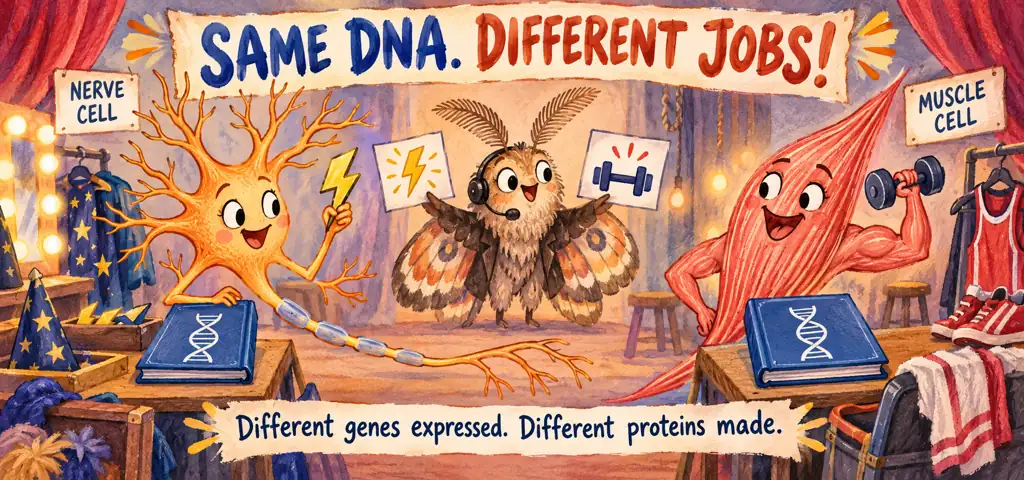
A nerve cell and a muscle cell can carry essentially the same genome. Their proteins differ. A cell controls which genes it uses and how much product it makes, so you need evidence about gene expression to explain its specialized work.
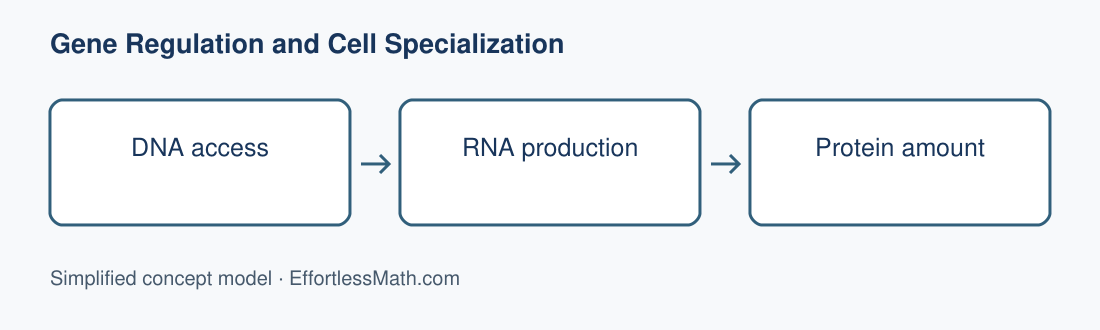
Gene regulation is the control of when, where, and how much a gene is expressed. Cells can regulate access to DNA, transcription, RNA processing and stability, translation, and protein activity. These controls help cells respond to signals and maintain specialized functions without requiring a different genome for every cell type.
Where can a cell control gene expression?
Start with a protein-coding gene. Making its product requires transcription into RNA and translation of that message. In eukaryotes, chromatin accessibility can influence transcription. RNA processing and degradation can affect the available message. And translation or protein breakdown can alter the final amount of protein. A change in protein activity can also occur without making more protein.

How does the lac operon respond to food?
In the standard E. Coli model, the lac repressor limits transcription when its operator is occupied. Allolactose, a molecule derived from lactose, binds the repressor and reduces its binding to the operator. Low glucose supports activation through the cAMP, CAP system. Strong expression therefore depends on both relief of repression and appropriate activation. “Lactose present” alone does not describe every condition.
Does a mutation always change the protein?
No. A substitution can be synonymous, change one amino acid, create a stop signal, or affect regulation. An insertion or deletion within a coding sequence shifts the reading frame when its length is not a multiple of three. Specify the mutation’s location and molecular effect before predicting its consequence.
Which process does each term describe?
| Term | Meaning in this lesson |
|---|---|
| Transcription control | Changes production of RNA from a gene |
| RNA stability | Changes how long an RNA remains available |
| Protein activity control | Changes what an existing protein does |
How can you reason through an example?
In a hypothetical experiment, a hormone increases a cell’s mRNA for an enzyme, and enzyme amount rises later. This supports regulation at or before mRNA accumulation. It does not by itself prove faster transcription: slower mRNA breakdown could also increase mRNA. Measuring new RNA production would help distinguish those explanations.
- Name the measured product: RNA, protein amount, or protein activity.
- Identify which stage could change that measurement.
- Separate what the data support from what would need another measurement.
Can you apply the ideas?
Answer these six questions before opening the explanations.
- Why can two cell types make different proteins with similar DNA?
- What directly binds the lac repressor in the standard induction model?
- Is high mRNA proof of rapid transcription?
- Does a three-base deletion necessarily shift the downstream reading frame?
- Can a cell change enzyme activity without changing its gene sequence?
- Why is a promoter mutation potentially important?
Check the six answers and explanations
- They express different sets and amounts of genes.
- Allolactose. It changes the repressor’s ability to bind the operator.
- No. Reduced RNA degradation can also raise mRNA abundance.
- No. It preserves the frame, although it can remove an amino acid and change protein function.
- Yes. Regulatory binding or chemical modification can change an existing enzyme’s activity.
- It may alter transcription and the amount of gene product even when the protein-coding sequence is unchanged.
What does the video explain?
Watch Gene Expression and Regulation by Amoeba Sisters. Use the video to locate regulation before transcription and after an RNA is made. Explain which of those steps could change the amount of mRNA measured in the hormone experiment.
Where does this lesson fit?
Use the Biology Learning Hub to choose your next topic. Related lessons explain testing a biological explanation, how DNA instructions become proteins, organisms in ecosystems.
Further reading: OpenStax Biology 2e topic reference. Lesson text and diagrams are original educational material. Examples marked hypothetical are teaching scenarios.
Recommended study resources
The algebra bundle below supports quantitative skills used in science, including reading relationships, working with units, and solving for unknown quantities.

For the AP course sequence and practice tests, use the AP Biology study hub.

Related to This Article
More math articles
- Alaska AK STAR Grade 6 Math Free Worksheets: Standards-Aligned Practice PDFs, No Signup Required
- 5th Grade MEA Math Worksheets: FREE & Printable
- How to Find Values of Functions from Graphs?
- Corporations, Trusts, and Vertical versus Horizontal Integration
- How to Complete a Graph and Table Linear Function
- Zero and One: The Fundamental Pillars of Mathematics
- Is the ACCUPLACER Test hard?
- Media strategy
- How to Use Models to Divide Whole Numbers by Unit Fractions?
- Rational-basis review




















What people say about "Gene Regulation and Cell Specialization"?
No one replied yet.