DNA, RNA, and Protein Synthesis
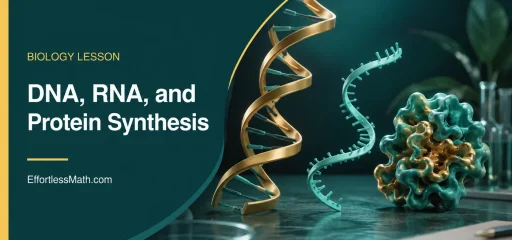
DNA stays in the nucleus while a ribosome in the cytoplasm builds a protein. How does the instruction reach it? For a nuclear protein-coding gene, messenger RNA carries a copy of the sequence information. You can follow that message to separate transcription from translation.
DNA stores genetic instructions in nucleotide sequences. During transcription, RNA is synthesized from a DNA template. A protein-coding gene can supply messenger RNA for translation. Other genes produce functional noncoding RNAs. During translation, a ribosome reads messenger RNA codons while transfer RNA brings amino acids, producing a polypeptide that can fold into a functional protein.
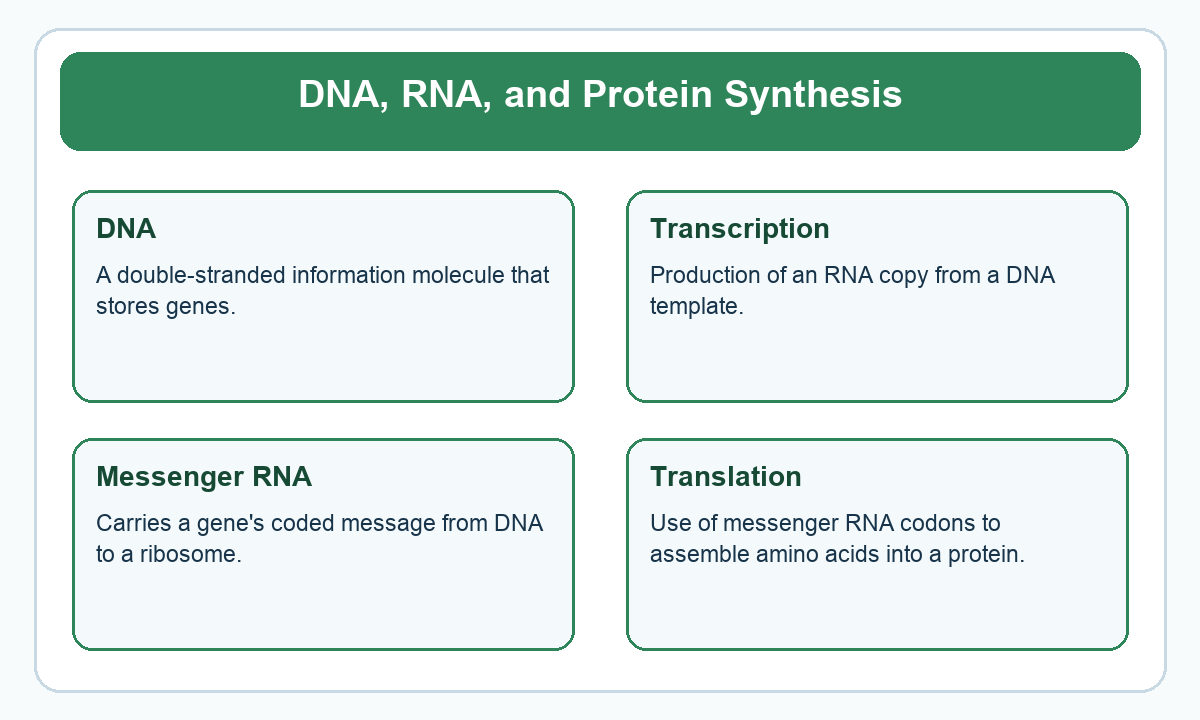
Terms used in this lesson
| Idea | What it means |
|---|---|
| DNA | A double-stranded information molecule that stores genes. |
| Transcription | Production of an RNA copy from a DNA template. |
| Messenger RNA | Carries a gene’s coded message from DNA to a ribosome. |
| Translation | Use of messenger RNA codons to assemble amino acids into a protein. |
Track the template and product
During transcription, RNA polymerase uses a DNA strand as a template to make RNA. A protein-coding gene can produce messenger RNA, but other genes produce functional RNAs such as ribosomal RNA and transfer RNA. Transcription therefore does not always lead to a protein product.
In a typical eukaryotic nuclear gene, the initial RNA transcript is processed before the mature messenger RNA leaves the nucleus. Ribosomes in the cytoplasm then read that message. Bacteria lack a nucleus, so their transcription and translation do not require this nuclear export step.
Read the messenger RNA in triplets
A codon contains three RNA bases. In the standard genetic code, AUG specifies methionine and commonly serves as the start codon. A ribosome establishes a reading frame and advances through successive codons. Transfer RNAs pair their anticodons with codons and deliver the appropriate amino acids.
Consider AUG UUU GAA UAA in that reading frame. The first three codons specify methionine, phenylalanine, and glutamate. UAA is a stop codon, so it signals termination rather than adding a fourth amino acid. Release factors help end translation at a stop codon.
Predict what a sequence change could do
If UUU changes to UUC, the standard code still specifies phenylalanine. This is a synonymous change at the level of the amino acid sequence. A different substitution might specify another amino acid or create a stop signal. Its effect on protein function depends on the change and its location.
Inserting or deleting one base within the translated region can shift the reading frame and alter many later codons. An insertion of three bases does not shift the downstream frame, although the resulting additional amino acid can still affect the protein.
Keep the products distinct
Replication copies DNA. Transcription makes RNA from a DNA template, and translation makes a polypeptide using messenger RNA. Write the starting molecule and product beside each arrow before comparing answer choices.
The completed polypeptide must fold, and some proteins undergo further processing or join other subunits before functioning. A gene sequence alone does not tell you whether enough active protein will be present in a particular cell. Gene regulation, RNA processing, translation, and protein turnover can all affect that outcome.
Watch a short lesson
Follow transcription and translation, separating the roles of DNA, messenger RNA, transfer RNA, and ribosomes.
Follow a mutation through the message
Compare a substitution with an insertion or deletion. Use the codon examples above to explain why a change can preserve an amino acid, alter one, or shift the reading frame.
Practice without looking at the answers
Write your responses before opening the answer panels.
-
What is the immediate product of transcription?
Check the answer
RNA synthesized from a DNA template. It may be a precursor to messenger RNA or a functional noncoding RNA.
-
For a typical nuclear protein-coding gene, what carries the message to cytoplasmic ribosomes?
Check the answer
Mature messenger RNA. The nuclear DNA remains in the nucleus during this process.
-
What does a ribosome read during translation?
Check the answer
Messenger RNA codons, each containing three bases in the established reading frame.
-
Using the standard code, how many amino acids does AUG UUU GAA UAA specify before termination?
Check the answer
Three: methionine, phenylalanine, and glutamate. UAA signals stop and does not specify an amino acid.
-
Why can UUU changing to UUC leave the amino acid sequence unchanged?
Check the answer
Both codons specify phenylalanine in the standard genetic code.
-
How can deleting one base affect later codons?
Check the answer
Within a translated region, it can shift the reading frame so that subsequent bases are grouped differently, potentially changing many downstream amino acids.
Where does this fit in your science review?
The ATI TEAS Science Study Hub places this lesson inside the larger biology review. Continue with these connected lessons:
For the AP course sequence and practice tests, use the AP Biology study hub.

Related to This Article
More math articles
- Congressional Reconstruction and Johnson’s Impeachment
- Voting
- Reagan’s Cold War, Iran-Contra, and the Soviet Collapse
- Market factor demand adds firms’ input demands
- How much Does It Cost to Retake the CBEST Test?
- SIFT Math Formulas
- Standing committees
- Modern Environmentalism, the EPA, and the Regulatory State
- How to Use a Graph to Factor Polynomials
- Reading and Writing Numbers in Different Forms for 4th Grade










What people say about "DNA, RNA, and Protein Synthesis"?
No one replied yet.