Mendelian Genetics

Two Aa parents can have an aa offspring. Each contributes one allele. A Punnett square lets you track those contributions and calculate their probabilities, provided you know the inheritance pattern and the parents’ genotypes. Start with the possible gametes before filling any boxes.
Mendelian genetics tracks how alleles can pass from parents to offspring. A genotype names the allele combination, while a phenotype describes the observable result. A Punnett square organizes possible gamete combinations. It predicts probabilities for many offspring, not a guaranteed outcome for one child.
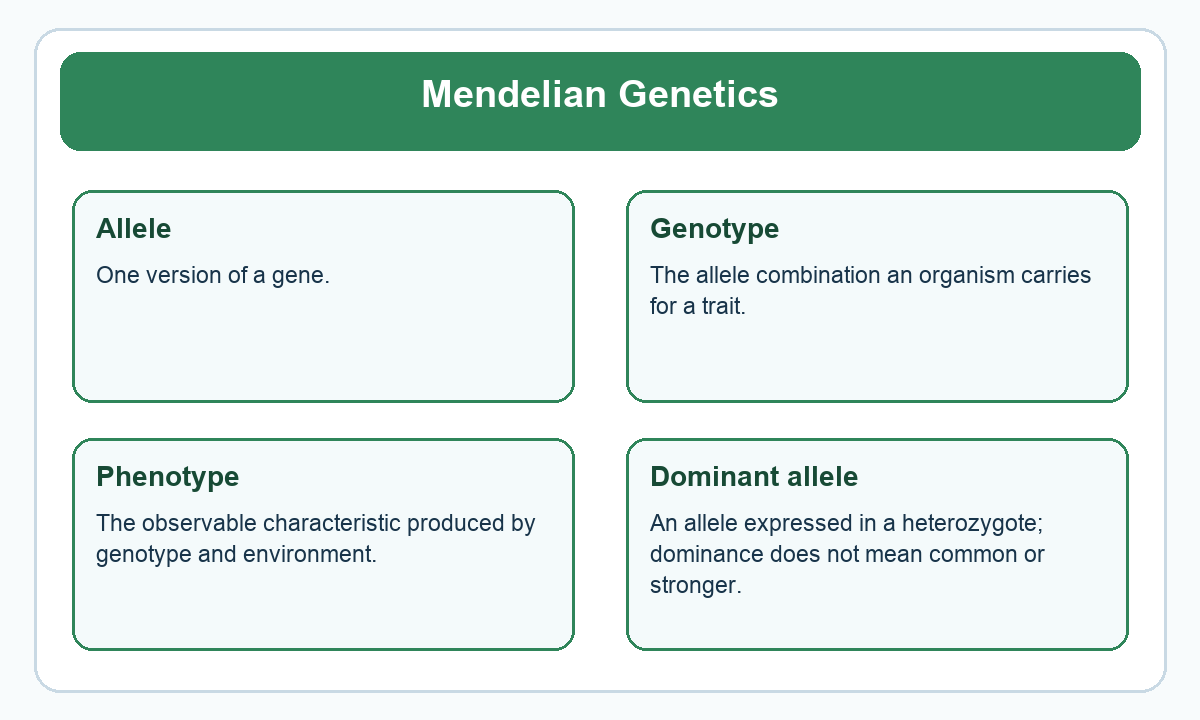
Terms used in this lesson
| Idea | What it means |
|---|---|
| Allele | One version of a gene. |
| Genotype | The allele combination an organism carries for a trait. |
| Phenotype | The observable characteristic produced by genotype and environment. |
| Dominant allele | An allele whose associated phenotype appears in the heterozygote for the trait being examined. Dominance does not mean common or stronger. |
Build the cross from gametes
Assume a single autosomal gene with alleles A and a, complete dominance of A, and normal Mendelian segregation. An Aa parent produces gametes carrying A or a with equal probability. Put those two possibilities along an edge of the Punnett square, then do the same for the other parent.
Combining the row and column entries gives AA, Aa, aA, and aa. Aa and aA describe the same heterozygous genotype. The expected genotype probabilities are one-quarter AA, one-half Aa, and one-quarter aa.
Convert genotype to phenotype
With complete dominance, AA and Aa show the dominant phenotype, giving a three-quarter probability of that phenotype in this cross. The recessive phenotype requires aa and has probability one-quarter. A codominant trait would require a different phenotype count.
Dominance describes the heterozygote’s phenotype for the trait being examined. It does not establish that an allele is common, beneficial, or increasing in the population. A rare allele can be dominant.
Interpret probability for separate offspring
Four equally likely boxes do not assign four outcomes in a fixed order. Under the same cross assumptions, the next offspring has a one-quarter chance of aa even if earlier offspring all showed the dominant phenotype. Small families can depart substantially from the expected ratio.
For two independent offspring, the chance that both are aa is one-quarter multiplied by one-quarter, or one-sixteenth. To find the probability of a heterozygote in a single Aa by Aa cross, add the two mutually exclusive routes, A from the first parent with a from the second and the reverse.
Know when the model needs more information
Some traits show incomplete dominance or codominance. Others involve several genes and environmental effects. A phenotype such as plant height may reflect growth conditions as well as genotype, so an observable difference alone does not identify the alleles an organism carries.
For an individual with the dominant phenotype, the genotype could be AA or Aa under the simple model. A testcross with aa can help distinguish them. An Aa parent can produce recessive offspring in that cross, whereas an AA parent would produce only Aa offspring under the stated assumptions.
Even then, a small sample containing only dominant offspring does not prove that the unknown parent is AA. Chance can produce that sample from Aa. Use the size and pattern of the offspring sample when judging how strongly the evidence supports a genotype.
Watch a short lesson
The genes-alleles-and-Punnett-squares video directly models the vocabulary and probability reasoning used in this lesson.
Practice without looking at the answers
Write your responses before opening the answer panels.
-
What gametes can an Aa parent produce under normal Mendelian segregation?
Check the answer
A-bearing and a-bearing gametes, each with probability one-half.
-
What is the probability of aa from Aa crossed with Aa?
Check the answer
One-quarter, because each parent must contribute a, with probability one-half times one-half.
-
Why do Aa and aA count as one genotype?
Check the answer
They contain the same two alleles. The order used to write them does not create another allele combination.
-
Does a dominant allele have to be common?
Check the answer
No. Dominance concerns the heterozygote’s phenotype, not the allele’s frequency in a population.
-
What is the probability that two independent offspring from Aa by Aa are both aa?
Check the answer
One-sixteenth, found by multiplying one-quarter by one-quarter.
-
An unknown dominant-phenotype parent crossed with aa produces an aa offspring. What does that support?
Check the answer
Under the simple complete-dominance model, the unknown parent is Aa because it contributed a. An AA parent could not produce aa in that cross.
Where does this fit in your science review?
The ATI TEAS Science Study Hub places this lesson inside the larger biology review. Continue with these connected lessons:
- Mitosis and Meiosis
- Biological Macromolecules
- DNA, RNA, and Protein Synthesis
- Microorganisms and Disease
For the AP course sequence and practice tests, use the AP Biology study hub.

Related to This Article
More math articles
- Algebra Puzzle – Challenge 47
- Human Ecology and Urban Spatial Models
- 3rd Grade PARCC Math Practice Test Questions
- Florida Algebra 1 EOC Practice Test PDF with Answers for 2026
- Chapter 12: Presidential Organization and Decision-Making
- FREE 3rd Grade MAP Math Practice Test
- The Best Grade 3 ELA Practice Tests for Arkansas Students
- Powerful Decimals: How to Uncover the Missing Number in Division by Powers of 10
- The Ultimate MCAP Algebra 1 Course (+FREE Worksheets)
- The Role of Statistics in Analyzing Sports Performance


















What people say about "Mendelian Genetics"?
No one replied yet.