Biological Macromolecules
Look beyond the food label. A slice of bread contains starch alongside proteins, lipids, and DNA from wheat cells, so calling the whole slice a carbohydrate hides its molecular variety. To identify one molecule, examine its building blocks and the bonds that connect them.
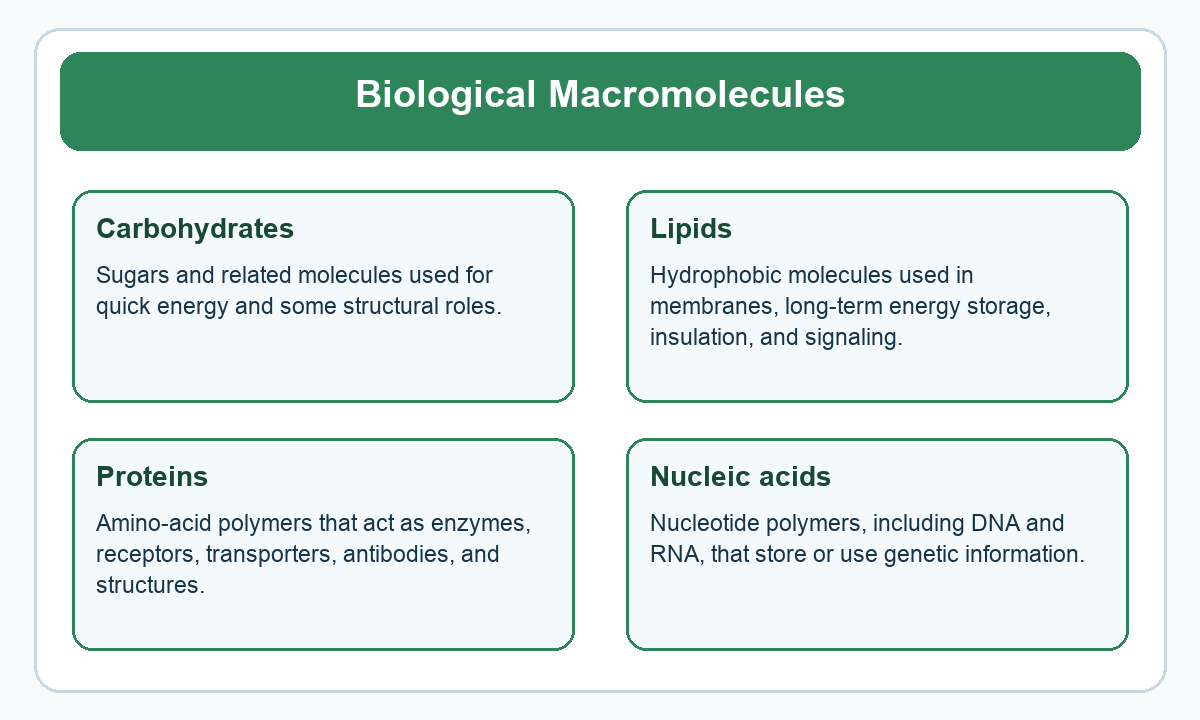
Biologists group the molecules discussed here into carbohydrates, lipids, proteins, and nucleic acids. Proteins, nucleic acids, and large carbohydrate polymers are macromolecules. The lipid family includes many smaller molecules and has no single repeating monomer shared by every member.
Sugars can become fuel or building material
Glucose is a single sugar. Cells can break it down and transfer some of its chemical energy into ATP. Join glucose units into chains and the result depends on how the units connect. Starch stores glucose in plants, while glycogen stores it in animals and fungi. Cellulose also contains glucose, yet its linkage pattern produces strong plant cell walls.
Human digestive enzymes can break the linkages in starch. They cannot break the main linkages in cellulose. The building block alone therefore does not tell you whether a molecule is digestible. Follow the bonds too.
Why fats and membranes belong together
A triglyceride contains glycerol attached to three fatty acids. Its largely nonpolar structure suits energy storage. A phospholipid has a water-attracting head and water-avoiding tails. In water, these features help phospholipids arrange into a bilayer with the tails sheltered inside.
The bilayer forms the framework of a cell membrane. Embedded proteins provide selective channels, carry substances across, or receive signals. Cholesterol is another lipid, with fused carbon rings. Calling every lipid a chain of fatty-acid monomers would miss that structural variety.
Protein sequence affects what a cell can do
Proteins are chains of amino acids. Interactions among the amino acids and the surrounding water help a chain fold. A change near an enzyme’s active site can change substrate binding, even when the protein still contains the same number of amino acids.
Most enzymes are proteins. Some RNA molecules, called ribozymes, also catalyze reactions. An enzyme lowers a reaction’s activation energy and can be used again, although heat, pH changes, or other conditions can damage it. A faster reaction does not mean the enzyme changed the reaction’s equilibrium.
DNA and RNA use nucleotide sequences
A nucleotide contains a sugar, phosphate, and a nitrogenous base. DNA stores inherited sequence information. RNA has several jobs: mRNA supplies a template for translation, tRNA helps match amino acids to codons, and ribosomal RNA contributes to the ribosome’s structure and catalytic work.
Consider a mutation that changes an enzyme’s amino-acid sequence. The altered information begins in DNA, is represented in RNA, and can affect a protein’s shape. The consequences may then reach carbohydrate breakdown or membrane transport. One question can involve several molecule families without changing the definition of any family.
Digestion also illustrates hydrolysis. Water contributes an H and an OH as a covalent link is broken, helping separate a polymer into smaller products. At the level of net chemical change, condensation can join units while releasing the components of water. Cells use enzymes and energy coupling to accomplish their synthesis reactions. These terms describe chemical changes, so melting a fat or dissolving sugar in water does not automatically count as hydrolysis.
Watch a short lesson
Compare the four biomolecule families, their subunits, and examples of what they do in cells.
Can you check your understanding?
Answer before opening each explanation.
-
What is the repeating building block of a protein?
Check the answer
An amino acid. The order of amino acids helps determine how the protein folds and functions.
-
Why can starch and cellulose have different properties if both contain glucose?
Check the answer
Their glucose units are linked differently. Human enzymes digest starch but do not break the principal linkages in cellulose.
-
What makes a phospholipid suited to a membrane?
Check the answer
Its polar head interacts with water, while its nonpolar tails cluster inside the bilayer.
-
Are all enzymes proteins?
Check the answer
Most are proteins, but catalytic RNA molecules called ribozymes are exceptions.
-
Which molecule supplies codons to a translating ribosome?
Check the answer
Messenger RNA, or mRNA. Its nucleotide sequence is read in the established three-base reading frame.
-
Does finding protein in a food mean the food contains no carbohydrates?
Check the answer
No. Foods contain mixtures. Classify the specified molecule from its structure or building blocks rather than assigning the whole food to one family.
Where does this fit in your science review?
The ATI TEAS Science Study Hub places this lesson inside the larger biology review. Continue with these connected lessons:
For the AP course sequence and practice tests, use the AP Biology study hub.

Related to This Article
More math articles
- Long Division using 1 Number
- Progressivism, Muckraking, Pragmatism, and Social Investigation
- Role of Algebra 2 in College Readiness
- Blackjack Insurance Sounds Smart Until You Do the Probability
- Conference committees
- How to Prepare for the ParaPro Math Test?
- Incorporating Technology in Math Education: Tools and Techniques for Modern Teachers
- Region
- Grade 3 Math: Equivalent Fractions
- Multi-Digit Multiplication for 5th Grade: Standard Algorithm











What people say about "Biological Macromolecules"?
No one replied yet.