Gas Laws: Pressure, Volume and Kelvin Temperature
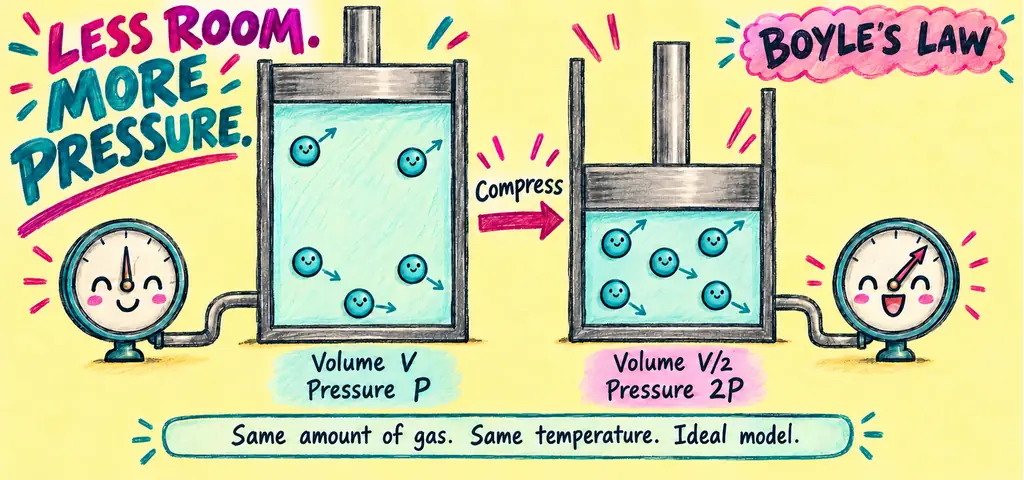
Gas laws relate pressure, volume, temperature, and amount of gas. The ideal gas model neglects particle volume and intermolecular attractions. It gives useful approximations when gases are sufficiently dilute and far from condensation. Gas-law temperatures use kelvin, while pressure and volume units must match the chosen gas constant or ratio.
Compress the same amount of gas at a fixed temperature and its pressure rises. The particles have less volume available and strike the container walls more frequently. A gas-law equation expresses that relationship, provided its assumptions fit the situation.
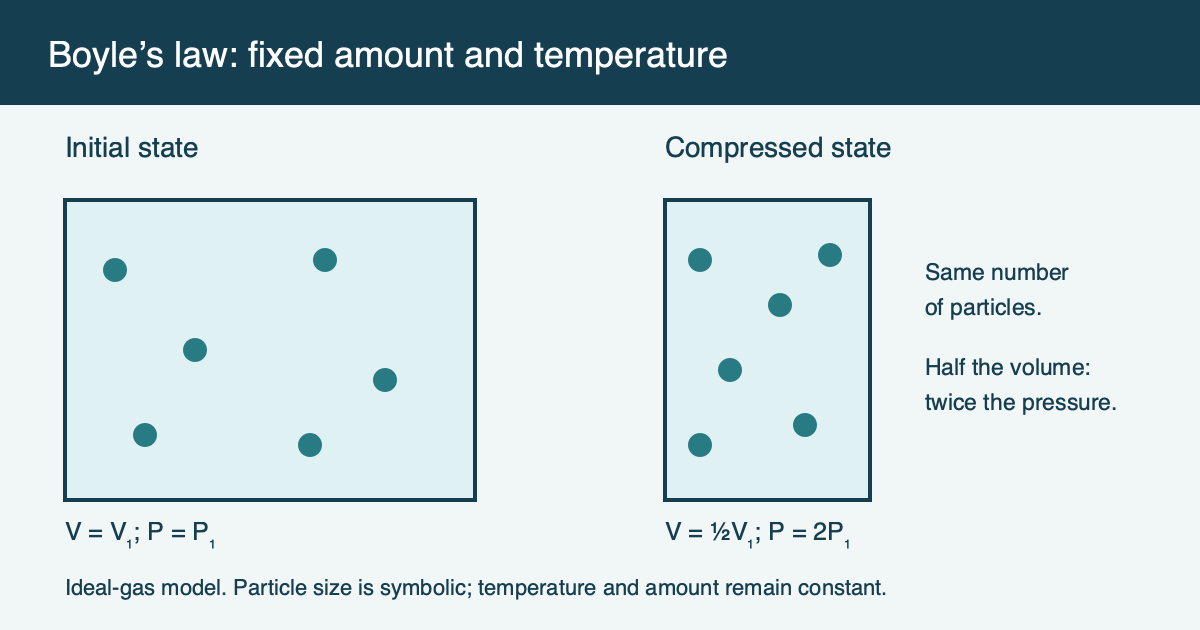
Which quantities are held constant?
For a fixed amount of gas at constant temperature, Boyle’s law gives \(P_1V_1=P_2V_2\). At constant pressure, volume is proportional to absolute temperature. For a fixed amount with both pressure and temperature changing, use
Convert Celsius to kelvin with \(T_K=T_C+273.15\). A ratio of Celsius temperatures does not represent the required absolute-temperature ratio.
Worked example: pressure after compression
A sealed gas sample occupies 2.00 L at 1.20 atm. It is compressed to 0.800 L while temperature remains constant. Assuming ideal behavior,
The volume falls to 40.0% of its original value, so pressure rises by a factor of 2.50. That direction agrees with the particle model.
When do you use the ideal gas equation?
Use \(PV=nRT\) when amount in moles is part of the calculation. For liters and atmospheres, a suitable rounded constant is \(R=0.08206\,\mathrm{L\,atm\,mol^{-1}\,K^{-1}}\). For SI pressure in pascals and volume in cubic meters, use a compatible value of \(R\).
High pressure and conditions near condensation can make particle volume and attractions significant. Under those conditions, the ideal-gas prediction may need a real-gas correction.
How do phase changes differ from gas expansion?
During evaporation, particles leave a liquid’s surface. Boiling occurs throughout a liquid when its vapor pressure reaches the external pressure. The boiling temperature therefore depends on the surrounding pressure.
- Identify the initial and final states.
- Write which quantities stay constant.
- Convert temperatures to kelvin and align units.
- Solve, then check whether the direction of change makes sense.
Can you apply the idea?
-
What temperature scale must be used in gas-law ratios?
Check your answer
Kelvin, the absolute-temperature scale.
-
At constant temperature, what happens to pressure when a fixed gas amount doubles its volume?
Check your answer
Pressure halves under the ideal model.
-
Convert \(25.00\,^{\circ}\mathrm{C}\) to kelvin.
Check your answer
\(298.15\,\mathrm{K}\).
-
At fixed pressure and amount, absolute temperature doubles. What happens to ideal-gas volume?
Check your answer
It doubles.
-
When does boiling occur in relation to vapor pressure?
Check your answer
When the liquid’s vapor pressure reaches the external pressure.
-
Why can the ideal model become inaccurate at very high pressure?
Check your answer
The finite volume of particles and their interactions can no longer be neglected.
Watch the idea explained
The Ideal Gas Law: Crash Course Chemistry #12, CrashCourse.
This selected excerpt runs from 0:50 to 1:35. Boyle law at fixed temperature and gas amount.
Where does this fit?
Use the chemistry learning hub to choose a lesson or practice test. Connect this topic with chemical equilibrium, solutions and concentration, reaction rates, net ionic equations.
Sources for Further Study
OpenStax Chemistry 2e provides further reading on gas-law relationships and kelvin temperature, non-ideal gas behavior, and phase transitions and boiling.
Continue with a chemistry study guide

Related to This Article
More math articles
- 8th Grade MEAP Math Practice Test Questions
- Unlocking the Power of Visualizations: How to Use Diagrams and Drawings to Master Math Concepts
- How to Graph Linear Inequalities? (+FREE Worksheet!)
- Measuring Angles with a Protractor for 4th Grade
- 7th Grade Mathematics Worksheets: FREE & Printable
- Idaho Algebra 1 Free Worksheets: 64 Free Algebra 1 PDF Worksheets, One Skill at a Time
- Freedom of assembly
- Math Books for 8th Graders: Compare Four Options by Learning Need
- The Best Grade 3 Math Book for Kentucky Students
- How to Factor Polynomials?








What people say about "Gas Laws: Pressure, Volume and Kelvin Temperature"?
No one replied yet.