Chemical Equilibrium: Expressions, Q vs. K and Shifts
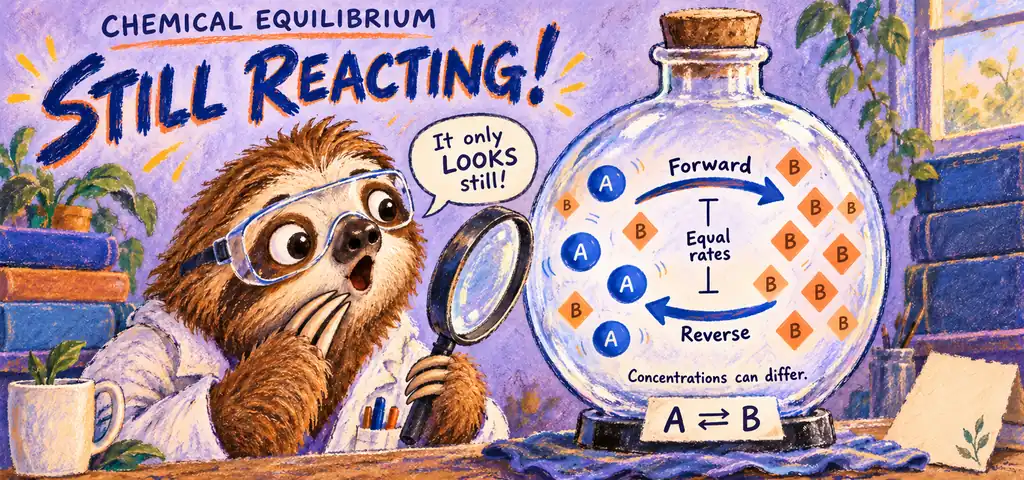
Chemical equilibrium is a dynamic state in which forward and reverse reaction rates are equal under fixed conditions. Equilibrium constants describe the relationship among species activities at equilibrium. Introductory calculations often approximate activities with concentrations or pressures. The reaction quotient uses the same expression for a mixture that may not yet be at equilibrium.
A reaction mixture can look unchanged while particles continue reacting in both directions. At equilibrium, the forward and reverse rates match. The concentrations stay constant, but they need not be equal.
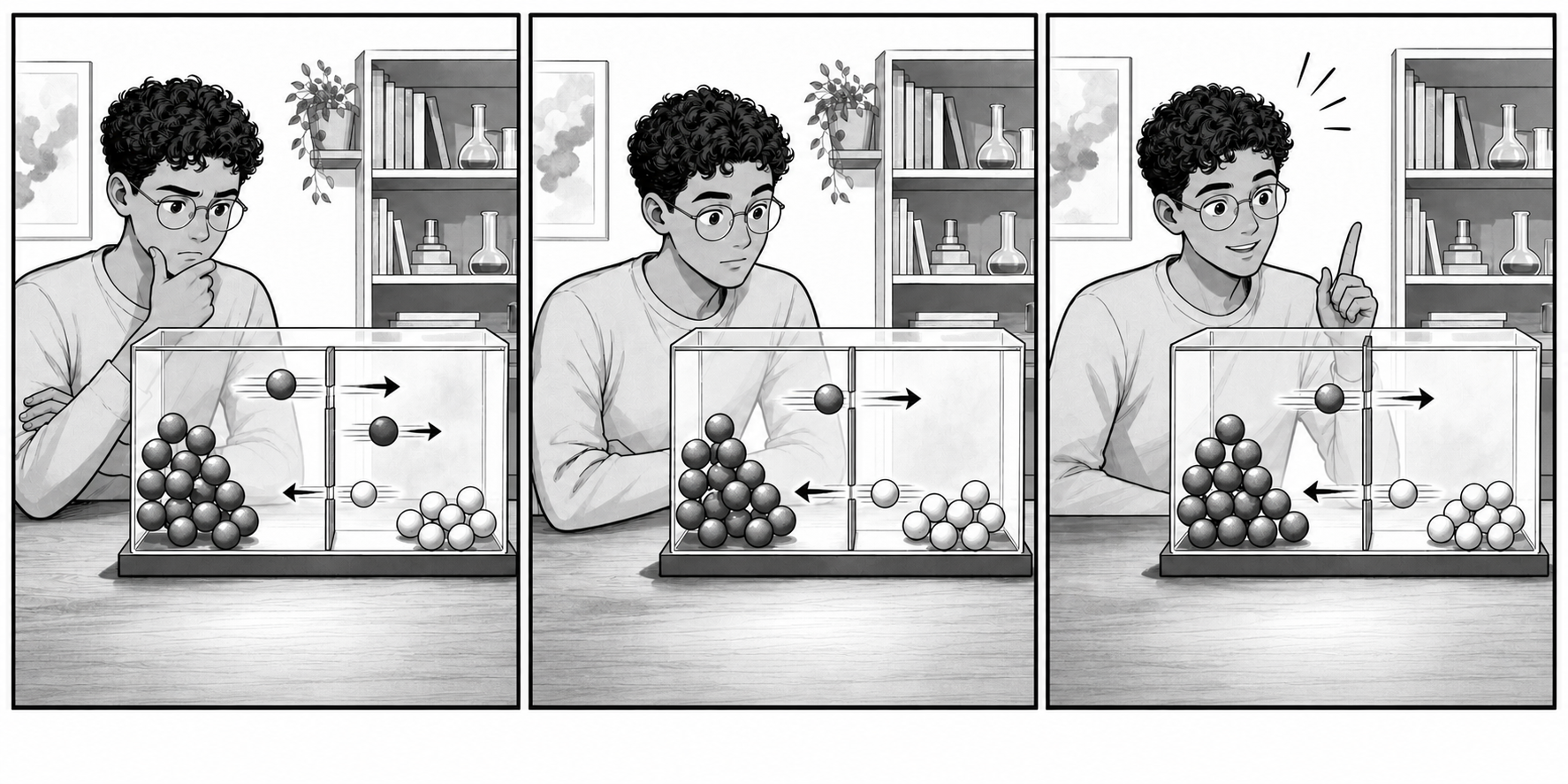
How do you write an equilibrium expression?
For the model reaction \(\mathrm{A(g)+2B(g)\rightleftharpoons C(g)}\), the classroom concentration expression is
The balanced coefficients become exponents. Pure solids and pure liquids are omitted from ordinary introductory expressions because their activities are taken as one. Dissolved species and gases are treated according to the specified model.
Thermodynamic equilibrium constants use dimensionless activities relative to standard states. Follow the concentration or pressure convention stated in your course when carrying out introductory numerical exercises.
Worked example: compare Q with K
Suppose the concentration model gives \(K_c=4.0\), and a mixture has \([A]=0.50\), \([B]=0.50\), and \([C]=0.25\), with concentrations expressed in mol/L. Its quotient is
Since \(Q_c\lt K_c\), net forward reaction is favored as the mixture moves toward equilibrium. Product concentration increases while reactant concentrations decrease in the stoichiometric proportions.
What changes K and what changes the mixture?
For a given reaction and standard-state convention, temperature changes the equilibrium constant. Adding a reactant changes the mixture’s quotient, so the composition adjusts toward the same equilibrium relationship at the original temperature.
A catalyst speeds the approach to equilibrium without changing the equilibrium constant. Compressing a gaseous mixture can shift its composition when the reaction has different total gas coefficients on the two sides. Check the actual equation before predicting the direction.
How do you organize an equilibrium calculation?
- Write the balanced equation and the correct expression.
- List initial amounts or concentrations.
- Represent changes using the equation’s ratios.
- Substitute equilibrium quantities into the expression.
- Reject impossible negative concentrations and check the result.
A large equilibrium constant favors products in the equilibrium expression. It does not by itself say that the reaction reaches equilibrium quickly.
Can you apply the idea?
-
At equilibrium, are forward and reverse reaction rates equal?
Check your answer
Yes. Both processes continue at equal rates.
-
Must reactant and product concentrations be equal at equilibrium?
Check your answer
No. They are constant under fixed conditions but can differ.
-
If \(Q\lt K\), which net direction moves the system toward equilibrium?
Check your answer
The forward direction, increasing products relative to reactants.
-
Does a catalyst change K at fixed temperature?
Check your answer
No. It speeds the approach to equilibrium.
-
Why omit a pure solid from a standard introductory equilibrium expression?
Check your answer
Its activity is treated as one while that pure solid phase is present.
-
Does a large K guarantee a fast reaction?
Check your answer
No. Equilibrium composition and reaction rate answer different questions.
Watch the idea explained
Equilibrium Equations: Crash Course Chemistry #29, CrashCourse.
This selected excerpt runs from 4:21 to 6:35. Set up an initial/change/equilibrium concentration table for H2 + F2 ⇌ 2HF.
Where does this fit?
Use the chemistry learning hub to choose a lesson or practice test. Connect this topic with reaction rates, gas laws and states of matter, calorimetry and heat, solutions and concentration.
Sources for Further Study
OpenStax Chemistry 2e explains equilibrium constants and reaction quotients and how concentration, pressure, temperature, and catalysts affect equilibrium.
Continue with a chemistry study guide

Related to This Article
More math articles
- Free Grade 3 English Worksheets for Georgia Students
- Word Problems Involving Comparing Rates
- The Best Grade 4 ELA Practice Tests for Montana Students
- Free Grade 4 English Worksheets for Montana Students
- The Ultimate SAT Math Course (+FREE Worksheets & Tests)
- Government aid to religion
- ASTB Math-Test Day Tips
- Bail
- 7th Grade Scantron Math Worksheets: FREE & Printable
- Congestion can change a good’s classification





What people say about "Chemical Equilibrium: Expressions, Q vs. K and Shifts"?
No one replied yet.