Household Chemistry: Soap and Concentration Labels
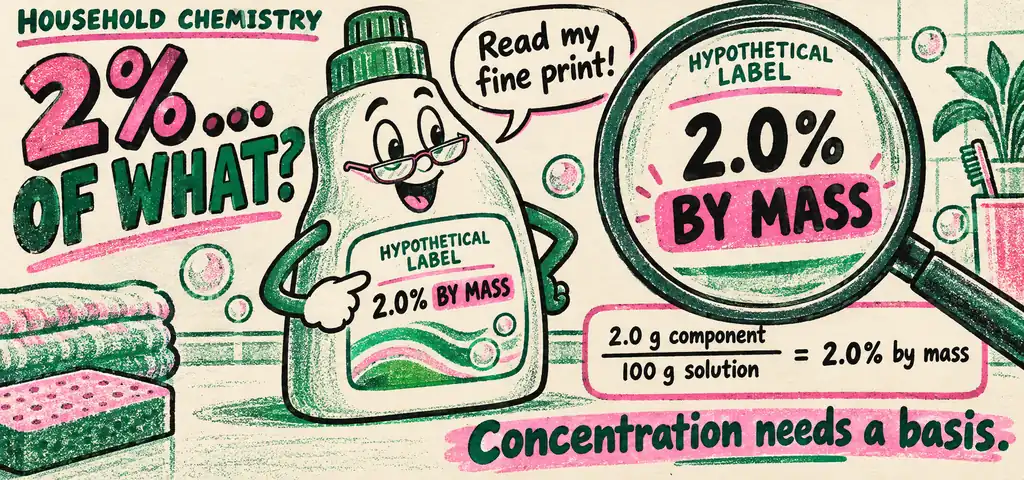
Household chemistry applies concepts such as solubility, acidity, oxidation, and concentration to everyday materials. Surfactants help water interact with oils and surfaces. Product labels specify intended uses and conditions. Chemical risk depends on hazards and exposure, so familiar appearance, a pleasant smell, or a natural origin does not establish safety.
A cleaner’s label connects chemistry with a particular use. It names the product, gives directions, and explains precautions. Understanding surfactants or concentration can help you read that label, but a classroom formula does not replace the product’s instructions.
How does soap help remove oily material?
A soap molecule has a hydrophobic hydrocarbon region and a charged water-interacting region. In suitable conditions, surfactants can gather around oily material, with their hydrophobic regions toward the oil and their water-interacting regions toward the water.
Agitation and rinsing help remove the dispersed material. The simplified micelle model explains one part of cleaning, although real product performance also depends on formulation, water chemistry, surface, and directions for use.
Worked example: interpret a concentration basis
In a hypothetical label-reading exercise, a solution is described as 2.0% by mass. That means 2.0 g of the named component in 100 g of total solution. In 250 g of solution, the component mass is
\[ (0.020)(250\,\mathrm{g})=5.0\,\mathrm{g}. \]
| Label expression | Meaning |
|---|---|
| 2.0% by mass | 2.0 g of component per 100 g of total solution |
| 2.0 g per 100 mL | A mass/volume basis: component mass per solution volume |
These are different concentration bases. Density would be needed to convert between them. The calculation explains a label expression and is not a recipe for preparing a household product.
Which label details deserve attention?
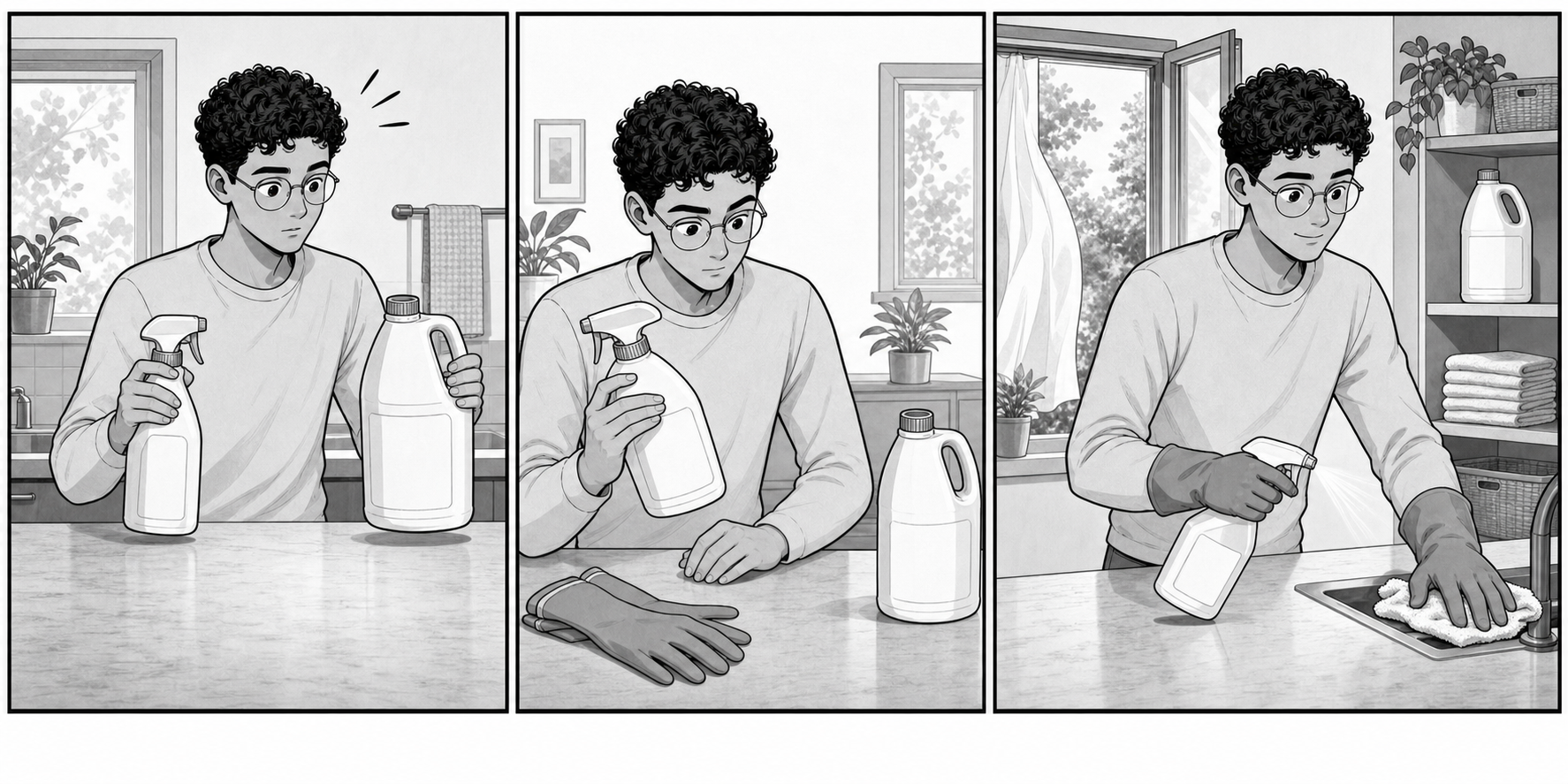
Read the intended surface or use, any required dilution, contact time, ventilation, protective equipment, storage, and disposal instructions. Cleaning and disinfecting are different claims. A disinfectant must be used according to its specific label, including any required wet contact time.
Do not mix cleaning products unless their labels explicitly direct it. Keep products in their original labeled containers and store them as directed, away from food and access by children or pets. The U.S. Environmental Protection Agency gives guidance on handling household hazardous waste.
How do you evaluate an everyday chemistry claim?
- Identify the exact substance or product.
- Read the stated concentration and its basis.
- Separate a chemical explanation from an advertised use claim.
- Check the conditions and the relevant label or reliable source.
For this lesson, examine a supplied label image or written scenario. Handling or testing household chemicals is unnecessary for the questions below.
Can you apply the idea?
-
Which part of a soap molecule interacts favorably with oil?
Check your answer
Its hydrophobic hydrocarbon region.
-
What does 2.0% by mass mean?
Check your answer
2.0 g of the specified component per 100 g of total solution or mixture.
-
Does 2.0% by mass automatically equal 2.0 g per 100 mL?
Check your answer
No. Those use different bases, and density is needed to convert between them.
-
Where should product-specific contact time be checked?
Check your answer
On the product’s current label directions.
-
Does a natural origin establish that a chemical is harmless?
Check your answer
No. Properties, dose or exposure, and conditions determine risk.
-
What should you do if a label-reading question omits the percentage basis?
Check your answer
Identify the ambiguity and request or locate whether the percentage is mass, volume, or mass/volume before calculating.
Watch the idea explained
Water & Solutions – for Dirty Laundry: Crash Course Chemistry #7, CrashCourse.
This selected excerpt runs from 2:40 to 3:15. Unequal electron sharing gives water partial charges.
Where does this fit?
Use the chemistry learning hub to choose a lesson or practice test. Connect this topic with chemistry of life, environmental chemistry, organic chemistry basics, materials chemistry.
Sources for Further Study
For product-label directions and the distinction between cleaning and disinfecting, see the CDC guidance on cleaning and disinfecting your home. The EPA household-waste guidance linked above covers storage and disposal.
Continue with a chemistry study guide

Related to This Article
More math articles
- Chapter 22: Rights of the Accused
- The Best Grade 2 English Worksheets for Colorado Students
- FREE CLEP College Algebra Practice Test
- Writing Linear Equations Practice — Slope-Intercept Form (Free)
- Free Printable Grade 2 English Worksheets for Delaware
- Illinois Algebra 1 Free Worksheets: Printable Algebra 1 Practice, Answers Included
- New York Grade 4 Math Worksheets: 43 Topic Links
- What Kind of Math Is on the TABE Test?
- How to Prepare for the ISEE Middle-Level Math Test?
- Completing the Puzzle: How to Finishing Equations when Multiplying Fractions by Whole Numbers Using Models


What people say about "Household Chemistry: Soap and Concentration Labels"?
No one replied yet.