Materials Chemistry: Compare Structure and Properties
Materials chemistry connects composition and structure with useful properties. Metals, ceramics, polymers, and composites have characteristic behaviors, with substantial variation within each class. Bonding, molecular arrangement, microstructure, and processing can affect strength, conductivity, flexibility, and chemical resistance. Material selection balances these properties against the demands of a particular use.
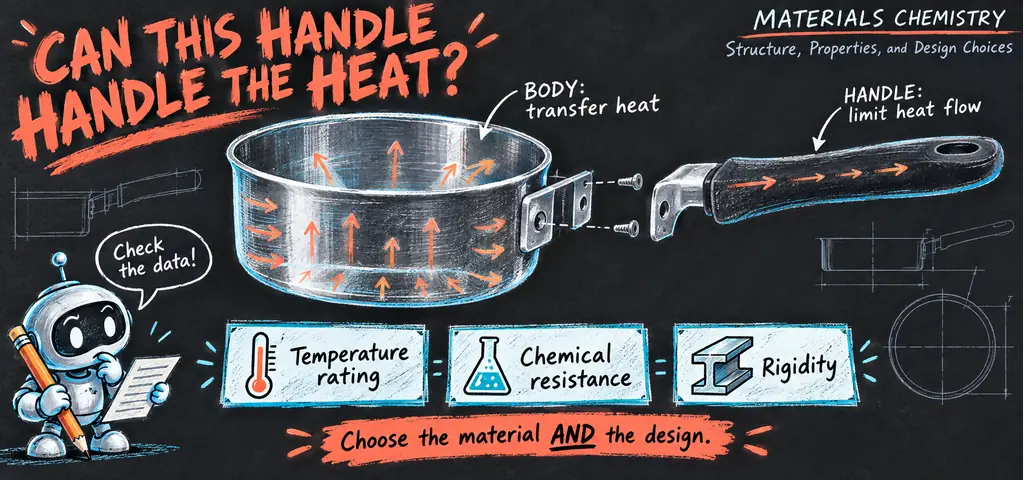
A saucepan handle and its cooking surface have different jobs. A useful handle limits heat transfer to your hand, while the cooking surface should distribute heat effectively. Choosing a material starts with the required function and the conditions it must withstand.
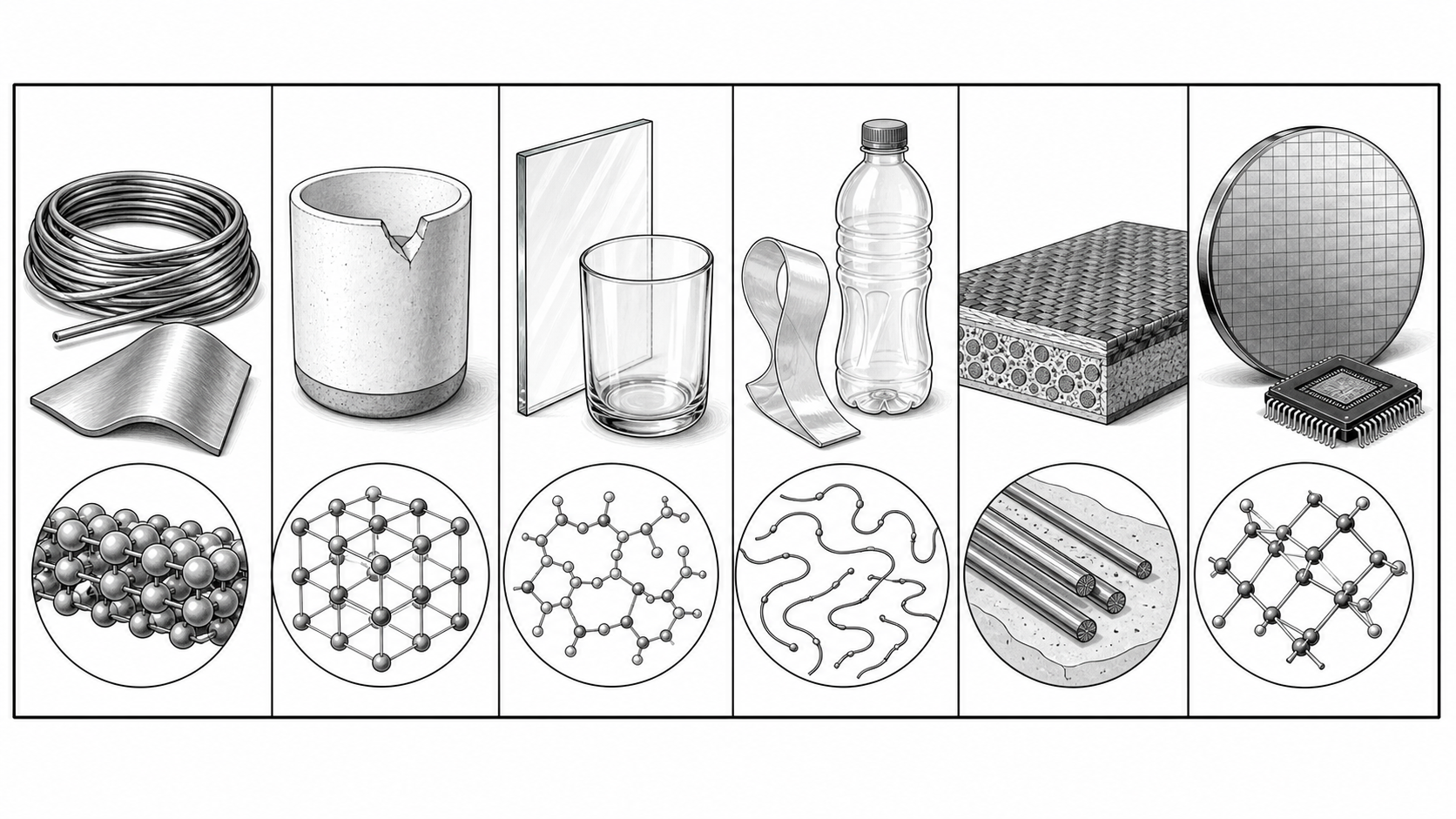
How do the major material classes compare?
| Class | Useful tendencies and limits |
|---|---|
| Metals | Many conduct heat and electricity and can be shaped, but corrosion and temperature behavior vary. |
| Ceramics | Many resist heat and wear but can be brittle. |
| Polymers | Properties range from flexible to rigid, with important temperature and chemical limits. |
| Composites | Combine constituents to achieve a chosen property balance. |
A class name narrows the investigation. It does not replace data for the particular formulation and operating conditions.
Worked example: choose a handle material
Suppose a handle must remain rigid during ordinary use, resist the expected cleaning chemicals, and limit heat flow from a hot metal pan. A suitable polymer formulation may reduce heat conduction, but its temperature rating must exceed the conditions it will experience.
Choosing it because all plastics are heatproof would be an error. Some soften well below the relevant temperature. A metal handle could still work with a design that reduces heat flow and an appropriate insulating grip. Evaluate the material and the design together.
Why does processing change properties?
A metal’s grain structure and defects influence deformation. Polymer chain length, branching, crystallinity, and crosslinking affect how chains move. Processing can alter these features without simply changing the material’s broad category.
Thermoplastics can soften and flow on heating within a suitable processing range. A highly crosslinked thermoset does not melt and flow in the same way and may degrade when overheated. Actual behavior depends on the material.
What evidence should support a materials decision?
- Define the operating load, temperature, and environment.
- Identify required properties and acceptable limits.
- Compare measured data for candidate materials.
- Consider manufacture, maintenance, reuse, and disposal.
- Explain the tradeoff behind the choice.
Recyclable on a label and accepted by a local collection program are different claims. End-of-use decisions depend on the material and the available processing system.
Can you apply the idea?
-
Why might a ceramic be useful in a high-temperature application?
Check your answer
Many ceramics maintain useful properties at high temperatures, subject to the specific material’s limits.
-
What is a composite?
Check your answer
A material combining constituents to achieve a chosen set of properties.
-
Does every polymer have the same heat resistance?
Check your answer
No. Structure, formulation, and processing affect its temperature behavior.
-
Name one structural feature that can affect a polymer’s properties.
Check your answer
Chain length, branching, crystallinity, or crosslinking.
-
Why is the operating environment part of material selection?
Check your answer
Heat, chemicals, moisture, and loading can change performance and durability.
-
Can a material label alone establish that a local program accepts it for recycling?
Check your answer
No. Local collection and processing rules must also be checked.
Watch the idea explained
Polymers: Crash Course Chemistry #45, CrashCourse.
This selected excerpt runs from 2:29 to 3:08. In the addition-polymer model, the ethene pi bond reacts to form new links between units while its carbon, carbon sigma bond remains.
Where does this fit?
Use the chemistry learning hub to choose a lesson or practice test. Connect this topic with environmental chemistry, chemistry laboratory safety, household chemistry, multistep chemistry problems.
Sources for Further Study
Penn State explains thermoplastic and thermosetting polymers. Cambridge introduces material selection charts and design tradeoffs. For disposal decisions, the EPA advises checking what your local recycling program accepts.
Continue with a chemistry study guide


Related to This Article
More math articles
- Full-Length 7th Grade Common Core Math Practice Test
- Write a Ratio
- Find the long-run cost-minimizing input combination
- Coordination and Subordination
- Z-Score & Normal Distribution Calculator (Free)
- Top 10 3rd Grade Common Core Math Practice Questions
- President pro tempore
- How to Solve Perfect Square Trinomial?
- Incorporating Technology in Math Education: Tools and Techniques for Modern Teachers
- Algebra 1 Worksheets: 64 Free PDFs with Answers









What people say about "Materials Chemistry: Compare Structure and Properties"?
No one replied yet.