YOUR GED STUDY COMPANION
The Best GED Math Book to Pass on Your First Try
Compare the study options below and choose the format that fits your next step in GED Math.
For most people preparing for the GED, math is the part that keeps them up at night. The reading and writing sections feel survivable. Math feels like a wall — especially if it has been years, or decades, since you sat in a math class. If that is you, the first thing to know is this: the GED math test is absolutely passable, and you do not need to be “a math person” to pass it.
What you need is the right book. Not a thick reference that assumes you remember high school, and not a thin booklet of practice questions with no teaching. You need a book that starts where you actually are and walks you all the way to test-ready.
Our pick: GED Math for Beginners
GED Math for Beginners was written for the exact person most GED study books forget — the adult learner who needs to rebuild math from the foundation up. It does not open with a hard practice test. It opens with teaching, in plain and patient language, and assumes you are starting fresh.
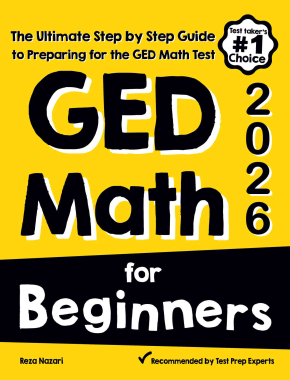
Every topic on the GED math test gets the same treatment: a clear explanation, step-by-step worked examples, and a focused set of practice problems with answers so you always know where you stand. Nothing is rushed and nothing is assumed. For an adult who has been away from math, that patient, ground-up approach is the whole difference between giving up and passing.
What is on the GED math test
The GED Mathematical Reasoning test has two parts — a short no-calculator section and a longer section where an on-screen calculator is allowed. The content falls into two broad areas:
- Quantitative reasoning — whole numbers, fractions, decimals, percents, ratios, proportions, and basic number operations
- Algebraic reasoning — expressions, equations, inequalities, linear functions, graphing, and basic quadratics
- Geometry and data — area, perimeter, volume, the coordinate plane, and reading graphs and tables
It is a broad test, but it is not a deep one — it rewards solid fundamentals far more than advanced tricks. That is exactly why a book that rebuilds the fundamentals well is the right tool for the job.
Why this book works for adult learners
- It assumes nothing. If you have forgotten how to work with fractions or negative numbers, the book teaches it — no embarrassment, no gaps.
- It is paced for real life. Short sections fit around a job, a family, and a tight schedule. You can study in 30-minute pieces and still make steady progress.
- It builds confidence on purpose. Each small success is designed to lead into the next, so momentum — not anxiety — carries you forward.
- It mirrors the real test. The practice reflects GED-style questions, so test day feels familiar instead of foreign.
How to study with it: a realistic plan
Most GED students are fitting study around a busy life. This plan is built for that:
- Weeks 1–2: Number foundations — whole numbers, fractions, decimals, percents. Do not rush. This is the base.
- Weeks 3–4: Ratios, proportions, and the start of algebra — expressions and simple equations.
- Weeks 5–6: Linear equations, graphing, and basic functions.
- Week 7: Geometry — area, perimeter, volume — and reading data and graphs.
- Week 8: Full review and practice tests under timed, test-like conditions.
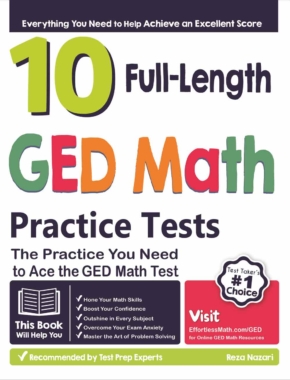
Once the teaching has done its job, the most powerful final step is volume practice. Working through full-length practice tests builds stamina and timing and turns “I know this” into “I can do this on test day.” Our 10 Full-Length GED Math Practice Tests is the natural companion for that final stretch.
Who this book is for
- Adults earning a GED who need to rebuild math from the basics
- Anyone who has been away from school for years and feels rusty
- Students who have struggled with math before and want a patient, judgment-free guide
- GED retakers who passed the other sections but need to clear the math hurdle
Common mistakes GED math students make
- Jumping straight to practice tests. Practice tests measure; they do not teach. Learn the material first, then test yourself.
- Skipping fractions and percents. They feel basic and unpleasant, so people avoid them — but they are everywhere on the GED.
- Not learning the on-screen calculator. Part of the test allows the TI-30XS calculator. Practice with it so it helps you instead of slowing you down.
- Believing “I am just bad at math.” You are not. You were under-taught. A patient book fixes that.
Frequently asked questions
What is the best GED math book?
For most adult learners, GED Math for Beginners is our top pick because it teaches every topic from the ground up before asking you to test yourself. Each lesson pairs a plain-language explanation with worked examples and practice problems with answers. If it has been years since your last math class, a book that starts with fractions, decimals and percents will serve you better than one that opens with a hard practice test.
What is the best way to pass GED math?
Build your foundation first, then practice under test conditions. Work through number sense, algebra, geometry and data topics in order, and keep a list of problems you miss. In the final weeks, take full-length timed practice tests and get comfortable with the formula sheet and the TI-30XS calculator, since the calculator is allowed on most of the test. You need a score of 145 to pass.
What is the best way to learn math for the GED?
Start where you actually are, not where you think you should be. Many adults begin with whole numbers, fractions and percents, then move on to equations and graphs once those feel easy. Study 30 to 45 minutes most days rather than in long weekend sessions, and work every example by hand before checking the answer. Short, steady practice rebuilds GED math skills faster than cramming.
What is the best GED math practice test?
The best practice test mirrors the real GED Mathematical Reasoning test: a short first part without a calculator, then a longer calculator section with multiple-choice, fill-in and drag-and-drop questions. Take one early as a diagnostic, then use timed full-length tests near the end of your study. GED Ready, the official practice test, is a good final check before you book your exam.
What is the best GED math study guide?
A good GED math study guide covers every tested topic, explains each one before drilling it, and gives answers with worked solutions so you can see where you went wrong. Look for one updated for the current test, with a full-length practice exam and the GED formula sheet. GED Math for Beginners checks these boxes and is written for adults rebuilding their skills from the basics.
The bottom line
The GED math test stops a lot of capable people — not because the math is beyond them, but because they never had a book that started where they actually were. GED Math for Beginners is that book: patient, plain-spoken, and built from the ground up for adult learners.
You can pass GED math. Start from the basics, study a little most days, finish with full practice tests, and walk in prepared. That diploma is closer than it feels right now.

Related to This Article
More math articles
- Wyoming WY-TOPP Grade 6 Math Free Worksheets: Printable Standards-Aligned Practice, Answers Included
- Full-Length 6th Grade MCAS Math Practice Test
- Building with Blocks: How to Multiply Decimals by 1-digit Whole Numbers
- Atoms and Their Parts
- Chapter 15: The Federal Courts
- Revising, Editing, and Keyboarding
- 4th Grade ACT Aspire Math FREE Sample Practice Questions
- Texas Revolution and Annexation: Slavery, Sovereignty and Statehood
- Cold War Origins, the Truman Doctrine and the Marshall Plan
- Top 10 7th Grade PSSA Math Practice Questions























What people say about "The Best GED Math Book to Pass First Try"?
No one replied yet.