How Strong Math Skills Can Improve Your Dissertation Research

Why Math Matters In Dissertation Work
Students often associate dissertation research to reading, writing and endless editing. These tasks are important, but math skills can make the difference between an essay that is just complete and one which is convincing. Math helps researchers to organize information, evaluate patterns and make more precise claims. Mathematical thinking can improve the structure and testing of ideas in subjects where there is not a lot of numerical content.
Usually, dissertation work involves dealing with information that can be messy, contradictory, and complex. Math can help bring order to this process. It helps you compare variables, identify relationships and avoid drawing weak conclusions. It builds confidence, which is more important. Your research will feel less overwhelming when you know how to interpret and explain the data.
How Math Supports Data Analysis
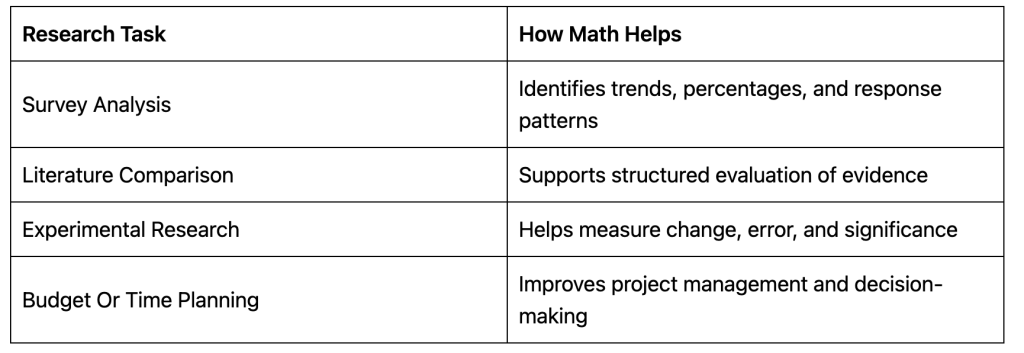
One of the clearest benefits of strong math skills appears during data analysis. Dissertation research often requires students to collect survey responses, review case studies, compare historical trends, or interpret experimental results. Without a basic grasp of numbers, percentages, averages, and statistical relationships, it becomes much harder to explain what the evidence actually shows. Math helps you move beyond description and into real analysis.
This is especially important when working with quantitative or mixed-method research. A student who understands numerical reasoning can interpret results more critically, identify unusual findings, and present patterns more accurately. This often helps reduce the need for extensive revisions later and makes the research process more efficient. At the same time, many students consider options like buy dissertation due to tight deadlines, academic pressure, and complex requirements, as it can help save time, reduce stress, and conserve energy during demanding stages of their studies.
How Math Strengthens Critical Thinking
Mathematics is more than formulas. It trains the brain to think carefully and logically. Every chapter of your dissertation requires that you make decisions. You will need to determine which sources are reliable and which methods best fit your questions, as well as whether you have enough evidence to support your argument. You should always check your assumptions before accepting them.
Mathematically stronger students are better at breaking complex problems down into smaller parts. It is important when you are creating a research problem, designing a technique, or reviewing results. You can also avoid common errors such as drawing broad conclusion from limited evidence.
The following are some areas where the use of mathematics can build research:
- Pattern recognition in complex information.
- Tests to determine if a conclusion has been supported.
- Compare alternatives logically.
- Evidence gaps and contradictions can be identified.
- Explaining results in greater clarity and precision.
These habits can improve the quality and overall look of a dissertation even if it is not based on mathematics.
Practical Ways Math Improves Research Across Fields
Math is useful in many disciplines, not just those that are heavily reliant on statistics. It can be used to help students compare classroom results or interpret assessment data. It is used to analyze behavioral trends and survey data in psychology. Math helps in business to evaluate performance, market patterns, and risk. Mathematical reasoning can be used to improve arguments in literature, history or sociology.
A history student, for example, can use time lines and frequency patterns to study social change through the years. While a literature student might not be able to calculate equations, they can still benefit from mathematical habits like classification, comparison and careful sequencing. Math becomes more than numbers on a sheet of paper. It is about disciplined thinking.
Research for a dissertation is not just about gathering information. Interpreting that information in a clear, balanced and defendable manner is important. Strong math skills help students to handle complexity without getting lost.
Building Confidence Through Skill Development
Students often believe that they must be mathematically gifted to use math for research. However, this is not true. Most of the time, it is important to have a basic understanding of math: percentages. Averages. Charts. Logical comparisons. This can be done gradually and a slight improvement will make the research process less daunting.
Confidence is a real asset. The content and structure of your dissertation improves when you understand your data and can question assumptions. Math helps you to move from guessing into reasoning and from insecurity to evidence-based essay writing. The shift from guessing to reasoning and from uncertainty to evidence-based writing is invaluable in any academic discipline.
Good ideas are not enough to make a dissertation strong. This also depends on the ability to analyze, organise, and defend your ideas. It is important to develop math skills to be able produce research which feels complete, thoughtful and credible.

Related to This Article
More math articles
- Why Do I Need MATLAB Assignments Experts Help and Where One Get It
- How Does SAT Essay Affect Writing Score?
- The Math Game Show: How to Find Probability of Simple and Opposite Events
- 4th Grade MEAP Math Worksheets: FREE & Printable
- Oversight and investigations
- 5 Best Accuplacer Math Study Guides
- How to Solve Angles and Angle Measure? (+FREE Worksheet!)
- How to Solve Rational Numbers Word Problems
- The Ultimate 7th Grade North Carolina EOG Math Course (+FREE Worksheets)
- Balancing Probabilities: A Comprehensive Guide to the Expected Value of Random Variables











What people say about "How Math Skills Improve Dissertation Research"?
No one replied yet.