Contemporary Public Policy
Once officials are elected, they get to work making public policy — the decisions and laws that address problems in society. Knowing how a problem becomes a policy, and how a bill becomes a law, is a practical civics skill the test rewards.
Public policy is the set of actions a government takes to deal with an issue, from healthcare to education to the environment. Most major policy takes the form of laws, so understanding the lawmaking process is the heart of this topic.
How a Problem Becomes Policy
Policy usually follows a rough cycle: a problem gets attention, options are proposed and debated, a policy is adopted (often as a law), and its results are later reviewed. Many groups shape this process — elected officials, government agencies, interest groups, and voters. Because resources are limited, policymakers constantly weigh trade-offs, deciding which problems to tackle and how to pay for solutions.
How a Bill Becomes a Law
The most testable slice of policy is the lawmaking process:
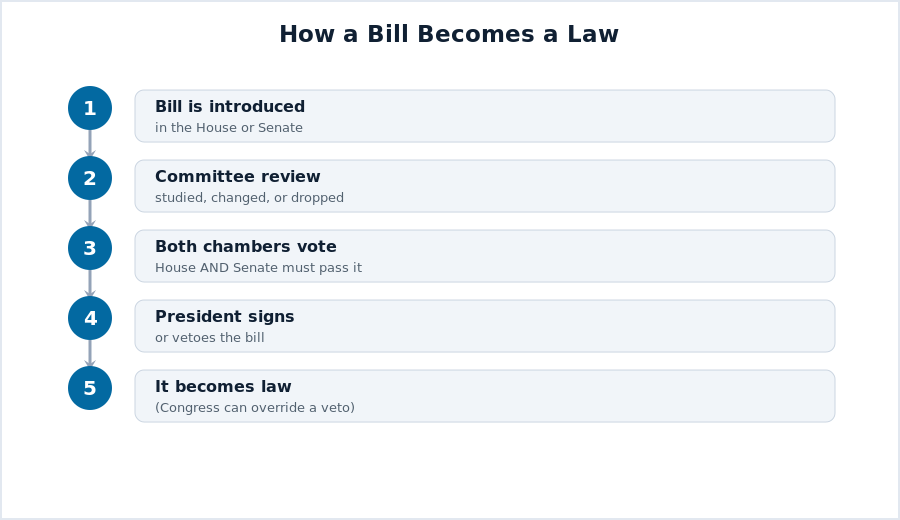
A bill is introduced in the House or Senate, studied and revised in committee, then voted on. Both the House and Senate must pass the same version. It then goes to the President, who can sign it into law or veto it. Congress can override a veto with a two-thirds vote. This is checks and balances in action.
Levels of Government
Policy is made at every level. The federal government handles national issues like defense and interstate matters; state governments handle education, licensing, and state roads; local governments handle schools, police, and zoning. When a question describes a policy, notice which level of government is responsible — that is often the key to the answer.
Watch: A Short Video Lesson
Khan Academy gives a clear overview to go with this lesson:
A Routine for Policy Questions
- Policy follows a cycle: identify a problem, debate options, adopt, review.
- A bill must pass both the House and Senate, then be signed by the President.
- A veto can be overridden by a two-thirds vote in Congress.
- Match a policy to the right level: federal, state, or local.
Practice
- What is public policy?
- Where can a bill be introduced?
- What must happen in both the House and Senate before a bill can become law?
- What are the President’s two options when a bill reaches their desk?
- How can Congress override a veto?
- Which level of government usually runs public schools’ day-to-day operations?
Answers
- The actions a government takes to address a problem in society.
- In the House or the Senate.
- Both chambers must pass the same version of the bill.
- Sign it into law or veto it.
- With a two-thirds vote.
- Local (and state) government.
Where This Fits in Your Social Studies Prep
Policy-making builds on the three branches and connects to government economic policy. See every topic on the Social Studies Prep Hub.
Recommended Prep Books
These study guides and practice books help you keep building momentum as you prepare:

Related to This Article
More math articles
- Best Strategies to Teach Math Effectively
- Subtracting Fractions with Unlike Denominators for 5th Grade
- Collective Action, Environmental Inequality, and Environmental Racism
- How to Write a Math-Based Analytical Paper Step by Step
- 3rd Grade FSA Math FREE Sample Practice Questions
- Study Habits That Support Both Math Learning and Academic Writing
- How to Pass the STAAR Math Test (Texas): The 2026 Parent & Student Playbook
- 5 Hidden Math Concepts Behind Today’s Most Popular Financial Platforms
- The Best Algebra 1 Book for Virginia Students
- Using a Table to Write down a Two-Variable Equation

















What people say about "Contemporary Public Policy"?
No one replied yet.