The Three Branches and Checks and Balances
The U.S. government is split into three branches, each with its own job, and each able to limit the other two. This design — the separation of powers with checks and balances — is one of the most heavily tested ideas in all of civics, and it is easy to master once you see the picture.
The legislative branch makes the laws, the executive branch carries them out, and the judicial branch interprets them. No branch is all-powerful, because each one can check the others.
The Three Branches and Their Jobs
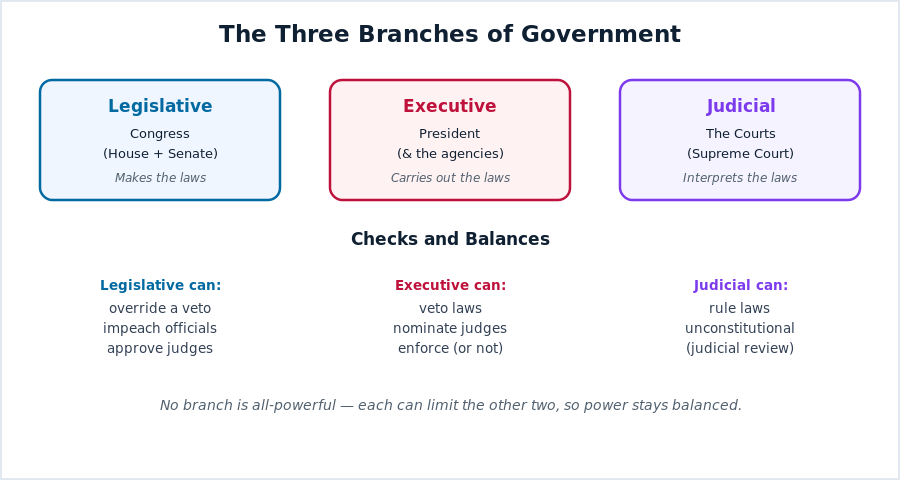
The legislative branch is Congress — the House of Representatives and the Senate — and it writes the laws. The executive branch is led by the President and includes the federal agencies; it enforces the laws. The judicial branch is the court system, topped by the Supreme Court; it interprets the laws and decides what the Constitution means.
Checks and Balances
Each branch holds powers that limit the others. Congress passes laws, but the President can veto them — and Congress can override a veto with a two-thirds vote. The President nominates judges, but the Senate must approve them. The courts can rule a law unconstitutional through judicial review. Congress can even impeach and remove a president or judge. These overlapping powers keep any one branch from taking over.
Why It Matters
The whole point is balance. The founders feared concentrated power, so they made the branches depend on one another. When the test describes an action — a veto, a court ruling, a Senate confirmation, an impeachment — it is usually asking you to name the branch involved or the check being used. Keep the three jobs straight (make, enforce, interpret) and the rest follows.
Watch: A Short Video Lesson
CrashCourse gives a clear overview to go with this lesson:
A Routine for Branch Questions
- Legislative = makes laws (Congress); executive = enforces (President); judicial = interprets (courts).
- Veto and override are a check between the President and Congress.
- Judicial review lets courts strike down unconstitutional laws.
- Match the action to the branch and the check it represents.
Practice
- Which branch makes the laws?
- Which branch enforces the laws?
- Which branch interprets the laws?
- What is it called when the President rejects a law?
- How can Congress respond to a veto?
- What is judicial review?
Answers
- The legislative branch (Congress).
- The executive branch (the President).
- The judicial branch (the courts).
- A veto.
- Override it with a two-thirds vote.
- The courts’ power to rule a law unconstitutional.
Where This Fits in Your Social Studies Prep
The branches build on the Constitution and federalism and connect to how public policy and laws are made. See every topic on the Social Studies Prep Hub.

Related to This Article
More math articles
- How to Simplify Polynomials? (+FREE Worksheet!)
- Presidential action
- How to Find Adjacent Angles
- SAT Math vs. ACT Math: the Key Differences
- How to Add Three or More Fractions with Like Denominators
- Addition of Hundreds
- How to Write the Standard Form of Linear Equations?
- Overview of the SHSAT Mathematics Test
- Volcanoes, Mountains, and Changing Crust
- Estimating Sums and Differences for 4th Grade





















What people say about "The Three Branches and Checks and Balances"?
No one replied yet.