The Constitution, Federalism, and Amendments
The Constitution is the rulebook for the entire U.S. government. It sets up the branches, divides power between the nation and the states, and lays out how it can be changed. Understanding its structure — and the idea of federalism — unlocks a large share of the civics questions on the test.
The Constitution is the supreme law of the land. Federalism is the system it creates for splitting power between the national (federal) government and the state governments. And the amendment process is the official way to change the Constitution over time.
What the Constitution Does
The Constitution opens with the Preamble ("We the People"), then uses articles to set up the three branches and their powers, and finally allows amendments to add or change rules. It replaced the Articles of Confederation, under which Congress lacked independent taxing power and reliable enforcement authority. The Constitution created a stronger central government while still protecting the states and the people.
Federalism: Sharing Power
Federalism means power is shared between the federal government and the states. Some powers belong only to the federal government, some only to the states, and some to both.
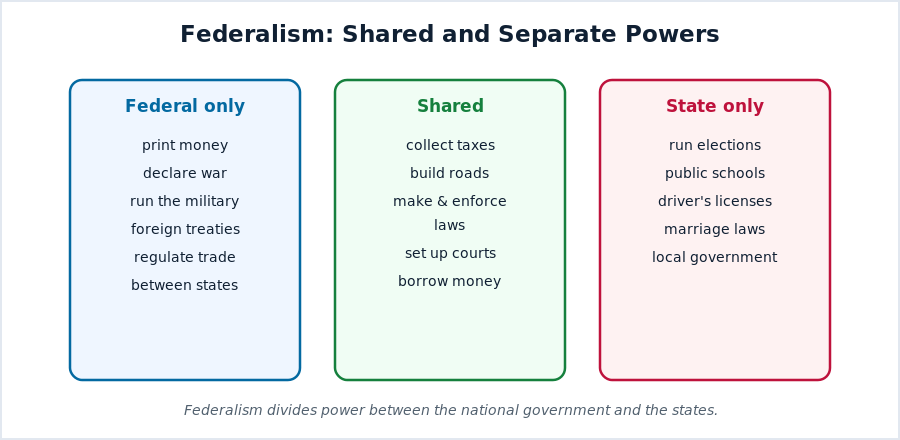
The national government alone can coin money, declare war, and make treaties. States hold primary responsibility for election administration, public schools, and driver's licensing, subject to federal constitutional and statutory limits. Both levels can tax, build roads, operate courts, and enact laws within their authority. When valid federal law conflicts with state law, the Supremacy Clause gives valid federal law priority.
The Amendment Process
The founders made the Constitution hard — but not impossible — to change. An amendment must be proposed (usually by a two-thirds vote in both houses of Congress) and then ratified (approved) by three-fourths of the states. Because it takes such broad agreement, only 27 amendments have passed in over 200 years. The first ten are the Bill of Rights. This high bar keeps the Constitution stable while still allowing change.
Watch: A Short Video Lesson
CrashCourse gives a clear overview to go with this lesson:
A Routine for Constitution Questions
- The Constitution is the supreme law; it set up the branches and replaced the Articles of Confederation.
- Federalism splits power: federal only, state only, and shared.
- Amendments are proposed (two-thirds of Congress) and ratified (three-fourths of states).
- The first ten amendments are the Bill of Rights.
Practice
- What is the Constitution?
- What does federalism divide?
- Name one power that belongs only to the federal government.
- Name one area primarily administered by the states.
- What are the two steps to change the Constitution?
- What are the first ten amendments called?
Answers
- The supreme law of the land / the government’s rulebook.
- Power between the federal government and the states.
- Any of: print money, declare war, make treaties.
- Any of: administer elections, operate public schools, issue driver's licenses.
- Proposal (two-thirds of Congress) and ratification (three-fourths of states).
- The Bill of Rights.
Where This Fits in Your Social Studies Prep
This builds on the principles of constitutional democracy and leads into the three branches and rights and liberties. See every topic on the Social Studies Prep Hub.

Related to This Article
More math articles
- Advanced Vocabulary Words: Chasm to Concoct
- SAT versus PSAT: What You Need to Know
- 10 Most Common 6th Grade OST Math Questions
- Literal Equations Worksheet with Answers PDF
- 5th Grade NSCAS Math Worksheets: FREE & Printable
- Free Spins Math: Pricing the Bonus Round Yourself
- What Kind of Math Is on the TABE Test?
- How to Convert, Compare, Add, and Subtract Mixed Customary Units?
- How to Complete the Table of Division Big Numbers By One-digit Numbers
- 8th Grade MEAP Math Worksheets: 82 Free Printable PDFs





















What people say about "The Constitution, Federalism, and Amendments"?
No one replied yet.