Principles of American Constitutional Democracy
American government rests on a handful of big ideas that the founders built into the system on purpose. Knowing these principles of constitutional democracy helps you answer a whole family of civics questions, because almost every part of the government traces back to one of them.
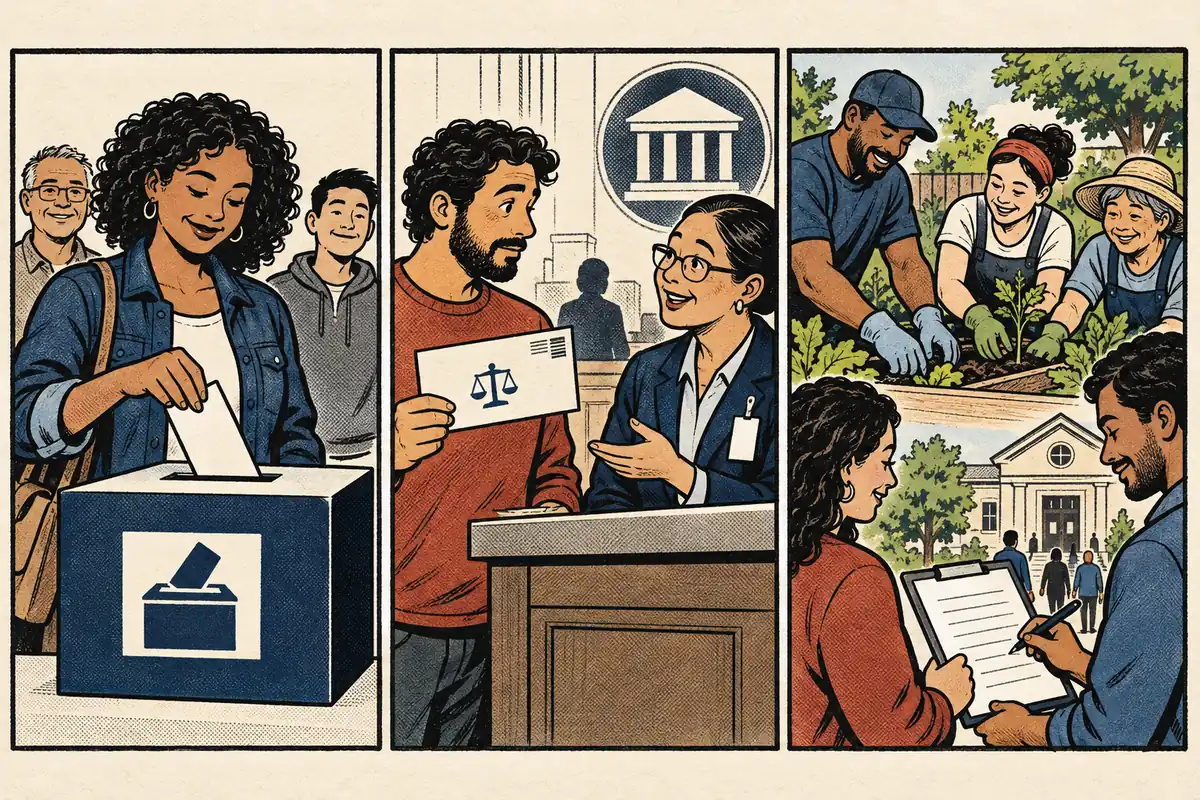
A constitutional democracy is a government where the people hold power and that power is limited by a written constitution. The point is to let the majority rule while still protecting individual rights and preventing any one person or group from taking over.
The Core Principles
Five ideas do most of the work:
- Popular sovereignty — the government’s power comes from the people. “We the People” open the Constitution for a reason.
- Rule of law — everyone, including leaders, must follow the law. No one is above it.
- Limited government — the government can only do what the Constitution allows; its power has boundaries.
- Separation of powers — power is split among three branches so no one branch controls everything.
- Checks and balances — each branch can limit the others.
Why These Principles Exist
The founders had just fought a war against a king with unchecked power, so they designed a system to prevent that from happening again. Popular sovereignty keeps power with the people; limited government and the rule of law keep leaders in check; separation of powers and checks and balances stop any single branch from dominating. Together they protect both majority rule and individual rights.
Federalism and Individual Rights
Two more principles round out the design. Federalism divides power between the national government and the states, spreading it out further. And a commitment to individual rights — spelled out in the Bill of Rights — guarantees freedoms that even a majority cannot take away. When the test describes a feature of American government, it is usually an example of one of these principles in action.
Watch: A Short Video Lesson
MrsLeeHistory gives a clear overview to go with this lesson:
A Routine for Principle Questions
- Popular sovereignty = power comes from the people.
- Rule of law = everyone must follow the law, including leaders.
- Limited government = the Constitution sets boundaries on power.
- Separation of powers + checks and balances = branches limit each other.
Practice
- What does popular sovereignty mean?
- What does the rule of law require of leaders?
- What is limited government?
- Why did the founders separate powers among three branches?
- What does federalism divide?
- Where are individual rights guaranteed?
Answers
- The government’s power comes from the people.
- They must follow the law like everyone else.
- Government power is bounded by the Constitution.
- So no single branch could control everything.
- Power between the national government and the states.
- In the Bill of Rights.
Where This Fits in Your Social Studies Prep
These principles build on types of government and lead into the Constitution and federalism and the three branches. See every topic on the Social Studies Prep Hub.

Related to This Article
More math articles
- The Ultimate 6th Grade DCAS Course (+FREE Worksheets)
- The Best Worksheets for Florida Grade 2 Students
- Cells, Tissues, Organs, and Homeostasis
- NREMT EMR Primary vs Secondary Assessment: Identify the Task in a Question (2027 Prep)
- The Best Grade 7 ELA Practice Tests for New Hampshire Students
- Free Grade 3 English Worksheets for Hawai’i Students
- NREMT AEMT Exam Changes: Check Your Level Before Choosing a Course (2027 Prep)
- Using Number Lines to Represent Fractions
- 4th Grade New York State Assessments Math Worksheets: FREE & Printable
- Free Grade 3 English Worksheets for Kentucky Students












What people say about "Principles of American Constitutional Democracy"?
No one replied yet.