Types of Government
Every country has a government, but they are not all organized the same way. The biggest difference is simple: who holds the power? Sorting governments by the answer to that question is one of the most testable ideas in civics.
A type of government describes how power is distributed — whether it rests with one person, a few people, or all the people. From a single ruler in a dictatorship to every citizen voting in a direct democracy, the type shapes how decisions get made and how much say ordinary people have.
Who Holds the Power?
Picture a scale from power in one hand to power in everyone’s hands:
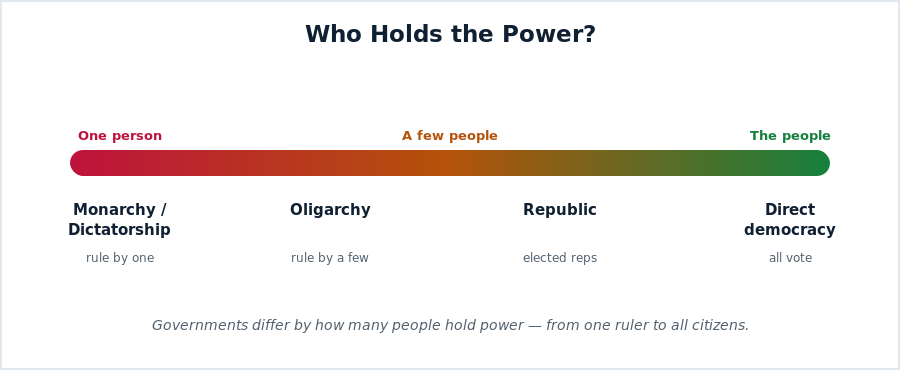
An absolute monarch or dictator concentrates governing power in one ruler, while a constitutional monarch may serve chiefly as head of state as elected institutions govern. In an oligarchy, a small group holds power. In a democracy, the people rule, either directly (everyone votes on issues) or through a republic, where citizens elect representatives to make decisions for them. The United States is a republic, a form of representative democracy.
Key Types to Know
A few terms come up again and again. A democracy is government by the people. A monarchy is rule by a king or queen, sometimes limited by a constitution. A dictatorship or autocracy is rule by one person with near-total power. An oligarchy is rule by a few. A theocracy is rule by religious leaders. Matching a description to the right label is exactly what the test asks.
Democracy in More Detail
Because this test focuses on American government, know the difference between a direct democracy, where citizens vote on laws themselves, and a representative democracy (republic), where citizens elect officials to vote for them. The United States uses the representative model, a practical system in which citizens choose officials to deliberate and vote on laws at national scale.
Watch: A Short Video Lesson
Tom Driscoll gives a clear overview to go with this lesson:
A Routine for Government-Type Questions
- Ask who holds the power: one person, a few, or the people.
- One ruler → monarchy or dictatorship; a few → oligarchy; the people → democracy.
- Direct democracy = everyone votes; republic = elected representatives.
- The United States is a representative democracy (a republic).
Practice
- In a democracy, who holds the power?
- What is rule by one person with near-total power called?
- What is rule by a small group called?
- What is the difference between a direct democracy and a republic?
- Which type of government does the United States have?
- What is a monarchy?
Answers
- The people.
- A dictatorship (autocracy).
- An oligarchy.
- In a direct democracy citizens vote on laws; in a republic they elect representatives to vote.
- A representative democracy (a republic).
- Rule by a king or queen.
Where This Fits in Your Social Studies Prep
This sets up the rest of civics: the principles of American constitutional democracy and the Constitution and federalism. See every topic on the Social Studies Prep Hub.

Related to This Article
More math articles
- Formal presidential powers
- Full-Length 7th Grade SBAC Math Practice Test
- Natural monopoly regulation controls a single low-cost network
- 4th Grade Math Worksheets for Smarter Balanced States: 43 Free Printable PDFs
- Nonresponse bias
- How to Solve Word Problems of Elapsed Time
- Best Laptops for Online Math Teaching
- Understanding How to Use Debit and Credit Cards for Payments
- 10 Most Common Pre-Algebra Math Questions
- Earmarks




















What people say about "Types of Government"?
No one replied yet.