YOUR HISET SOCIAL STUDIES PREP STARTS HERE
HiSET Social Studies Online Center
Prepare for HiSET Social Studies with independent practice, flashcards, and connected lessons. Identify the source’s purpose and evidence before treating a claim as established fact. Choose one skill to strengthen before your next practice session.
Free study tools · Focused review · Books to compare
HiSET Social Studies Practice Tests
Open the existing practice form, review explanations, and use the results to choose a skill. Results are study feedback, not official scores.
HiSET Social Studies Flashcards
Recall the idea, then connect it with an example.
HiSET Social Studies Study Guides
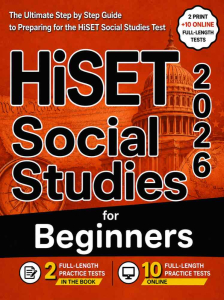
HiSET Social Studies for Beginners
Social Studies preparation with focused explanations and practice. Compare the preview with your learning needs.
View book & purchase options →HiSET Social Studies Quick Review
Choose a topic or review explanation before returning to practice.
Open this resource →MEET THE ASSESSMENT · CHOOSE YOUR NEXT SKILL
Know HiSET Social Studies before you start.
HiSET Social Studies has 60 multiple-choice questions in 70 minutes. Prepare to interpret and evaluate information across history, government, economics, geography, and the social sciences. The independent practice forms here provide study feedback rather than official HiSET scores.
Official assessment information ↗Sources and historical context
Identify the source’s purpose and evidence before treating a claim as established fact.
Explore this study route →Civics and institutions
Distinguish the power of an institution from the opinion of an individual official.
Explore this study route →Maps, economic data, and claims
Check the scale and unit before explaining a change or comparison.
Explore this study route →Official preparation
Check the current assessment guidance and use official samples alongside your independent study.
Explore this study route →HiSET Social Studies Practice Center
Take a full practice test, review the explanations, then use the flashcards to repair the terms and ideas that slowed you down.
HiSET Social Studies Study Blueprint
Open each area to see what to master. The bars show how this Online Center distributes its lessons, so you can plan study time without mistaking the map for an official exam weighting.
01 Social studies thinking skillsInterpret sources, claims, chronology, maps, tables, and evidence. 6lessons
- Primary and secondary sources
- Cause, effect, comparison, inference, and bias
02 Civics and governmentStudy constitutional ideas, institutions, rights, participation, and policy. 8lessons
- Foundations, federalism, branches, and law
- Civil liberties, elections, and citizenship
03 U.S. and world historyConnect major periods through chronology, causation, and historical evidence. 9lessons
- United States development and reform
- Global civilizations, conflict, exchange, and change
04 EconomicsApply economic reasoning to households, markets, government, and nations. 5lessons
- Scarcity, markets, incentives, and trade
- Growth, prices, employment, and policy
05 Geography and social scienceInterpret human and physical patterns across places and societies. 4lessons
- Maps, regions, migration, resources, and environment
- Culture, population, behavior, and institutions
Study-map shares describe the learning resources on this page. They are not presented as official test percentages.
HiSET Social Studies Practice Online Center: a single starting point that brings together the lessons, worksheets, practice tests, and review material for this subject, arranged in a sensible order so you can work through it from start to finish.
Effortless Math • HiSET Social Studies Prep Center
Build confidence with the source-reading habits, civics, history, economics, and geography knowledge the HiSET Social Studies test asks you to use. Start small, work steadily, and let evidence guide every answer.
70 minutes
4 content areas
Primary sources & data
12 full-length practice forms
Choose a HiSET subtest
HiSET has five subject areas. Pick the Online Center that matches the subtest you are studying.
Start Here: What the HiSET Social Studies Test Measures
The HiSET Social Studies test asks you to understand a source, identify its claim or purpose, compare evidence, and apply familiar social studies ideas to a new situation. It is not a contest to memorize every date. Careful reading, realistic context, and a sound reason for your choice matter most.
Test details are based on the HiSET Test at a Glance. Policies and formats can change, so confirm current requirements with the official HiSET program before test day.
How to use this Online Center
Begin with the thinking skills. A strong source routine helps with every content area: read the question, identify what the source actually says, mark the exact evidence, and eliminate choices that go beyond the evidence. Then move through civics and history, followed by economics and geography. Your goal is not to rush through a checklist. It is to be able to explain why an answer is supported.
Quick-study flashcards
Use these cards for a short, high-value review. Say the answer aloud before you open a card. The goal is to recognize the thinking move, not merely memorize a word.
Evidence
Information from a source that can support or challenge a claim. On the test, choose the detail that actually proves the answer, not merely a related fact.
Inference
A careful conclusion drawn from clues. It goes one step beyond the source, but it must not claim more than the evidence allows.
Claim
A statement an author wants readers to accept. Ask what evidence the author gives and whether that evidence is relevant and sufficient.
Primary source
A record created at or near the time of an event, such as a letter, law, photograph, speech, map, or census record. It still has a purpose and a point of view.
Corroboration
Checking whether another relevant source supports, complicates, or challenges a claim. Agreement can strengthen a conclusion, but it does not remove every limit.
Context
The time, place, audience, and conditions surrounding a source or event. Context helps explain why a source was created and what its evidence can show.
Federalism
The division of power between national and state governments. Identify which level has authority before deciding which action or rule makes sense.
Checks and balances
Constitutional tools that let one branch limit another branch. Think of a veto, congressional oversight, judicial review, appointments, or impeachment.
Scarcity
The condition in which wants exceed available resources. Scarcity forces choices, and every choice has trade-offs.
Opportunity cost
The next-best option given up when a choice is made. It is not simply the money spent; it is the most valuable alternative that was not chosen.
Map scale
The relationship between a distance on a map and the actual distance on Earth. Use the scale and the units before comparing routes or locations.
Correlation
A pattern in which two measures change together. It may suggest a relationship, but by itself it does not prove that one measure caused the other.
Complete HiSET Social Studies Study Map
32 connected topics
Use this directory as your roadmap. Each group mirrors a section of HiSET Social Studies for Beginners, so you can choose a focused lesson instead of wondering what to study next.
Social studies thinking skills
- How the HiSET Social Studies test worksOpen focused lesson : How the HiSET Social Studies test works
- Facts, opinions, values, and evidenceOpen focused lesson : Facts, opinions, values, and evidence
- Inference, purpose, assumptions, and argumentsOpen focused lesson : Inference, purpose, assumptions, and arguments
- Primary sources, reliability, and perspectiveOpen focused lesson : Primary sources, reliability, and perspective
- Timelines, maps, charts, tables, and cartoonsOpen focused lesson : Timelines, maps, charts, tables, and cartoons
- Comparing sources and evaluating conclusionsOpen focused lesson : Comparing sources and evaluating conclusions
Civics and government
- Citizenship, rights, responsibilities, and participationOpen focused lesson : Citizenship, rights, responsibilities, and participation
- Founding principles and constitutional democracyOpen focused lesson : Founding principles and constitutional democracy
- Federalism and division of powerOpen focused lesson : Federalism and division of power
- Congress, the president, agencies, and checksOpen focused lesson : Congress, the president, agencies, and checks
- Courts, civil liberties, and equal protectionOpen focused lesson : Courts, civil liberties, and equal protection
- Elections, parties, interest groups, and public opinionOpen focused lesson : Elections, parties, interest groups, and public opinion
- State and local government, public policy, and meetingsOpen focused lesson : State and local government, public policy, and meetings
- Comparative governments and governance systemsOpen focused lesson : Comparative governments and governance systems
U.S. And world history
- River valleys and classical worldsOpen focused lesson : River valleys and classical worlds
- Exploration, exchange, and colonial encountersOpen focused lesson : Exploration, exchange, and colonial encounters
- The American Revolution and early national eraOpen focused lesson : The American Revolution and early national era
- Expansion, reform, immigration, and Indigenous policyOpen focused lesson : Expansion, reform, immigration, and Indigenous policy
- The Civil War and ReconstructionOpen focused lesson : The Civil War and Reconstruction
- Industrialization, the Gilded Age, and reformOpen focused lesson : Industrialization, the Gilded Age, and reform
- World War I, the Great Depression, and the New DealOpen focused lesson : World War I, the Great Depression, and the New Deal
- World War II and the postwar worldOpen focused lesson : World War II and the postwar world
- The Cold War, decolonization, civil rights, and recent historyOpen focused lesson : The Cold War, decolonization, civil rights, and recent history
Economics
- Scarcity, choice, incentives, and opportunity costOpen focused lesson : Scarcity, choice, incentives, and opportunity cost
- Supply, demand, prices, and competitionOpen focused lesson : Supply, demand, prices, and competition
- Work, income, inflation, unemployment, and growthOpen focused lesson : Work, income, inflation, unemployment, and growth
- Government, economic systems, globalization, and tradeOpen focused lesson : Government, economic systems, globalization, and trade
- Consumer economics, savings, credit, interest, and advertisingOpen focused lesson : Consumer economics, savings, credit, interest, and advertising
Geography and social science
- Physical geography, resources, climate, and environmentOpen focused lesson : Physical geography, resources, climate, and environment
- Human geography, culture, regions, and populationOpen focused lesson : Human geography, culture, regions, and population
- Migration, urbanization, borders, and developmentOpen focused lesson : Migration, urbanization, borders, and development
- Spatial evidence and social science case studiesOpen focused lesson : Spatial evidence and social science case studies
A realistic four-week study plan
Aim for steady practice rather than marathon study sessions. A 45-to-60-minute study block is enough when you read carefully, answer a few questions, and review the reason behind every miss.
1Build your source routine
Learn how to separate evidence from opinion, infer a conclusion, compare sources, and read maps, charts, timelines, and political cartoons.
2Focus on civics
Study constitutional principles, branches and checks, federalism, rights, elections, and how public policy is made.
3Connect history and economics
Trace major historical turning points while practicing scarcity, markets, employment, trade, inflation, and consumer choices.
4Finish with geography and timed practice
Review regions, migration, climate, resources, and data interpretation. Then use a full practice form to find the habits that need one more week of work.
Your full-length practice library
Twelve complete practice tests: the companion study guide provides a complete twelve-form practice plan. Use the two print tests to rehearse paper pacing, then open the ten additional interactive forms with the individual QR cards printed in the book.
For reader access, the individual QR codes remain inside the book. This public learning Online Center never lists book-only test addresses or answer keys.
HiSET Social Studies FAQ
How long is the HiSET Social Studies test?
The current HiSET Test at a Glance lists 70 minutes for Social Studies. Use that timing in your full-length practice sessions, and check the official program before your appointment because policies can change.
How many questions are on the test?
The test is a 60-question multiple-choice test. Each question has four choices and one best answer.
Do I need to memorize every date or court case?
No. You need a workable foundation, but the test regularly gives you a source, map, graph, table, timeline, cartoon, or short passage to analyze. Practice reading the evidence before relying on what you remember.
Which content areas deserve the most time?
History and civics/government receive the largest share of the test. Economics and geography still matter, especially when they appear through tables, maps, or real-world scenarios.
How should I review a missed question?
Name the reason the wrong choice seemed attractive, then point to the exact word, number, rule, or detail that supports the correct choice. That small repair step is how a missed question becomes useful study material.
Related preparation centers
Choose one skill and begin
Start with a source, a question, and one calm decision. Read closely, use the evidence, and keep going. Your confidence grows every time you can explain why an answer belongs.
Official source: what the HiSET covers, how the five subtests are structured and how the credential works are published by PSI, which administers the exam, at hiset.org.
Every lesson in one place
Open a lesson in a new tab and keep this Online Center nearby as your study home.
Browse the complete lesson directory
A USEFUL NEXT STEP
HiSET Social Studies: study questions
What should I know about HiSET Social Studies?
HiSET Social Studies has 60 multiple-choice questions in 70 minutes. Prepare to interpret and evaluate information across history, government, economics, geography, and the social sciences. The independent practice forms here provide study feedback rather than official HiSET scores.
Official source ↗How should I use these independent HiSET Social Studies study tools?
Start with a practice activity, review explanations for missed questions, and use quick review or flashcards for one weak topic. The practice results are study feedback, not official exam scores. Compare a book’s contents with your course or test requirements before buying.
Resources from Effortless Math · Editorial standards