YOUR HISET LANGUAGE ARTS PREP STARTS HERE
HiSET Language Arts Online Center
Prepare for HiSET Language Arts with independent practice, flashcards, and connected lessons. Check how a sentence functions in the passage before choosing an edit. Choose one skill to strengthen before your next practice session.
Free study tools · Focused review · Books to compare
HiSET Language Arts Practice Tests
Open the existing practice form, review explanations, and use the results to choose a skill. Results are study feedback, not official scores.
HiSET Language Arts Flashcards
Recall the idea, then connect it with an example.
HiSET Language Arts Study Guides
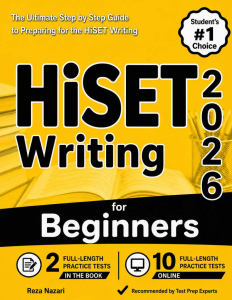
HiSET Language Arts–Writing for Beginners
This featured guide focuses on Writing. Use the separate Reading Online Center for reading-specific preparation.
View book & purchase options →HiSET Language Arts Quick Review
Choose a topic or review explanation before returning to practice.
Open this resource →MEET THE ASSESSMENT · CHOOSE YOUR NEXT SKILL
Know HiSET Language Arts before you start.
HiSET has separate Reading and Writing subtests. Writing allows 120 minutes for multiple-choice questions and an essay; Reading allows 65 minutes in English or 80 minutes in Spanish. The practice forms here focus on language usage. Prepare an actual essay as well, using the official scoring guidance. Independent practice results are not official scores.
Official assessment information ↗Grammar and sentence clarity
Check how a sentence functions in the passage before choosing an edit.
Explore this study route →Revision and organization
Use the writer’s purpose to decide whether a sentence should be moved, added, or removed.
Explore this study route →Essay reasons and evidence
Explain how each example supports the position and address the opposing perspective.
Explore this study route →Official preparation
Check the current assessment guidance and use official samples alongside your independent study.
Explore this study route →HiSET Language Arts Practice Center
Take a full practice test, review the explanations, then use the flashcards to repair the terms and ideas that slowed you down.
HiSET Language Arts Study Blueprint
Open each area to see what to master. The bars show how this Online Center distributes its lessons, so you can plan study time without mistaking the map for an official exam weighting.
01 Reading meaning and evidenceFind explicit meaning, central ideas, details, and supported inferences. 16lessons
- Main idea, summary, sequence, and relationships
- Inference, evidence, and valid conclusions
02 Reading structure and craftInterpret vocabulary, structure, point of view, tone, and author choices. 17lessons
- Context clues, organization, and transitions
- Literary elements, purpose, tone, and figurative language
03 Arguments and paired textsEvaluate claims and compare how two texts use evidence and reasoning. 16lessons
- Claim, reason, evidence, credibility, and bias
- Paired-text similarities, differences, and synthesis
04 Grammar and sentence controlEdit sentence boundaries, agreement, usage, and mechanics. 16lessons
- Clauses, fragments, run-ons, and agreement
- Pronouns, modifiers, capitalization, spelling, and punctuation
05 Organization and revisionImprove clarity, development, order, transitions, and language choices. 17lessons
- Paragraph purpose, cohesion, and logical organization
- Conciseness, precision, style, and revision strategy
06 Essay and test strategyPlan and write an evidence-based response while managing the full test. 16lessons
- Position, evidence, explanation, and counterclaim
- Planning, drafting, revising, pacing, and final review
Study-map shares describe the learning resources on this page. They are not presented as official test percentages.
HiSET Language Arts Study Center: Reading and Writing: a single starting point that brings together the lessons, flashcards, practice questions and review material for this section of the test, arranged in the order you would sensibly work through them.
Choose a HiSET subtest
HiSET has five subject areas. Pick the Online Center that matches the subtest you are studying.
Choose your Language Arts track
Keep Reading and Writing in one study center while giving each session one clear goal.
Reading
Understand and prove
Build passage comprehension, inference, evidence, literary analysis, and argument reading.
Writing
Revise and develop
Build conventions, sentence craft, whole-draft revision, and the paired-source essay.
Reading track
Reading: choose your next move
A strong reading score comes from repeatable decisions, not from trying to memorize every answer. Start where your current study session needs help.
Review the HiSET format
Check the official Reading and Writing task descriptions, timing, and practice resources for your test language.
Build a reading habit
Practice a short routine for mapping a passage, paraphrasing difficult lines, and proving each choice.
Find the proof
Get faster at returning to the exact sentence or detail that supports a correct answer.
A simple four-step study routine
Use this sequence for a lesson, a passage set, or an error you found in a practice test.
Name the task
Underline the key verb in the question. Are you finding a detail, making an inference, or judging an argument?
Read for the map
Notice the topic, main movement, and signals such as however, for example, and therefore.
Prove one answer
Return to the relevant part of the text. Choose the answer that the passage supports most precisely.
Repair one pattern
After practice, name one reason for a miss and work the connected lesson before testing again.
HiSET Reading Vocabulary Flashcards
Strong readers know the terms that questions use: inference, central idea, tone, counterclaim, credibility, synthesis, and more. This complete 96-card deck groups the important vocabulary and gives each word a clear test-use example.
The deck is available here in the Online Center and in its own tab for focused study.
Two printed full-length tests
Practice Tests 1 and 2 are printed in HiSET Language Arts Reading for Beginners. Use each as a full simulation: set a 65-minute timer, answer every question, then review the evidence behind each miss.
Form 1 • establish your baseline
Practice Test 1
Use this printed form to identify one high-value repair move before you begin the online series.
- 50 questions
- 65 minutes
- printed book form
Included in the book
Form 2 • measure the repair
Practice Test 2
Take this printed form after focused practice. Compare your reading process and evidence choices, the total score.
- 50 questions
- 65 minutes
- printed book form
Included in the book
Complete reading skill map
Choose a lesson by the reason you missed a question. Each lesson opens separately, so you can study without losing this map.
Chapter 1: Read Without Panic
Know the HiSET Reading Test
The HiSET Reading subtest asks you to understand a passage, make a careful inference, and choose one answer that the text supports.
Use the Question and Passage Together
A question tells you what to notice, but the passage gives the context that makes the answer meaningful. Choose the order that protects both.
Sentence Meaning: Who, Does What, Under What Conditions
Long sentences become manageable when you find the main actor, the main action, and the details that limit or explain that action.
Paragraph Anatomy: Main Point and Support
A paragraph is a small argument or explanation: it makes one controlling point and uses sentences to develop that point.
Active Reading: Pause, Paraphrase, Predict, Prove
Active reading keeps your mind in the passage. You stop at useful moments, say the idea simply, anticipate the next move, and confirm your thinking with text.
Read an Annotated Passage: See the Thinking
A strong reader does not underline everything. Mark only the parts that help you answer a real question: the claim, a proof detail, a turn, a limitation, and each paragraph’s job.
Find and Mark Text Evidence
A correct reading answer needs a proof line. The proof may be direct words or a small set of clues that logically supports an inference.
Chapter 2: Main Ideas, Details, and Inference
Find Explicit Details
An explicit detail is stated directly. The work is to locate it accurately, even when a tempting choice changes one small word.
Find Stated and Implied Main Ideas
The main idea is the most important point a paragraph or passage develops. It may be written in one sentence or built from several details.
Choose Supporting Details and Explain Their Role
A supporting detail earns its place by proving, explaining, illustrating, or qualifying a larger idea.
Write an Accurate Summary
A summary gives the central idea and the most important development in fewer words, without adding judgment or copying every example.
Make Sentence-Level Inferences
An inference is a conclusion the author invites but does not state directly. It must fit every important clue.
Draw Conclusions, Generalize, and Apply Ideas
A conclusion combines important ideas from a text; a generalization states a broader pattern; an application carries that pattern into a new but similar situation.
Chapter 3: Relationships and Informational Structure
Sequence and Chronology
Sequence questions ask what happened first, next, or as a result of a process. Track events, not merely the order in which details are mentioned.
Cause and Effect, Not Just Before and After
A cause helps produce an effect. Mere sequence shows that one event occurred earlier; it does not prove that the earlier event caused the later one.
Compare and Contrast
Comparison shows how two subjects are alike, different, or both. The tested point is often why the author places them together.
Problem/Solution, Description, and Classification
Informational texts organize ideas by job. Some define or describe a subject, some group it into categories, and some present a problem with one or more responses.
Connect People, Events, and Ideas
Texts develop meaning through relationships: one person influences another, an event changes a plan, or an idea is refined by new evidence.
Explain the Job of a Sentence or Paragraph
A sentence or paragraph contributes to the whole by introducing, supporting, illustrating, qualifying, contrasting, or concluding an idea.
Connect Adjacent Sections and Read Signal Words
Transitions show the logical bridge between ideas. The bridge may add, contrast, cause, qualify, exemplify, or shift time.
Explain How Overall Structure Shapes Meaning and Purpose
Overall structure controls what readers notice first, how evidence accumulates, and where the author places a conclusion or qualification.
Chapter 4: Reading Literary Texts
Plot, Conflict, Turning Point, and Resolution
Plot is the chain of choices and consequences in a story. Conflict creates pressure, a turning point changes the direction, and a resolution shows what the conflict becomes.
Character Traits, Motivation, and Change
Character analysis begins with evidence: what a person says, chooses, notices, avoids, and does under pressure.
Setting and Context
Setting is more than place. Time, social conditions, weather, customs, and available technology can limit choices and shape meaning.
Narrator, Speaker, and Point of View
The narrator tells a story; the speaker voices a poem or speech; point of view controls what the reader can know and how events are colored.
Sequence, Flashback, and Foreshadowing
Literary time may move backward to explain the present or plant details that prepare readers for what comes later.
Theme and Supporting Elements
Theme is a general insight a story develops about life, choices, or relationships. It is not one word and it is not a plot summary.
Figurative Language, Imagery, and Symbolism
Figurative language carries meaning beyond the literal words. Imagery builds sensory experience; a symbol gains larger meaning through repetition and context.
Tone, Mood, and the Effect of Word Choice
Tone is the voice’s attitude toward a subject; mood is the feeling created for the reader. Specific words are the evidence for both.
Read Poetry for Shifts, Images, and Meaning
A poem may say a great deal in a small space. Track what changes, notice the images that repeat, and connect those details to the speaker’s larger view.
Read Memoir for Memory, Perspective, and Implied Meaning
A memoir tells a remembered experience from a particular point of view. Notice both what happened then and what the narrator understands about it now.
Read Biographical Sketches for Development and Emphasis
A biographical sketch selects moments from a life to show how a person responded to a challenge, developed an idea, or made an impact. Track what the author emphasizes and what the sequence of events suggests.
Chapter 5: Vocabulary, Purpose, and Author’s Craft
Use Context Clues
Context clues let you estimate a word’s meaning from the sentence and nearby ideas. The goal is a meaning that fits here, not every dictionary definition.
Handle Multiple-Meaning Words and Unfamiliar Terms
A familiar word may carry an unfamiliar meaning. Let the sentence choose the definition.
Separate Denotation from Connotation
Denotation is a word’s basic reference; connotation is the attitude or association the word carries.
Predict How Replacing a Word Changes Tone
Replacing one word can strengthen, soften, praise, blame, or make a sentence more formal. Compare implication, not just dictionary meaning.
Separate Author’s Purpose from Point of View
Purpose is what the author wants the text to do. Point of view is the author’s attitude or position toward the subject.
Infer an Unstated Purpose
An author may never say, “I wrote this to …” Infer purpose from selection, emphasis, audience, and the response the text invites.
Analyze Rhetorical Techniques
Rhetorical techniques are deliberate choices that make an idea clearer, more memorable, more urgent, or more persuasive.
Analyze How an Author Addresses Other Viewpoints
A strong author may acknowledge objections, qualify a claim, or answer conflicting evidence rather than pretending no disagreement exists.
Chapter 6: Arguments and Evidence
Map Claim, Reason, Evidence, and Conclusion
An argument asks readers to accept a claim. Reasons explain why; evidence gives support; a conclusion states what follows.
Trace the Steps of an Argument
Claims in a strong argument build on one another. Trace the chain to see whether each step actually supports the next.
Recognize Types of Evidence
Evidence can be numerical, observational, testimonial, documentary, or example-based. Type matters because each kind answers different questions.
Judge Relevance
Relevant evidence bears directly on the claim. Interesting facts, emotional details, and related topics can still be irrelevant.
Judge Sufficiency and Quality
Sufficient evidence is enough in quantity, variety, and quality to justify the size of the claim.
Separate Supported and Unsupported Claims
A supported claim has relevant evidence and a logical bridge. An unsupported claim may have no evidence, irrelevant evidence, or evidence too weak for its certainty.
Test Valid Reasoning and Spot Common Fallacies
Valid reasoning connects evidence to a conclusion without a broken rule. Fallacies are common patterns that make an argument look stronger than it is.
Find Premises and Hidden Assumptions
A premise is a stated starting point. An assumption is a starting point the author takes for granted without stating it.
Analyze Counterclaims and Rebuttals
A counterclaim challenges the author’s position. A rebuttal answers that challenge with reasoning or evidence.
Judge Credibility, Bias, and Objective Support
Credibility is the degree to which a source deserves trust for a specific claim. Bias is a tendency that may shape selection or interpretation.
Chapter 7: Comparing Texts, Arguments, and Visuals
Build a Two-Text Comparison Matrix
Paired-text questions become manageable when you compare the same categories across both sources.
Compare Texts with the Same Topic or Theme
Two texts may address the same subject while developing different main ideas, themes, or conclusions.
Read Paired Civic and Historical Texts
Founding-era texts and later civic voices often use the same ideals in different historical situations. Read them as evidence-based texts, not as a test of memorized history.
Compare Perspective, Tone, Style, and Structure
Sources can differ in what they say but in who speaks, how the voice sounds, how sentences are shaped, and how ideas are ordered.
Compare Scope, Purpose, Audience, Emphasis, and Impact
Format and audience determine what a source covers, what it leaves out, and which details receive attention.
Compare Opposing Arguments and Their Evidence
When two authors disagree, compare claims, standards, evidence quality, assumptions, and responses to counterevidence.
Connect Prose to a Table, Graph, Timeline, or Image
Visual information can support, extend, qualify, or contradict prose. Read labels and units before interpreting the pattern.
Synthesize Sources and Apply Information to a New Situation
Synthesis combines compatible ideas from multiple sources into a new conclusion. Application carries that combined principle into a similar situation.
Chapter 8: The HiSET Reading Game Plan
Master the HiSET Multiple-Choice Format
Every HiSET Reading item asks for one best answer. The interface may change, but the reasoning never does: understand the question, return to the passage, and choose the answer with the strongest proof.
Use a Reliable Passage-Set Workflow
A passage set becomes faster when you read once for the map, answer local questions with targeted returns, and save whole-passage judgments for informed rereading.
Eliminate, Flag, Review, and Recover from a Hard Question
Elimination is evidence checking. Remove choices that are contradicted, unsupported, too broad, too narrow, or answers to a nearby question.
Manage 65 Minutes, Stamina, and Test Day
The HiSET Reading test is a 65-minute reading task. Build a steady pace, make evidence-based decisions, and arrive with the practical details already settled.
Writing track
Revise with evidence. Write with a plan.
Study conventions, sentence craft, full-draft revision, and the paired-source essay. Each of the 63 book lessons has a verified companion post and teaching video.
Printed form 1 • baseline
Writing Practice Test 1
Complete all 60 multiple-choice questions and the paired-source essay under one 120-minute clock.
- 60 questions
- 1 essay
- 120 minutes
Included in the Writing book
Printed form 2 • confirm the repair
Writing Practice Test 2
Use your review map from Form 1, then take a distinct full-length form and compare the reason behind each miss.
- 60 questions
- 1 essay
- 120 minutes
Included in the Writing book
HiSET Writing Skill Flashcards
This 63-card deck follows the Writing book lesson by lesson. Use it to retrieve the rule, explain the decision, and name the trap before you return to a full draft.
The Writing deck is visible here and also opens in its own focused-study tab.
Complete Writing skill map
Choose the lesson that matches the reason for a missed question. Every lesson opens in a safe new tab and includes its reviewed teaching video.
Chapter 1: Sentence Foundations
Know the HiSET Writing Test
The HiSET Writing subtest asks you to improve draft texts one choice at a time and then to write one essay of your own.
Complete Sentences: Subject, Predicate, Complete Thought
Every complete sentence names something and says something about it, and it leaves the reader with a finished thought.
Fragments: Spot Them, Repair Them
A fragment looks like a sentence, capital letter, period, but a working part is missing. Editing questions reward you for noticing which part.
Run-Ons and Comma Splices: Where One Sentence Ends
A run-on crams two complete thoughts into one sentence without a proper connection. There are two kinds, and four reliable repairs.
Parts of Speech in Context
A word's part of speech is the job it does in one particular sentence, and many words change jobs from sentence to sentence.
Word Forms in Context
Many words come in families, decide, decision, decisive, decisively. The sentence's structure tells you which family member the slot requires.
Reading a Draft Before You Edit It
The Writing test hands you whole drafts, not isolated sentences. Editors who read before they fix choose better answers.
Chapter 2: Agreement, Verbs, and Pronouns
Subject, Verb Agreement
A verb must match its subject in number: one subject takes a singular verb, and more than one takes a plural verb.
Tricky Agreement: Interrupters, Indefinites, and There Is
Agreement gets harder when words separate the subject from its verb, when the subject is a word like each or everyone, or when the subject comes after the verb.
Verb Tense and Verb Form
Tense places an action in time, and irregular verbs change their spelling to show it, the third form always travels with a helping verb.
Tense Consistency and Voice
Stay in the tense a passage establishes, shift only when the time truly changes, and know when the passive voice earns its place.
Pronoun Case: I or Me, Who or Whom
Pronouns change form to match the job they do in a sentence, and a quick substitution test tells you which form you need.
Pronoun, Antecedent Agreement
A pronoun must match the word it stands for in number and person, and a paragraph should not wander among you, one, and they.
Clear Pronoun Reference
A pronoun is only useful when the reader can point to exactly one word it replaces; when the reader cannot, name the noun instead.
Adjectives, Adverbs, and Comparisons
Choose adjective or adverb by what the word describes, use -er or more for two things and -est or most for three or more, and never double up.
Misplaced and Dangling Modifiers
Descriptive words attach to whatever sits next to them, so place each modifier beside the thing it describes, and give every opening phrase a doer.
Chapter 3: Mechanics
Capitalization: Names, Not Importance
Capital letters follow rules, not feelings, capitalize the first word of a sentence and the official names of specific people, places, and things.
Commas at Work: Series, Introductions, and Joining
Three comma jobs carry most of the test: separating items in a series, marking off an introduction, and joining two complete sentences with a small connecting word.
Commas That Fence Off Extras
Commas set off words the sentence could live without, an added description, a name spoken to directly, or the extra parts of a date or address.
Apostrophes: Owners and Contractions
An apostrophe has exactly two jobs, showing ownership and standing in for missing letters, and making a plain plural is not one of them.
Semicolons and Colons
A semicolon joins two complete, closely related sentences; a colon follows a complete sentence and points ahead to a list, an explanation, or a quotation.
Quotation Marks
Quotation marks report a speaker's exact words; in American punctuation, commas and periods tuck inside the closing marks.
Dashes, Hyphens, Parentheses, and Ellipses
A dash breaks in with emphasis, parentheses murmur an aside, a hyphen welds two words into one description, and an ellipsis marks words left out.
Choosing the Right Mark
Most punctuation questions are really asking one thing, where does one complete idea end, and how does it relate to the next?
Spelling: Patterns Worth Knowing
A handful of patterns and a short list of everyday troublemakers cover almost every spelling question you will meet in a draft.
Using a Dictionary, Thesaurus, and Glossary
Three reference tools answer three different questions, and knowing which one to open is itself a tested skill.
Chapter 4: Sentence Craft and Usage
Sentence Types: Clauses and the Four Structures
Every sentence is built from clauses, and once you can count and sort them, you can name any sentence's structure and control it in your own writing.
Combining Sentences Without Losing the Logic
Short, choppy sentences hide how ideas connect; the best combination joins them with a connector that says exactly what the relationship is.
Sentence Variety: Fixing Choppy and Overloaded Writing
A strong paragraph mixes sentence lengths and openings; your job on the test is to choose the revision that reads most clearly while keeping every fact.
Parallel Structure: Matching the Parts of a List
When a sentence lists or pairs ideas, every item should wear the same grammatical form, verbs with verbs, nouns with nouns, phrases with matching phrases.
Consistency: Avoiding Shifts in Person, Number, Tense, Voice, and Mood
A draft should stay with the same person, number, tense, voice, and mood unless the meaning truly requires a change.
Frequently Confused Words
Words that sound alike do different jobs; the reliable habit is to test the meaning the sentence needs, then choose the spelling that does that job.
Standard Usage and Idioms
Some phrases are at home in speech but not in edited writing; the test expects the written-standard forms, natural idioms, and the prepositions that custom pairs with certain words.
Formal and Informal Language: Matching Words to the Audience
Register is the level of formality in your wording, and a strong draft keeps one register that fits its purpose and its reader from the first sentence to the last.
Chapter 5: Clear, Organized Writing
Clarity and Conciseness: Say It Once, Say It All
A concise sentence keeps every part of the writer's message and drops every word that only takes up space.
Precise Word Choice: The Word That Fits
Precise writing chooses the word whose meaning and feeling both fit the sentence, not the vaguest word available, and not the fanciest.
Paragraph Structure: One Idea, Well Supported
A paragraph is a small team: one sentence states the main idea, the others support it, and a closing sentence brings the point home.
Unity and Relevance: Every Sentence Earns Its Place
A true, interesting sentence can still be the wrong sentence, each one must support the paragraph's main idea, or it goes.
Organization Patterns: Name the Plan Before You Revise
Before you move, add, or delete anything, name the pattern that organizes the passage, the pattern decides where everything belongs.
Openings, Bridges, and Closings
An effective opening names the real topic, a transitional sentence connects two paragraphs, and a closing wraps up without opening a new door.
Sentence Placement: Find Where It Belongs
A misplaced sentence carries an anchor, a pronoun, a time word, or a cause. That tells you exactly where it belongs.
Transitions: Name the Relationship First
Name the relationship between two ideas before you look at the choices, the right transition is simply the word that says that relationship out loud.
Chapter 6: Revising Full Drafts
How HiSET Drafts Work
All sixty multiple-choice questions live inside complete drafts. Learn the drafts' anatomy and the five question families, and nothing on test day will look unfamiliar.
The Draft Walk: A Method for Whole Passages
A passage set rewards order. Learn purpose and audience first, settle the sentence-level questions next, save whole-draft questions for last, and always reread the repair in place.
Editing Grammar Inside a Full Draft
Agreement, tense, pronoun, and punctuation errors hide better in a paragraph than in a single sentence; the evidence that exposes them, and the proof your repair works, lives in the neighboring sentences.
Revising Organization Inside a Full Draft
Add, delete, move, combine, open, and close, organization questions all ask the same thing: what job does this sentence do for the whole draft?
Revising for Clarity Inside a Full Draft
The best clarity revision trims the fat, keeps the meaning, matches the draft's tone, and adds no new error, all four at once.
Timed Passage Practice
The skills are in place; now run the Draft Walk with a clock ticking, the way test day will ask you to.
Chapter 7: The HiSET Essay
What the Essay Asks You to Do
The HiSET essay gives you two texts on one issue and asks you to take a position and support it with evidence from the texts and from your own experience.
Reading the Source Texts
Before you can argue, you need quick notes on what each author claims, why, and with what evidence, and a two-column chart captures all of it in minutes.
Planning the Essay in Five Minutes
A defensible position, a reasons-based thesis, and a four-line outline turn a blank page into a set of small, manageable jobs.
Writing the Introduction
A strong introduction does three jobs in about three sentences: it names the issue, states your position, and previews your reasons.
Body Paragraphs: Claim, Evidence, Explanation
Each body paragraph makes one claim, backs it with evidence from a text or from your life, and then explains how that evidence proves the claim.
The Counterargument Paragraph
Strong essays face the other side's best point, grant what is fair about it, and answer it with evidence and logic.
Writing the Conclusion
A conclusion restates your position in fresh words, gathers your reasoning, and tells the reader why the issue matters, then stops.
Revising in the Final Minutes
Check the big things first, thesis, evidence, explanation, counterargument, and the sentence-level things second.
Two Sample Essays, Scored
Reading a weak essay and a strong essay on the same prompt shows you exactly what the scoring categories reward.
Chapter 8: The Writing Game Plan
The Multiple-Choice Playbook
You already know the grammar. This lesson turns that knowledge into a repeatable way to choose one best answer, question after question.
Budget the 120 Minutes
One clock covers the whole subtest, sixty questions and the essay. A few checkpoints and a one-minute habit keep everything inside it.
Essay Contingencies
The essay rewards a defensible position, developed support, and a calm finish, even when the prompt, your memory, or the clock refuses to cooperate.
Mixed Review A: Conventions and Sentence Craft
A short warm-up, then real editing: one draft letter, four questions, and every skill from the first half of the book in play at once.
Mixed Review B: Organization, Revision, and the Essay Eye
Round two moves up a level: relevance, transitions, counterargument, and thesis judgment, all inside one short argument.
Your Test-Day Plan
The last lesson is not a new skill. It is a plan: the night before, the first two minutes, the rule for changing answers, and the reset for a rattled moment.
n
Official source: what the HiSET covers, how the five subtests are structured and how the credential works are published by PSI, which administers the exam, at hiset.org.
HiSET Writing: 105 terms and definitions
Every term from the flashcards above, written out and grouped by topic, so you can revise without clicking through the cards, search the page for a term, or print the set.
Agreement, Verbs, and Pronouns
- Adjectives, Adverbs, and Comparisons
- Choose adjective or adverb by what the word describes, use -er or more for two things and -est or most for three or more, and never double up.
- Clear Pronoun Reference
- A pronoun is only useful when the reader can point to exactly one word it replaces; when the reader cannot, name the noun instead.
- Misplaced and Dangling Modifiers
- Descriptive words attach to whatever sits next to them, so place each modifier beside the thing it describes, and give every opening phrase a doer.
- Pronoun Case: I or Me, Who or Whom
- Pronouns change form to match the job they do in a sentence, and a quick substitution test tells you which form you need.
- Pronoun, Antecedent Agreement
- A pronoun must match the word it stands for in number and person, and a paragraph should not wander among you, one, and they.
- Subject, Verb Agreement
- A verb must match its subject in number: one subject takes a singular verb, and more than one takes a plural verb.
- Tense Consistency and Voice
- Stay in the tense a passage establishes, shift only when the time truly changes, and know when the passive voice earns its place.
- Tricky Agreement: Interrupters, Indefinites, and There Is
- Agreement gets harder when words separate the subject from its verb, when the subject is a word like each or everyone, or when the subject comes after the verb.
- Verb Tense and Verb Form
- Tense places an action in time, and irregular verbs change their spelling to show it, the third form always travels with a helping verb.
Algebra
- Equivalent expression
- Equivalent expressions have the same value for every allowed input, even when they look different.
Argument
- Counterclaim
- A counterclaim is a reasonable opposing position that the writer should represent fairly before responding.
- Qualified claim
- A qualified claim sets honest limits with words such as often, under these conditions, or in most cases.
- Rebuttal
- A rebuttal answers a counterclaim with relevant evidence and reasoning rather than dismissing it.
- Source integration
- Introduce the source, present the evidence accurately, and explain its role in your reasoning.
- Warrant
- A warrant explains why the evidence supports the claim. Strong writing makes this reasoning visible.
Clear, Organized Writing
- Clarity and Conciseness: Say It Once, Say It All
- A concise sentence keeps every part of the writer’s message and drops every word that only takes up space.
- Openings, Bridges, and Closings
- An effective opening names the real topic, a transitional sentence connects two paragraphs, and a closing wraps up without opening a new door.
- Organization Patterns: Name the Plan Before You Revise
- Before you move, add, or delete anything, name the pattern that organizes the passage, the pattern decides where everything belongs.
- Paragraph Structure: One Idea, Well Supported
- A paragraph is a small team: one sentence states the main idea, the others support it, and a closing sentence brings the point home.
- Precise Word Choice: The Word That Fits
- Precise writing chooses the word whose meaning and feeling both fit the sentence, not the vaguest word available, and not the fanciest.
- Sentence Placement: Find Where It Belongs
- A misplaced sentence carries an anchor, a pronoun, a time word, or a cause. That tells you exactly where it belongs.
- Transitions: Name the Relationship First
- Name the relationship between two ideas before you look at the choices, the right transition is simply the word that says that relationship out loud.
- Unity and Relevance: Every Sentence Earns Its Place
- A true, interesting sentence can still be the wrong sentence, each one must support the paragraph’s main idea, or it goes.
Data
- Center versus spread
- A measure of center describes a typical location; a measure of spread describes how far values vary around it.
- Correlation is not causation
- A pattern between two variables does not by itself prove that changing one variable causes the other to change.
- Outlier influence
- An extreme value can pull the mean strongly while often changing the median less. Choose a summary that fits the distribution.
Editing
- Antecedent
- The noun or noun phrase a pronoun refers to. A clear pronoun points to one unmistakable antecedent.
- Coordination
- Coordination joins ideas of similar importance with a coordinating conjunction, semicolon, or another valid structure.
- Nonrestrictive clause
- A nonrestrictive clause adds extra information and is normally set off with commas.
- Restrictive clause
- A restrictive clause identifies which person or thing is meant and is normally not set off with commas.
- Subordination
- Subordination makes one clause dependent so the sentence clearly shows which idea is primary and how the ideas relate.
Essay
- Concession
- A concession acknowledges a fair point from another view without abandoning the writer’s own position.
- Evidence commentary
- Commentary explains what evidence shows and why it matters; it should not merely repeat the quotation or fact.
- Final revision pass
- Check thesis, evidence, explanation, organization, and clarity before spending the last moments on minor surface errors.
- Thesis
- A thesis states the position and controlling reasons the essay will develop.
- Topic sentence
- A topic sentence names the paragraph’s claim and connects it to the thesis.
Geometry
- Area versus perimeter
- Perimeter measures boundary length in linear units; area measures covered surface in square units.
- Draw and label
- Sketch the figure, label known measurements and the unknown, and mark equal or perpendicular parts before selecting a formula.
- Scale-factor effect
- If every length is multiplied by k, perimeter scales by k, area by k squared, and volume by k cubed.
Mechanics
- Apostrophes: Owners and Contractions
- An apostrophe has exactly two jobs, showing ownership and standing in for missing letters, and making a plain plural is not one of them.
- Capitalization: Names, Not Importance
- Capital letters follow rules, not feelings, capitalize the first word of a sentence and the official names of specific people, places, and things.
- Choosing the Right Mark
- Most punctuation questions are really asking one thing, where does one complete idea end, and how does it relate to the next?
- Commas at Work: Series, Introductions, and Joining
- Three comma jobs carry most of the test: separating items in a series, marking off an introduction, and joining two complete sentences with a small connecting word.
- Commas That Fence Off Extras
- Commas set off words the sentence could live without, an added description, a name spoken to directly, or the extra parts of a date or address.
- Dashes, Hyphens, Parentheses, and Ellipses
- A dash breaks in with emphasis, parentheses murmur an aside, a hyphen welds two words into one description, and an ellipsis marks words left out.
- Quotation Marks
- Quotation marks report a speaker’s exact words; in American punctuation, commas and periods tuck inside the closing marks.
- Semicolons and Colons
- A semicolon joins two complete, closely related sentences; a colon follows a complete sentence and points ahead to a list, an explanation, or a quotation.
- Spelling: Patterns Worth Knowing
- A handful of patterns and a short list of everyday troublemakers cover almost every spelling question you will meet in a draft.
- Using a Dictionary, Thesaurus, and Glossary
- Three reference tools answer three different questions, and knowing which one to open is itself a tested skill.
Number Sense
- Negative-number sense
- A negative sign may describe direction, loss, or a value below zero. Interpret the context before applying sign rules.
- Order of operations
- Work through grouping, exponents, multiplication or division left to right, then addition or subtraction left to right.
- Percent as a multiplier
- An increase of r% multiplies by 1+r/100; a decrease multiplies by 1-r/100. Repeated changes use repeated multiplication.
- Rate and unit rate
- A rate compares quantities with different units. Divide to find the amount for one unit, then scale as needed.
- Ratio as a relationship
- A ratio compares quantities in a stated order. Equivalent ratios scale both terms by the same nonzero factor.
Reasoning
- Check with an inverse operation
- Undo the operation when possible: addition with subtraction, multiplication with division, and squaring with a square root plus a sign check.
- Distinguish exact and approximate
- Keep exact forms such as fractions and radicals during the work; round only when the question or context requires it.
- Eliminate impossible choices
- Reject answers with the wrong sign, scale, unit, domain, or relationship before doing detailed arithmetic.
- Estimate before calculating
- Predict the size and sign of an answer first. The estimate helps catch a misplaced decimal, wrong operation, or impossible result.
- Explain the deciding step
- After solving, state why the method fits. A short explanation reveals whether the answer came from understanding or a lucky pattern.
- Find the hidden constraint
- Check for limits such as positive length, nonzero denominator, integer count, defined radical, or realistic time.
- Read every label
- For a table, graph, diagram, or formula, identify the title, variables, units, scale, and restrictions before calculating.
- Test a simple case
- Use an easy valid number to check whether a rule or algebraic statement behaves the way you expect.
- Translate one phrase at a time
- Name the unknown, translate each relationship, and only then combine the pieces into an equation or expression.
- Use units as evidence
- Carry units through the work. A final unit that does not match the question often reveals an incorrect setup.
Revising Full Drafts
- Editing Grammar Inside a Full Draft
- Agreement, tense, pronoun, and punctuation errors hide better in a paragraph than in a single sentence; the evidence that exposes them, and the proof your repair works, lives in the neighboring sentences.
- How HiSET Drafts Work
- All sixty multiple-choice questions live inside complete drafts. Learn the drafts’ anatomy and the five question families, and nothing on test day will look unfamiliar.
- Revising for Clarity Inside a Full Draft
- The best clarity revision trims the fat, keeps the meaning, matches the draft’s tone, and adds no new error, all four at once.
- Revising Organization Inside a Full Draft
- Add, delete, move, combine, open, and close, organization questions all ask the same thing: what job does this sentence do for the whole draft?
- The Draft Walk: A Method for Whole Passages
- A passage set rewards order. Learn purpose and audience first, settle the sentence-level questions next, save whole-draft questions for last, and always reread the repair in place.
- Timed Passage Practice
- The skills are in place; now run the Draft Walk with a clock ticking, the way test day will ask you to.
Revision
- Consistent point of view
- Maintain the same person and perspective unless a deliberate shift is required by the meaning.
- Logical transition
- A transition should name the real relationship, such as contrast, cause, example, sequence, or conclusion.
- Paragraph coherence
- A coherent paragraph moves through ideas in a clear order and uses references and transitions to show the connections.
- Precise verb
- A precise verb carries action and meaning directly, reducing the need for vague helper phrases.
- Redundancy
- Redundancy repeats an idea without adding meaning. Keep the clearest necessary version once.
Sentence Craft and Usage
- Combining Sentences Without Losing the Logic
- Short, choppy sentences hide how ideas connect; the best combination joins them with a connector that says exactly what the relationship is.
- Consistency: Avoiding Shifts in Person, Number, Tense, Voice, and Mood
- A draft should stay with the same person, number, tense, voice, and mood unless the meaning truly requires a change.
- Formal and Informal Language: Matching Words to the Audience
- Register is the level of formality in your wording, and a strong draft keeps one register that fits its purpose and its reader from the first sentence to the last.
- Frequently Confused Words
- Words that sound alike do different jobs; the reliable habit is to test the meaning the sentence needs, then choose the spelling that does that job.
- Parallel Structure: Matching the Parts of a List
- When a sentence lists or pairs ideas, every item should wear the same grammatical form, verbs with verbs, nouns with nouns, phrases with matching phrases.
- Sentence Types: Clauses and the Four Structures
- Every sentence is built from clauses, and once you can count and sort them, you can name any sentence’s structure and control it in your own writing.
- Sentence Variety: Fixing Choppy and Overloaded Writing
- A strong paragraph mixes sentence lengths and openings; your job on the test is to choose the revision that reads most clearly while keeping every fact.
- Standard Usage and Idioms
- Some phrases are at home in speech but not in edited writing; the test expects the written-standard forms, natural idioms, and the prepositions that custom pairs with certain words.
Sentence Foundations
- Complete Sentences: Subject, Predicate, Complete Thought
- Every complete sentence names something and says something about it, and it leaves the reader with a finished thought.
- Fragments: Spot Them, Repair Them
- A fragment looks like a sentence, capital letter, period, but a working part is missing. Editing questions reward you for noticing which part.
- Know the HiSET Writing Test
- The HiSET Writing subtest asks you to improve draft texts one choice at a time and then to write one essay of your own.
- Parts of Speech in Context
- A word’s part of speech is the job it does in one particular sentence, and many words change jobs from sentence to sentence.
- Reading a Draft Before You Edit It
- The Writing test hands you whole drafts, not isolated sentences. Editors who read before they fix choose better answers.
- Run-Ons and Comma Splices: Where One Sentence Ends
- A run-on crams two complete thoughts into one sentence without a proper connection. There are two kinds, and four reliable repairs.
- Word Forms in Context
- Many words come in families, decide, decision, decisive, decisively. The sentence’s structure tells you which family member the slot requires.
The HiSET Essay
- Body Paragraphs: Claim, Evidence, Explanation
- Each body paragraph makes one claim, backs it with evidence from a text or from your life, and then explains how that evidence proves the claim.
- Planning the Essay in Five Minutes
- A defensible position, a reasons-based thesis, and a four-line outline turn a blank page into a set of small, manageable jobs.
- Reading the Source Texts
- Before you can argue, you need quick notes on what each author claims, why, and with what evidence, and a two-column chart captures all of it in minutes.
- Revising in the Final Minutes
- Check the big things first, thesis, evidence, explanation, counterargument, and the sentence-level things second.
- The Counterargument Paragraph
- Strong essays face the other side’s best point, grant what is fair about it, and answer it with evidence and logic.
- Two Sample Essays, Scored
- Reading a weak essay and a strong essay on the same prompt shows you exactly what the scoring categories reward.
- What the Essay Asks You to Do
- The HiSET essay gives you two texts on one issue and asks you to take a position and support it with evidence from the texts and from your own experience.
- Writing the Conclusion
- A conclusion restates your position in fresh words, gathers your reasoning, and tells the reader why the issue matters, then stops.
- Writing the Introduction
- A strong introduction does three jobs in about three sentences: it names the issue, states your position, and previews your reasons.
The Writing Game Plan
- Budget the 120 Minutes
- One clock covers the whole subtest, sixty questions and the essay. A few checkpoints and a one-minute habit keep everything inside it.
- Essay Contingencies
- The essay rewards a defensible position, developed support, and a calm finish, even when the prompt, your memory, or the clock refuses to cooperate.
- Mixed Review A: Conventions and Sentence Craft
- A short warm-up, then real editing: one draft letter, four questions, and every skill from the first half of the book in play at once.
- Mixed Review B: Organization, Revision, and the Essay Eye
- Round two moves up a level: relevance, transitions, counterargument, and thesis judgment, all inside one short argument.
- The Multiple-Choice Playbook
- You already know the grammar. This lesson turns that knowledge into a repeatable way to choose one best answer, question after question.
- Your Test-Day Plan
- The last lesson is not a new skill. It is a plan: the night before, the first two minutes, the rule for changing answers, and the reset for a rattled moment.
Every lesson in one place
Open a lesson in a new tab and keep this Online Center nearby as your study home.
Browse the complete lesson directory
A USEFUL NEXT STEP
HiSET Language Arts: study questions
What should I know about HiSET Language Arts?
HiSET has separate Reading and Writing subtests. Writing allows 120 minutes for multiple-choice questions and an essay; Reading allows 65 minutes in English or 80 minutes in Spanish. The practice forms here focus on language usage. Prepare an actual essay as well, using the official scoring guidance. Independent practice results are not official scores.
Official source ↗How should I use these independent HiSET Language Arts study tools?
Start with a practice activity, review explanations for missed questions, and use quick review or flashcards for one weak topic. The practice results are study feedback, not official exam scores. Compare a book’s contents with your course or test requirements before buying.
Resources from Effortless Math · Editorial standards